
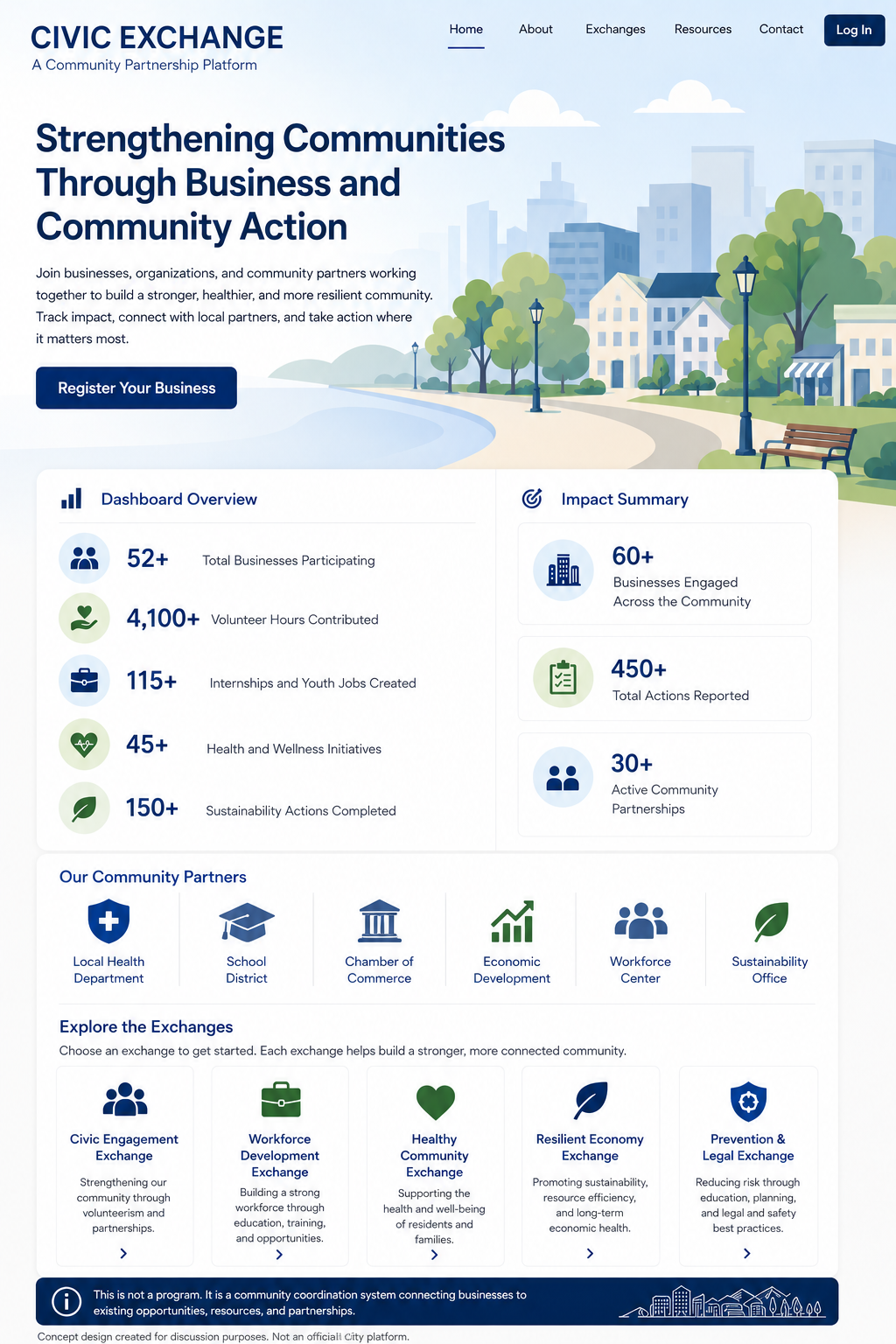
A Simple, Scalable Model for Mobilizing Businesses Around City Priorities
Every city is already home to employers, schools, colleges, health systems, neighborhood businesses, workforce organizations, chambers of commerce, cultural institutions, nonprofits, community groups, and civic leaders working every day to strengthen opportunity.
The challenge is not that cities lack effort. The challenge is that much of this work is scattered across different programs, departments, neighborhoods, institutions, and initiatives. A business may want to help, but may not know where to start. A school may need employer partners, but may not know which companies are willing. A health department may want to work with employers on prevention, food access, mental health, or emergency preparedness, but may not have one simple way to identify interested partners. A nonprofit may need volunteers, sponsors, mentors, technical support, or local business relationships, but those opportunities are often hard to organize at scale.
That is why a citywide partnership model could be useful.
A citywide partnership model would not replace existing programs. It would help connect them. It would serve as one shared connection point where businesses, city departments, schools, colleges, nonprofits, workforce partners, health organizations, neighborhood groups, and economic development leaders could better align around practical action.
Today, a business that wants to contribute may have to navigate multiple systems. It may need to determine which city office to contact, which workforce program fits, which neighborhood partner is active, which school needs support, which nonprofit aligns with its goals, which health initiative is relevant, or which sustainability effort is already underway. For large companies, that process can be inefficient. For small businesses, it can be overwhelming. For city leaders, it makes coordination harder. For community partners, it means valuable business interest may never be captured.
A citywide partnership model would make that process simpler.
Through this model, a business could go to one organized place and identify what it is already doing, where it may be willing to contribute next, and what kind of partner it would like to connect with. A restaurant could express interest in healthy food access or youth employment. A manufacturer could support apprenticeships, training, or second chance hiring. A hospital could align with community health goals. A bank could support financial education, small business mentoring, or nonprofit capacity. A construction firm could support workforce pathways. A technology company could offer career speakers, internships, digital skills training, or cybersecurity support. A company with sustainability goals could identify energy efficiency, waste reduction, water stewardship, or resilience opportunities.
What makes this different is that it is not another stand alone initiative. It is a coordination layer. Cities already have many strong programs. The opportunity is to make those programs easier to find, easier to connect, easier to measure, and easier to align with citywide priorities.
For businesses, the value is clarity. They would not need to guess who to call first. They would have one place to say what they are doing, where they may be willing to help, and what kind of partner they need. Participation would be voluntary, flexible, and based on what each business can realistically contribute.
For a mayor’s office and city leadership, the value is visibility. City leaders are expected to show progress on jobs, youth opportunity, public health, neighborhood investment, public safety, sustainability, education, small business growth, and economic inclusion. A citywide partnership model would help connect business activity to those priorities in a measurable way. It would give leadership a clearer view of where employers are already engaged, where interest exists, and where more coordination is needed.
For city council members, this could become a practical district and neighborhood level tool. Council members could better understand which businesses in their communities are engaged, where local needs remain unmet, and where city departments or community partners could help connect employers to meaningful opportunities. It would give policymakers a way to support visible neighborhood results without creating new mandates or unnecessary reporting burdens.
For economic development leaders, this could become a stronger business attraction and retention asset. Companies increasingly want to locate in places where they can find talent, build community relationships, support employee wellbeing, and demonstrate public value. A city could show current and prospective employers that it has an organized way to connect companies with workforce pipelines, schools, neighborhood partners, sustainability opportunities, and community priorities.
For existing programs and agencies, this would increase visibility rather than compete with them. Workforce programs could find more employers. Schools and colleges could identify businesses willing to offer mentorship, internships, apprenticeships, job shadowing, classroom partnerships, or career speakers. Health partners could connect with employers interested in wellness, prevention, food access, mental health, emergency preparedness, or community outreach. Nonprofits could find businesses willing to volunteer, donate, sponsor projects, or provide technical support. Sustainability offices could identify companies interested in energy, waste, water, transportation, resilience, or climate related action.
The central point is simple: a citywide partnership model would not take ownership away from existing partners. It would help those partners find each other.
This model could also strengthen grants and funding strategies. Many federal, philanthropic, and regional funding opportunities reward evidence of employer engagement, cross sector collaboration, community need, and measurable outcomes. A citywide partnership model could help document that collaboration in one organized structure. It could show how many businesses are engaged in workforce development, how many are interested in youth opportunity, how many are supporting community health, how many are taking sustainability actions, and where unmet needs remain.
That kind of information matters because it turns partnership claims into evidence. Instead of saying a city has strong public private collaboration, city and community leaders could point to aggregate participation data. They could show where businesses are contributing, where future interest exists, and where additional support is needed. That makes planning stronger, grant applications more competitive, and public reporting more credible.
For public health and community wellbeing, this model could help connect business activity to the conditions that shape health. Employers influence health through jobs, wages, benefits, work conditions, transportation access, food access, mental health supports, employee wellness, emergency preparedness, volunteerism, and neighborhood investment. By capturing business activity and interest in one place, public health leaders and community partners could better understand where private sector support already exists and where more engagement is needed.
For workforce development, a citywide partnership model could help close the gap between education, training, and employer need. Businesses could identify whether they are willing to offer internships, apprenticeships, job shadowing, mentorship, career speakers, classroom partnerships, tuition assistance, skills based training, returnship programs, or second chance hiring. Schools, colleges, workforce boards, community based organizations, unions, employers, and economic development partners could then better understand which employers are ready to participate. That makes workforce strategy more targeted, more neighborhood based, and more connected to real demand.
For neighborhoods, the structure can adapt. Downtown employers may use it to connect with large scale workforce, civic, health, climate, and education efforts. Neighborhood businesses may use it to support youth opportunity, local hiring, small business growth, food access, public safety, and community investment. Industrial corridors may use it to build training pipelines and strengthen local employment. Commercial corridors may use it to connect small businesses with community priorities. Neighborhood nonprofits may use it to identify partners who are ready to help.
One of the strongest benefits is that a citywide partnership model could create a common language for business participation. Instead of every program asking businesses different questions in different formats, the city could use one shared structure for identifying current activity and future interest. That makes the information easier to compare, aggregate, and act on. It also reduces duplication because partners would not need to repeatedly ask businesses the same basic questions.
The larger opportunity is to turn scattered goodwill into measurable civic value. A city does not need every business to do the same thing. It needs a practical system that helps each business do something useful, realistic, and aligned with community need. Some businesses may support students. Some may strengthen employee wellness. Some may invest in sustainability. Some may help local nonprofits. Some may provide volunteers. Some may support emergency preparedness. Some may help workers gain new skills. A citywide partnership model would organize those actions into a broader local impact strategy.
This would not be a mandate. It would not be a compliance system. It would not be another heavy reporting requirement. It would be a practical civic and economic engagement tool that helps businesses participate more easily and helps public, nonprofit, education, workforce, health, and community partners coordinate more effectively.
At its best, a citywide partnership model becomes one shared connection point for business, city government, nonprofits, schools, health partners, workforce leaders, economic development organizations, neighborhood groups, and civic institutions to align around practical action. Businesses get a clearer way to participate. Existing programs get more visibility. Communities get better access to partners. Economic development leaders get a stronger attraction and retention tool. City council members get a practical way to support district and neighborhood level impact. City leadership gets better visibility into citywide progress.
And every city gets a stronger way to answer one essential question with confidence: what are we improving together, and how do we know?
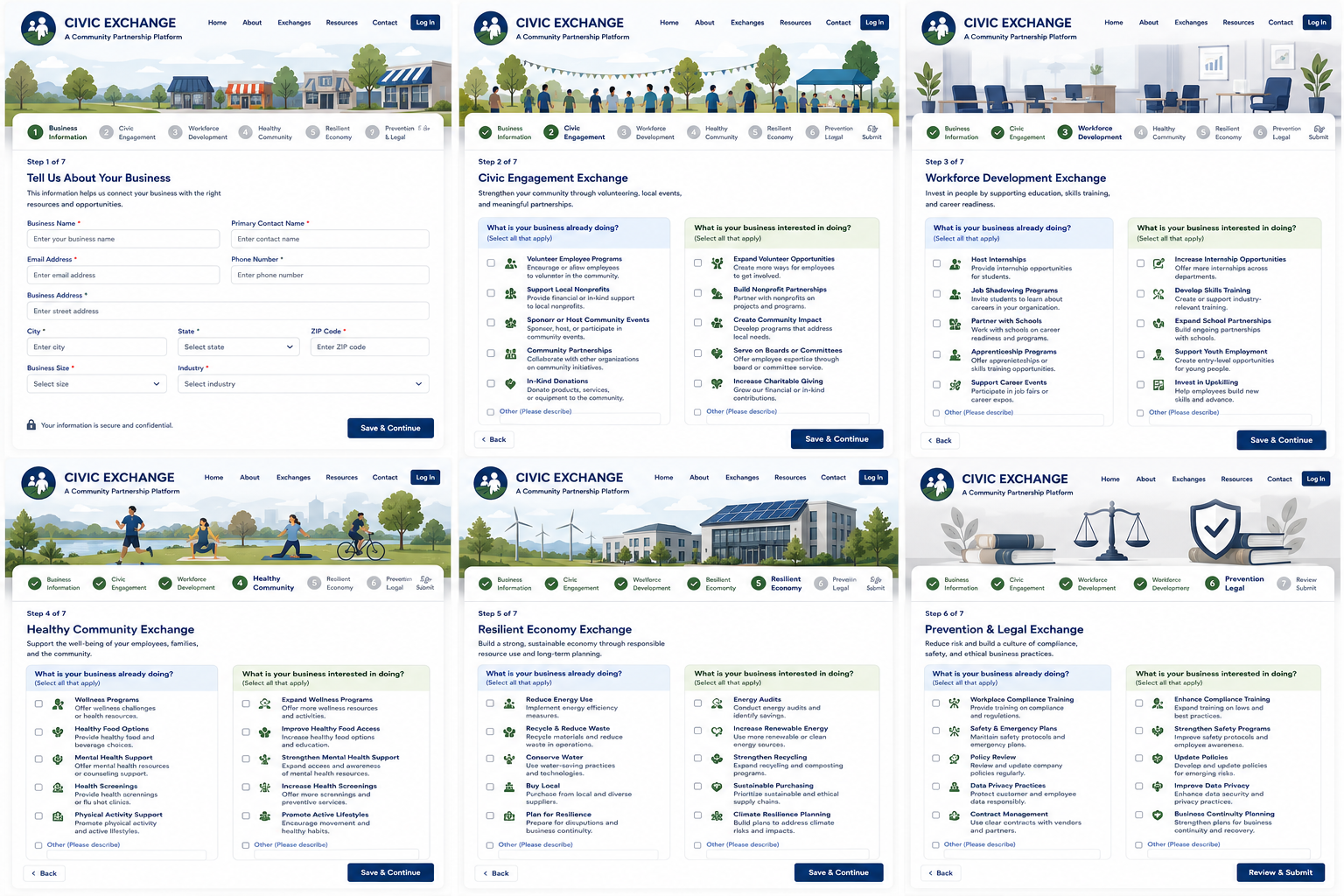
City Civic Exchange
City Civic Exchange is designed around a simple idea: businesses should not have to navigate a maze to help their city, and city leaders should not have to rely on scattered anecdotes to understand where civic partnership is happening. Each exchange creates a clear category of action, captures what businesses are already doing, identifies what they may be willing to do next, and helps connect that interest to the right public, nonprofit, school, workforce, health, or community partner.
This is different because it does not ask a city to create one more isolated initiative. It creates a shared operating system for civic partnership. The value for a mayor’s office, city council, and economic development leaders is that it turns scattered goodwill into usable information, visible coordination, and measurable public value.
Business Information
The Business Information step is the foundation of the entire model. It gathers basic details about the business, including location, industry, size, contact information, and other core information needed to understand who is participating.
This matters because a city cannot coordinate what it cannot see. A citywide partnership model needs to know which businesses are engaged, where they are located, what sectors they represent, and who the right point of contact is. Without that basic structure, partnership work often depends on personal networks, one time outreach, or informal relationships.
What makes this different is that it creates a common intake point for businesses across the city. A small business, manufacturer, restaurant, hospital, bank, technology company, logistics firm, construction company, nonprofit employer, or neighborhood business could all enter the same structured system. That gives city leaders a clearer picture of business engagement by neighborhood, district, sector, and size.
For city council members, this could help identify which local employers are willing to be part of neighborhood solutions. For a mayor’s office, it creates a citywide view of participation. For economic development leaders, it becomes a practical relationship building tool for business retention, attraction, and follow up.
Civic Engagement Exchange
The Civic Engagement Exchange focuses on how businesses support the community through volunteerism, local events, nonprofit partnerships, donations, employee service, community boards, and neighborhood initiatives.
This helps because many businesses already contribute to civic life, but that activity is often invisible to citywide strategy. A company may sponsor a youth program. A restaurant may donate meals. A bank may support financial education. A law firm may provide pro bono help. A small business may support neighborhood events. These efforts matter, but they are often not captured in a way that helps city leaders understand the full scale of civic contribution.
What makes this different is that it turns civic participation into organized information. Instead of city leaders only hearing about individual examples, they could see patterns. Which neighborhoods have strong business volunteerism? Which nonprofits are attracting support? Which areas need more corporate or small business engagement? Which businesses want to serve but need a partner?
For a mayor and city council, this creates a stronger way to mobilize civic capacity around neighborhood priorities. For economic development leaders, it shows that a city is not just a market. It is a place where businesses can build public value and belong to the life of the community.
Workforce Development Exchange
The Workforce Development Exchange is one of the most important parts of the model. It helps identify businesses that are already offering internships, job shadowing, apprenticeships, mentoring, career speakers, school partnerships, training, tuition support, entry level hiring, second chance hiring, or other workforce pathways.
This helps because a city’s workforce challenge is not only about training people. It is about connecting education, training, and employer demand in a more organized way. Schools, colleges, workforce boards, unions, nonprofits, and employers all play important roles, but the system often lacks one simple way to see which businesses are ready to participate and what kind of participation they are willing to offer.
What makes this different is that it captures employer readiness at the front end. Instead of asking workforce organizations to chase employers one by one, the exchange gives businesses a structured way to raise their hand. Some may be ready for apprenticeships. Some may only be ready to host a career speaker. Some may want interns. Some may be open to hiring from training programs. All of that information is valuable.
For a mayor’s office, this creates a stronger bridge between economic development and workforce strategy. For city council members, it can help connect local residents to real employers and practical pathways. For economic development leaders, it becomes a talent pipeline asset. A company deciding whether to grow in a city wants to know whether the city can help it find and develop workers. This exchange helps answer that question.
Healthy Community Exchange
The Healthy Community Exchange focuses on the role businesses can play in improving health and wellbeing. This could include employee wellness, mental health support, healthy food options, preventive health programs, health screenings, physical activity, work life balance, tobacco free policies, emergency preparedness, and partnerships with health or community organizations.
This helps because health is shaped by far more than hospitals and clinics. Jobs, food access, workplace conditions, stress, wages, transportation, neighborhood safety, and social connection all affect health. Businesses influence many of those conditions every day.
What makes this different is that it gives public health and community partners a structured way to understand where employers are already helping and where they may be willing to do more. A business may not think of itself as part of public health, but it may be supporting employee wellness, providing healthy food options, offering mental health benefits, sponsoring a community walk, or helping with emergency response. Those actions matter.
For city leadership, this exchange could support Community Health Assessment work, health improvement planning, prevention strategies, grant applications, and neighborhood health partnerships. For city council members, it offers a practical way to connect businesses to local health needs. For economic development leaders, it reinforces that a healthy workforce and healthy neighborhoods are core economic assets.
Resilient Economy Exchange
The Resilient Economy Exchange focuses on sustainability, resource efficiency, long term business stability, and climate resilience. It can include energy efficiency, recycling, waste reduction, water conservation, circular economy actions, green transportation, emergency preparedness, pollution reduction, and business continuity planning.
This helps because a city’s economy depends on businesses that can adapt, reduce risk, manage costs, and prepare for disruption. Energy prices, extreme weather, supply chain shocks, infrastructure stress, public safety challenges, and environmental risk all affect business stability. Resilience is not only an environmental issue. It is an economic competitiveness issue.
What makes this different is that it translates broad sustainability and resilience goals into practical business actions. A small business may not know how to engage with a climate plan, but it may be willing to reduce waste, improve energy use, prepare for emergencies, or explore greener transportation. A larger employer may have formal sustainability goals but need better ways to align them with city priorities.
For a mayor’s office, this exchange creates a clearer view of business participation in resilience and sustainability. For city council members, it can help identify local businesses that need support or are ready to lead. For economic development leaders, it strengthens the city’s position as a place where growth, sustainability, and long term competitiveness can move together.
Prevention and Legal Exchange
The Prevention and Legal Exchange focuses on reducing risk before problems become crises. It can include workplace compliance training, safety protocols, employee handbook review, cybersecurity, data protection, emergency procedures, contracts, insurance review, business continuity planning, and connections to legal or risk management professionals.
This helps because many businesses, especially small businesses, do not fail because they lack ambition. They often struggle because they lack access to basic prevention, legal, safety, compliance, or continuity support. One preventable mistake can become a lawsuit, closure, cyber incident, workplace injury, contract dispute, or financial loss.
What makes this different is that it treats prevention as economic development. Instead of only responding after problems happen, the city could help businesses identify where they need education, technical assistance, or partner support. This is especially valuable for small businesses, minority owned businesses, neighborhood businesses, and startups that may not have in house legal, HR, cybersecurity, or compliance capacity.
For city council members, this could help protect neighborhood businesses and local jobs. For a mayor’s office, it supports business stability and public safety. For economic development leaders, it strengthens business retention by helping employers reduce avoidable risk. A stronger small business ecosystem is not only built through capital and customers. It is also built through prevention.
Review and Submit
The Review and Submit step is where the business can see its selections, confirm its information, and submit one organized partnership profile.
This helps because it turns a conversation into a usable record. Instead of scattered emails, informal promises, or disconnected forms, the city would have a structured summary of what each business is already doing and where it may be willing to help next.
What makes this different is that it creates a repeatable data layer. Over time, the city could aggregate information without exposing private details. Leaders could see how many businesses are interested in workforce partnerships, how many are supporting community health, how many want to help nonprofits, how many are taking sustainability actions, and where gaps remain.
For a mayor, that creates citywide visibility. For city council, it creates district and neighborhood relevance. For economic development leaders, it creates a stronger follow up system. For community partners, it creates a better way to find businesses that are ready to engage.
Why This Would Help Any City
The strength of City Civic Exchange is that it does not depend on one department, one program, or one priority. It gives a city shared civic infrastructure that can support many priorities at once.
It helps a mayor’s office because it provides better visibility into what businesses are doing across the city and how that activity connects to public goals.
It helps city council because it can show neighborhood and district level opportunities, needs, and business engagement.
It helps economic development leaders because it creates a stronger business retention, attraction, and relationship management tool.
It helps businesses because participation becomes easier, clearer, and less bureaucratic.
It helps nonprofits, schools, workforce partners, and health organizations because they can identify businesses that are already interested in helping.
It helps grant writing and public reporting because it turns collaboration into evidence.
The difference is that City Civic Exchange is not simply a website. It is a practical coordination model. It brings business interest, community need, and public priorities into one organized structure. It helps a city move from scattered activity to shared strategy, from informal goodwill to measurable impact, and from “who should we call?” to “who is ready to help?”
At its best, this gives any city something every great city needs: a clearer way to organize action, measure progress, and show residents that public, private, nonprofit, and community partners are working together to improve the city.
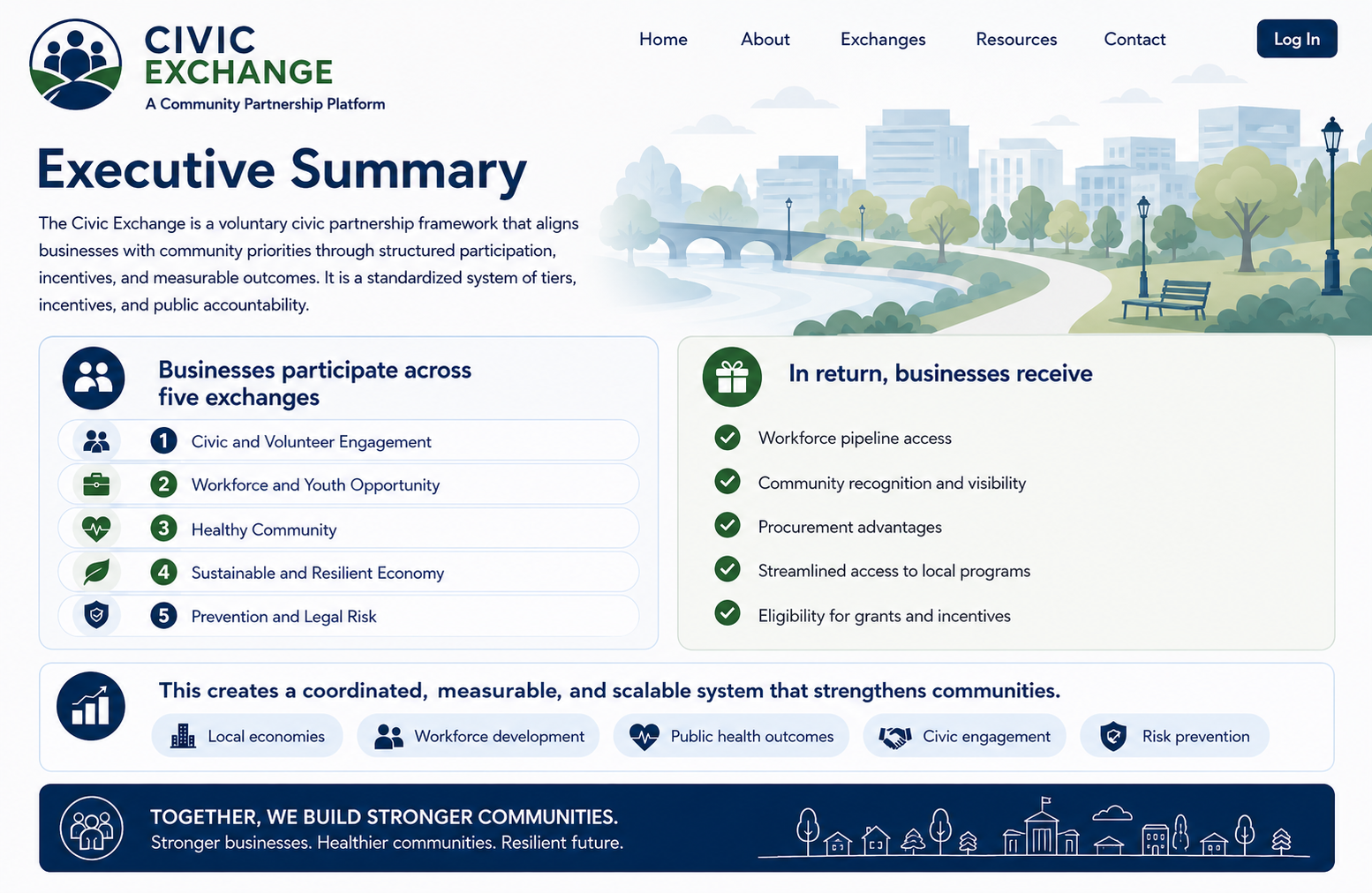
City Civic Exchange is a voluntary, city led partnership model designed to organize how businesses participate in local public priorities. It gives employers one clear front door to identify what they are already doing, where they may be willing to help next, and what kind of city, nonprofit, school, workforce, health, or community partner they need.
What makes this different is that it does not replace existing programs. It connects them. Cities already have workforce programs, neighborhood organizations, public health efforts, sustainability initiatives, chambers, schools, colleges, nonprofits, and economic development partners. The problem is that many of these efforts operate in separate lanes. City Civic Exchange creates one shared structure so business participation can be seen, coordinated, measured, and connected to citywide priorities.
Businesses would participate across five practical exchanges. Civic and Volunteer Engagement captures how employers support neighborhoods, nonprofits, local events, and community service. Workforce and Youth Opportunity connects businesses to internships, apprenticeships, mentoring, job shadowing, career speakers, and talent pipelines. Healthy Community identifies employer support for wellness, prevention, mental health, food access, screenings, and community health partnerships. Sustainable and Resilient Economy organizes business action around energy efficiency, waste reduction, water stewardship, transportation, preparedness, and long term resilience. Prevention and Legal Risk helps businesses reduce avoidable problems through safety, compliance, cybersecurity, emergency planning, contracts, and continuity support.
The value for businesses is simplicity. Instead of guessing which office, agency, school, nonprofit, or program to contact first, a business can enter one organized system and say what it can realistically do. In return, the city can recognize participation, connect businesses to workforce pipelines, identify eligible grants or incentives, reduce duplication, and make city processes more coordinated. This creates a better experience for small businesses, large employers, neighborhood organizations, and public agencies.
The value for city leaders is visibility. A mayor’s office could see where business engagement is growing and where more coordination is needed. City council members could understand opportunities and gaps at the district, ward, or neighborhood level. Economic development leaders could use the model as a business retention and attraction tool, showing employers that the city has an organized way to connect companies with talent, community partnerships, sustainability goals, and public value.
Most importantly, City Civic Exchange turns scattered goodwill into measurable civic impact. It creates a shared data layer showing how many businesses are helping with workforce development, youth opportunity, public health, sustainability, nonprofit support, and risk prevention. That makes grant applications stronger, public reporting more credible, and citywide strategy more actionable.
At its best, this is not just a website. It is civic infrastructure. It helps a city move from isolated programs to coordinated action, from informal partnerships to measurable outcomes, and from good intentions to visible results. Together, it gives any city a practical way to build stronger businesses, healthier communities, and a more resilient future.
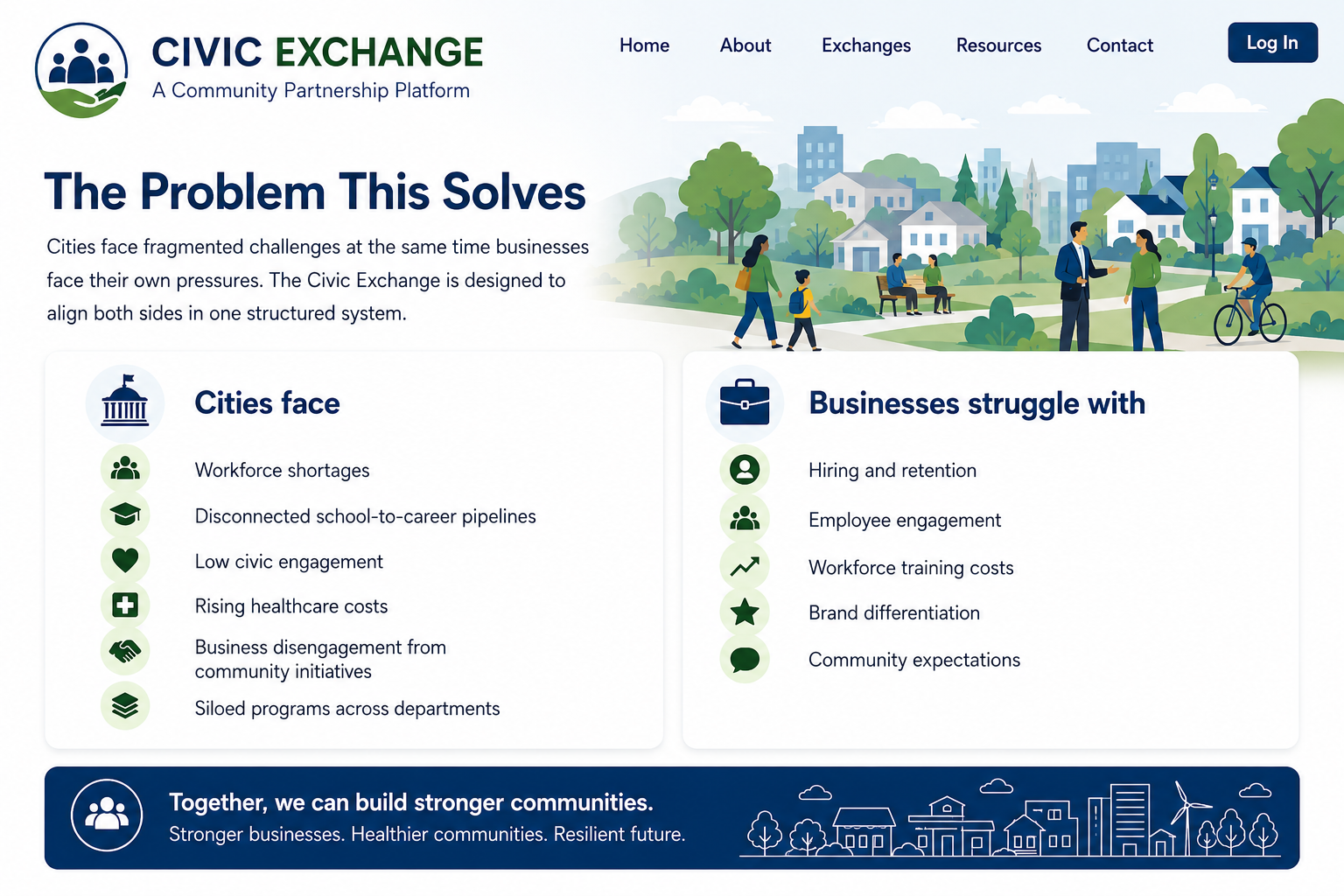
Every city has no shortage of civic effort. Strong employers, neighborhood organizations, schools, workforce partners, health systems, nonprofits, and public agencies are working every day to solve real problems. But too often, those efforts are fragmented. Programs operate in separate lanes. Businesses do not always know where to plug in. City leaders do not always have a clear view of who is engaged, where gaps exist, or which partners are ready to help.
At the same time, businesses face their own pressures. They are trying to hire and retain talent, manage rising costs, strengthen employee engagement, meet community expectations, protect their brand, and show that they are contributing to the community where they operate. Many businesses want to be part of the solution, but the path to participation is not always simple.
City Civic Exchange is designed to solve both problems at once. It gives a city a structured way to organize business participation around public priorities, while giving businesses a clearer way to connect with workforce, health, education, nonprofit, sustainability, and community partners.
For the city, this model could help address workforce shortages, disconnected school to career pathways, low civic engagement, rising health pressures, business disengagement, and siloed programs across departments. For businesses, it creates a simpler way to find talent pipelines, support employees, build community relationships, reduce risk, and demonstrate public value.
What makes this different is that it does not start with a new program. It starts with coordination. Most cities already have many of the right organizations, programs, and partners. The missing piece is a shared front door that helps connect business capacity to city priorities in one organized place.
The result is a more practical system for action. City leaders can see where businesses are already contributing. Council members can identify neighborhood level opportunities. Economic development leaders can use the model to strengthen business retention and attraction. Community partners can find employers who are ready to help. Businesses can participate without having to navigate a maze.
City Civic Exchange turns scattered interest into organized partnership. It helps a city move from fragmented effort to coordinated action, from informal goodwill to measurable impact, and from separate programs to a shared strategy for building a stronger, healthier, more connected community.
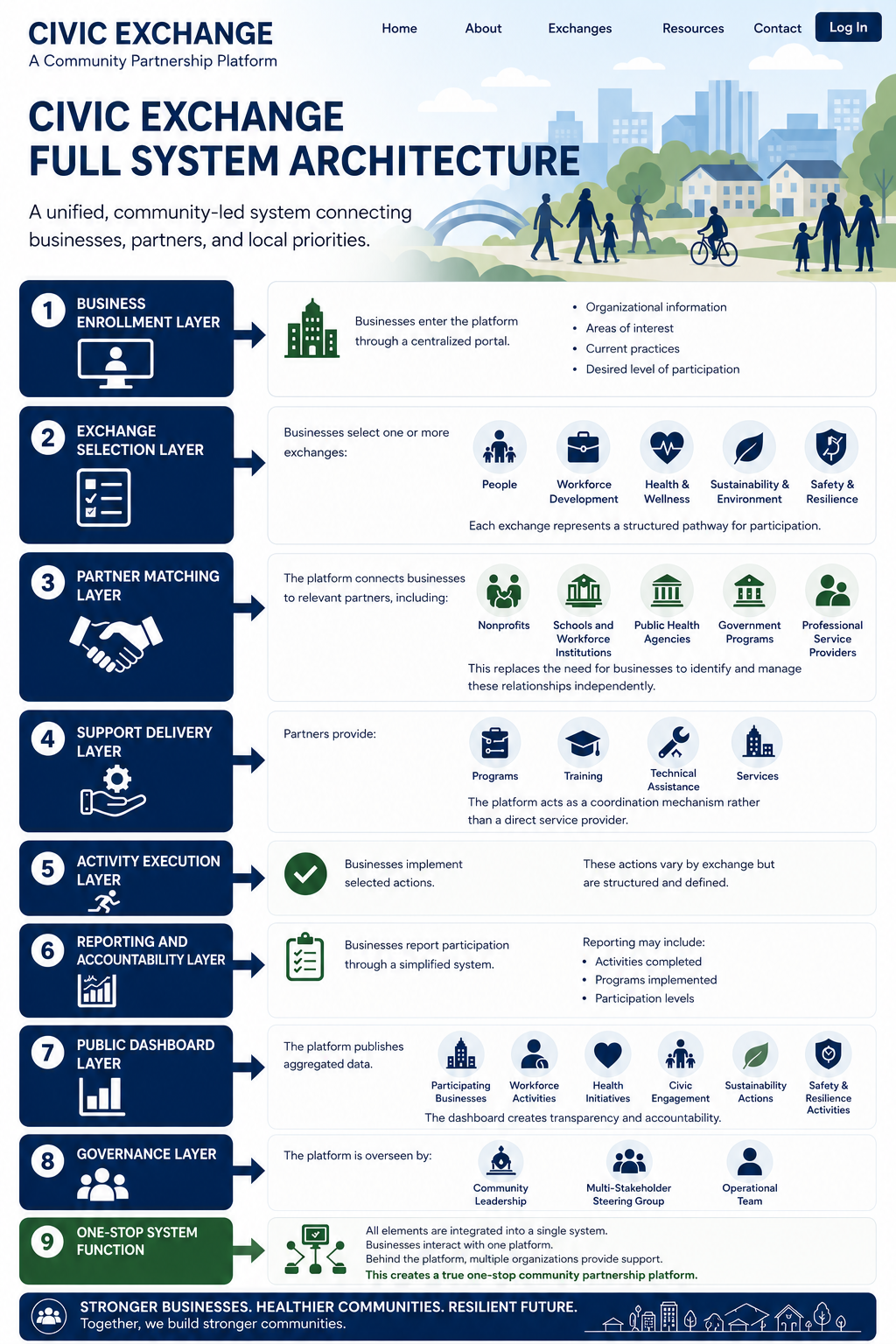
City Civic Exchange: A One Stop System for Business Participation and Public Impact
City Civic Exchange is designed as a full civic operating system, not just a sign up form or public website. Its purpose is to give any city one organized structure for connecting business capacity with community priorities, city goals, nonprofit partners, workforce needs, public health priorities, sustainability actions, and risk prevention.
The value of the architecture is that every step has a clear function. Businesses enter once, select the areas where they are active or interested, get connected to the right partners, take practical action, report participation in a simple way, and help the city build a public picture of progress. That is what makes the model different. It does not depend on scattered outreach, informal relationships, or one department trying to manage everything alone. It creates a repeatable system.
Business Enrollment Layer
This is the entry point. A business provides basic information, including organization name, contact person, location, industry, size, current activities, and areas of interest.
This matters because a city cannot coordinate business participation if the information is scattered across different departments, nonprofits, chambers, workforce boards, and community organizations. The enrollment layer gives the city one clean starting point.
For a mayor’s office, this creates a citywide view of who is participating. For city council members, it can support district, ward, or neighborhood level insight. For economic development leaders, it becomes a practical relationship management tool for business retention, business attraction, and employer engagement.
What makes it different is that most programs start with a single issue. This starts with the business and then routes that business to the right issue, partner, and opportunity.
Exchange Selection Layer
After enrollment, businesses choose one or more exchanges where they are already active or willing to contribute. These exchanges could include Civic Engagement, Workforce Development, Healthy Community, Resilient Economy, and Prevention and Legal Risk.
This is the heart of the model. It gives businesses a structured menu of ways to participate without forcing every business into the same role. A small restaurant may choose healthy food access or local hiring. A manufacturer may choose apprenticeships or safety training. A hospital may choose community health. A bank may choose financial education or nonprofit support. A company with climate goals may choose sustainability and resilience.
This helps because it creates a common language for public private partnership. Instead of every department asking different questions in different formats, a city could use one shared structure to understand business interest and action.
What makes it different is that it turns business engagement into organized categories that can be compared, measured, and acted on citywide.
Partner Matching Layer
Once a business identifies its interests, the system connects it to relevant partners. Those partners may include nonprofits, schools, workforce institutions, public health agencies, city programs, chambers, neighborhood organizations, professional service providers, or technical assistance groups.
This is where the model becomes practical. Businesses often want to help, but they do not know who to contact. Community partners often need help, but they do not know which businesses are willing. The partner matching layer closes that gap.
For city council members, this could help connect local businesses to district or neighborhood priorities. For economic development leaders, it strengthens business relationships by helping employers find useful connections. For a mayor’s office, it helps align citywide priorities with actual private sector capacity.
What makes it different is that it reduces the burden on businesses to navigate the civic ecosystem by themselves. The system helps route interest to the right partner instead of expecting every business to figure it out alone.
Support Delivery Layer
The Civic Exchange is not designed to do everything itself. It is designed to coordinate the partners who already provide programs, training, technical assistance, services, and implementation support. This is important because most cities already have many organizations doing good work. The goal is not to replace them. The goal is to make them easier to find and easier to connect with businesses.
A workforce organization may provide training. A nonprofit may manage volunteers. A public health partner may provide wellness resources. A legal aid or professional service partner may provide compliance support. A sustainability office may provide energy efficiency guidance. The Civic Exchange becomes the coordination mechanism.
This helps because it strengthens existing institutions instead of competing with them. What makes it different is that the city does not need to build every service from scratch. It can organize access to the services already available.
Activity Execution Layer
This is where businesses take action. They implement the commitments or activities they selected through the exchange process. Those actions may include hosting interns, offering job shadowing, sponsoring a nonprofit, improving workplace wellness, reducing energy use, supporting food access, creating an emergency plan, reviewing employee safety protocols, or volunteering in a neighborhood initiative.
This layer matters because the model is not just about collecting interest. It is about helping interest become action.
This helps because it gives city leaders a clearer way to move from conversations to implementation. What makes it different is that the actions are voluntary and flexible, but still structured enough to be tracked and understood.
Reporting and Accountability Layer
Businesses report participation through a simplified system. This may include activities completed, programs implemented, participation levels, partnerships formed, or future areas of interest. This does not need to be a heavy reporting burden. It can be simple, practical, and focused on useful information.
The point is not to regulate businesses. The point is to understand what is happening and where more support is needed.
For a mayor’s office, this creates better evidence of progress. For city council members, it supports neighborhood accountability. For economic development leaders, it creates data that can support business retention, grant applications, and public reporting.
This helps because it turns scattered activity into evidence. What makes it different is that it creates accountability without turning the platform into a compliance system.
Public Dashboard Layer
The public dashboard publishes aggregated data. It could show participating businesses, workforce activities, health initiatives, civic engagement, sustainability actions, and risk prevention activities.
This creates transparency without exposing sensitive business information. The city does not need to publish every individual detail. It can show aggregate progress by category, geography, industry, or exchange.
This matters because public trust grows when people can see action. Residents, council members, funders, community partners, and businesses can better understand what is improving and where more work is needed.
This helps because it gives a city a visible scoreboard for civic partnership. What makes it different is that most partnership work is hard to see. This makes it visible, measurable, and easier to communicate.
Governance Layer
The governance layer provides oversight. This could include city leadership, an operational team, and a multi stakeholder steering group representing business, nonprofits, workforce, education, public health, sustainability, economic development, and community partners.
This matters because a platform like this needs trust. Businesses need to know the system is credible. Community partners need to know it is fair. City leaders need to know the data is useful. Residents need to know it serves public priorities.
Good governance also helps keep the system from becoming too political, too bureaucratic, or too disconnected from community needs.
This helps because it protects credibility and keeps the model aligned with real city priorities. What makes it different is that it builds shared ownership into the structure from the start.
One Stop System Function
The final layer is the full system function. This is where all pieces work together as one civic infrastructure system.
Businesses enter through one platform. They choose exchanges. They connect to partners. Partners deliver support. Businesses take action. Participation is reported. Aggregate progress is shown publicly. Governance keeps the system accountable.
This is what makes City Civic Exchange more than a website. It becomes a one stop civic infrastructure system for business participation and public impact.
This helps because it makes civic engagement easier for businesses, more coordinated for city leaders, more useful for community partners, and more measurable for the public.
What makes it different is that instead of creating another isolated program, it creates an operating model that can connect many existing programs into one organized system.
Why City Leaders Should Care
For a mayor’s office, this creates a stronger way to organize citywide progress across workforce, public health, sustainability, business support, civic engagement, and resilience.
For city council members, this creates a practical tool for district, ward, and neighborhood level impact. Council members could see where businesses are engaged, where gaps exist, and where local partners may need support.
For economic development leaders, this becomes a business retention and attraction asset. It shows employers that the city is not only asking businesses to operate locally. It is giving them a structured way to connect with talent, communities, incentives, public goals, and long term opportunity.
For businesses, it reduces confusion. They get one place to participate instead of multiple disconnected entry points.
For residents, it helps turn public private partnership from a slogan into something visible.
The core idea is simple: most cities already have many of the right pieces. The Civic Exchange helps those pieces work together. It organizes business interest, connects partners, supports action, measures participation, and gives the city a clearer way to answer the question that matters most: what are we improving together, and how do we know?
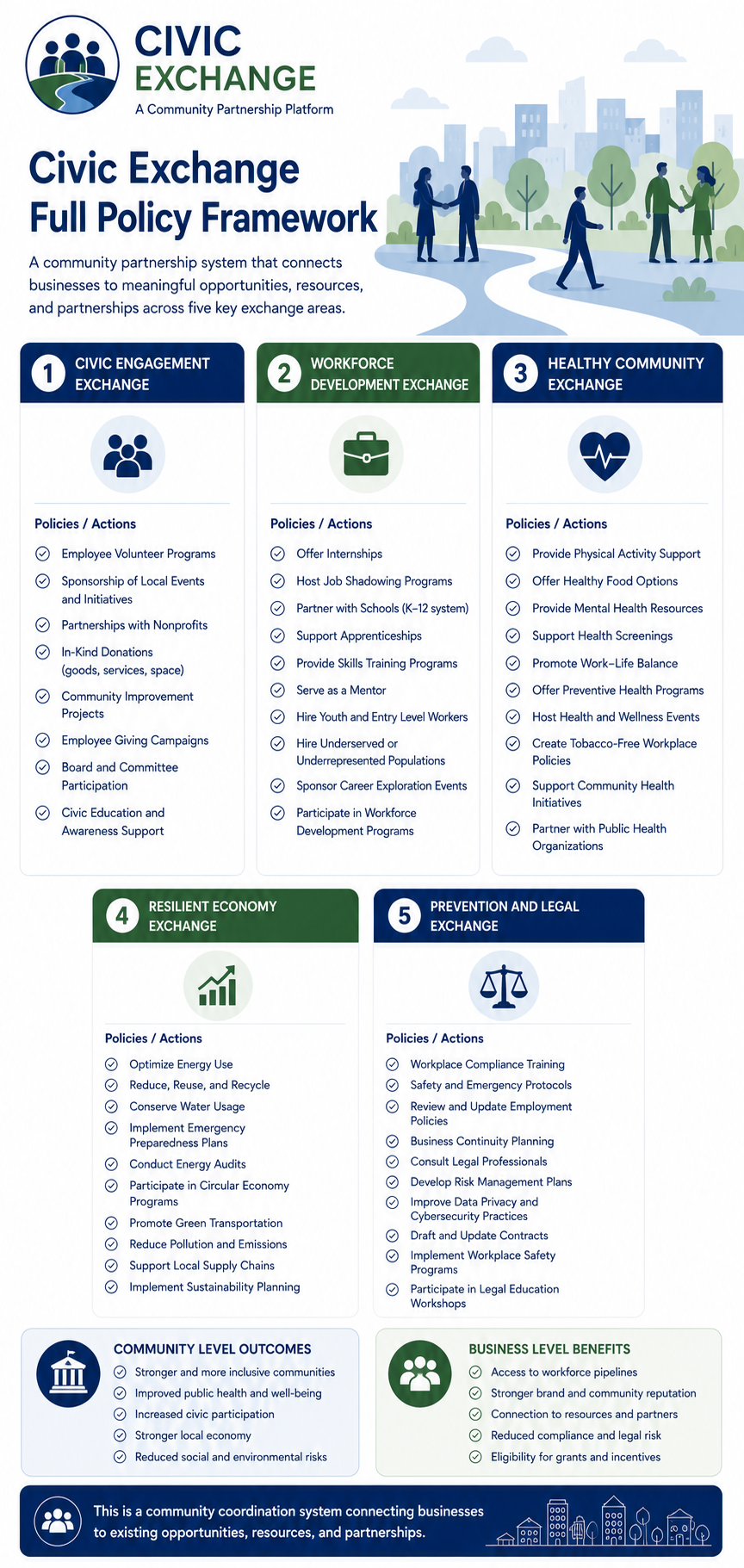
City Civic Exchange: Five Practical Exchange Areas for Any City
City Civic Exchange is built around five practical exchange areas that translate broad city priorities into clear business actions. The purpose is not to create another government program. The purpose is to create one organized framework where businesses can see how to participate, city leaders can see where engagement is happening, and community partners can connect with employers who are ready to help.
This framework matters because cities often talk about workforce development, public health, civic engagement, sustainability, and risk prevention as separate issues. In real life, they are connected. A business that hires young workers is supporting workforce development. A business that offers wellness programs is supporting public health. A business that volunteers locally is strengthening civic trust. A business that reduces energy use is strengthening resilience. A business that improves safety and compliance is protecting jobs and reducing avoidable harm.
Civic Engagement Exchange
The Civic Engagement Exchange gives businesses a clear way to support neighborhoods, nonprofits, community events, and civic life.
This could include employee volunteer programs, sponsorship of local events, partnerships with nonprofits, in kind donations, community improvement projects, employee giving campaigns, board and committee participation, and civic education or awareness support.
This helps because cities have many businesses that may be willing to contribute time, resources, space, expertise, donations, or volunteers, but that energy is often not organized in one place. This exchange gives a city a way to identify who is already helping and who may be ready to do more.
What makes it different is that it treats civic engagement as a measurable city asset. Instead of relying only on informal relationships or one time outreach, city leaders could see where business engagement exists by neighborhood, district, industry, and type of support.
For city council members, this creates a practical way to connect local businesses with district priorities and neighborhood organizations. For a mayor’s office, it creates a broader view of civic capacity. For economic development leaders, it shows that the city is not just a place to do business. It is a place where businesses can belong, contribute, and build trust.
Workforce Development Exchange
The Workforce Development Exchange helps connect businesses to the city’s talent pipeline.
This could include internships, job shadowing, partnerships with schools, apprenticeships, skills training, mentoring, hiring youth and entry level workers, hiring underserved or underrepresented populations, sponsoring career exploration events, and participating in workforce innovation programs.
This helps because workforce development only works when employers are actively connected to schools, training providers, community colleges, workforce boards, and community based organizations. This exchange gives employers a simple way to raise their hand and say what kind of workforce partnership they can support.
What makes it different is that it captures employer readiness before the need becomes urgent. Instead of waiting until a company has a hiring crisis or a workforce program has to search for employer partners, a city could build a live map of employer interest and capacity.
For a mayor’s office, this strengthens alignment between economic development and workforce strategy. For city council members, it creates a path to connect residents with real opportunities. For economic development leaders, it becomes a major retention and attraction tool because companies want to know whether the city can help them find, train, and keep talent.
Healthy Community Exchange
The Healthy Community Exchange recognizes that businesses are part of the public health ecosystem.
This could include physical activity support, healthy food options, mental health resources, health screenings, work life balance, preventive health programs, health and wellness events, tobacco free workplace policies, community health initiatives, and partnerships with public health programs.
This helps because health is shaped by where people work, what they earn, how they commute, whether they have access to healthy food, whether mental health support is available, and whether workplaces support prevention. Employers touch these conditions every day.
What makes it different is that it gives public health leaders a structured way to engage the business community. Instead of public health work being limited to clinics, agencies, or nonprofits, this model brings employers into prevention, wellness, emergency readiness, and community wellbeing.
For a mayor’s office, this supports healthier workers and healthier neighborhoods. For city council members, it creates a concrete way to connect businesses to local health needs. For economic development leaders, it reinforces a key truth: a healthy workforce is an economic asset.
Resilient Economy Exchange
The Resilient Economy Exchange connects business action to sustainability, preparedness, and long term economic stability.
This could include optimizing energy use, reducing, reusing, and recycling, conserving water, emergency preparedness plans, energy audits, circular economy programs, green transportation, pollution and emissions reduction, support for local supply chains, and sustainability planning.
This helps because resilience is not only about climate or the environment. It is also about keeping businesses open, reducing costs, protecting infrastructure, preparing for disruption, and strengthening local supply chains. A more resilient business community means a more resilient city.
What makes it different is that it translates big sustainability goals into practical business actions. A small business may not know how to connect to a climate plan, but it may be willing to reduce waste, lower energy costs, improve preparedness, or participate in a local supply chain effort. This exchange makes those pathways visible.
For a mayor’s office, this creates a clearer picture of business participation in sustainability and resilience. For city council members, it can identify businesses that need support or are ready to lead locally. For economic development leaders, it positions the city as a place where growth, sustainability, and competitiveness reinforce each other.
Prevention and Legal Exchange
The Prevention and Legal Exchange focuses on reducing risk before it becomes a crisis.
This could include workplace compliance training, safety and emergency protocols, reviewing and updating employment policies, business continuity planning, consulting legal professionals, developing risk management plans, improving data privacy and cybersecurity practices, drafting and updating contracts, workplace safety programs, and legal education workshops.
This helps because businesses, especially small and neighborhood businesses, often face preventable risks that can become expensive or even devastating. A contract issue, cybersecurity incident, workplace injury, compliance problem, emergency disruption, or employment policy mistake can threaten jobs and business stability.
What makes it different is that it treats prevention as an economic development strategy. Rather than only helping businesses after a problem occurs, a city could help businesses strengthen basic legal, operational, safety, and continuity practices before problems escalate.
For city council members, this helps protect neighborhood businesses. For a mayor’s office, it supports public safety, business stability, and economic resilience. For economic development leaders, it strengthens retention by helping employers avoid preventable losses.
City Level Outcomes
The policy framework creates value for the city as a whole. It supports workforce pipeline development, improved public health outcomes, increased civic participation, a stronger local economy, reduced legal and operational risk, and a more resilient and sustainable city.
The most important point is that these outcomes become easier to organize and measure. A city could better understand where businesses are already contributing, where interest exists, which neighborhoods have strong participation, and where additional outreach is needed.
Business Level Benefits
Businesses also receive practical value. They gain access to workforce pipelines, stronger brand and community reputation, connections to local resources and programs, reduced compliance and legal risk, possible eligibility for grants and incentives, and stronger employee engagement and retention.
This is important because the model is not charity. It is shared value. The city benefits when businesses participate in public priorities, and businesses benefit when the city helps them connect to talent, resources, partners, recognition, and stability.
Why This Framework Matters
The reason this model works is that it gives any city a common structure. Every business does not need to do everything. A small business, hospital, manufacturer, bank, law firm, university, grocery store, construction company, restaurant, or technology company can each contribute in a way that fits its capacity.
That is the power of the exchange model. It respects business reality while advancing public priorities.
For a mayor, it provides a citywide operating framework.
For city council, it provides district and neighborhood level usefulness.
For economic development leaders, it provides a stronger tool for retention, attraction, and employer engagement.
For community partners, it provides a clearer path to business collaboration.
For residents, it helps make public private partnership visible and accountable.
City Civic Exchange would help any city move from scattered programs to a shared framework, from informal goodwill to measurable outcomes, and from disconnected outreach to organized civic action. At its best, it gives cities a practical way to build stronger businesses, healthier communities, and a more resilient future.
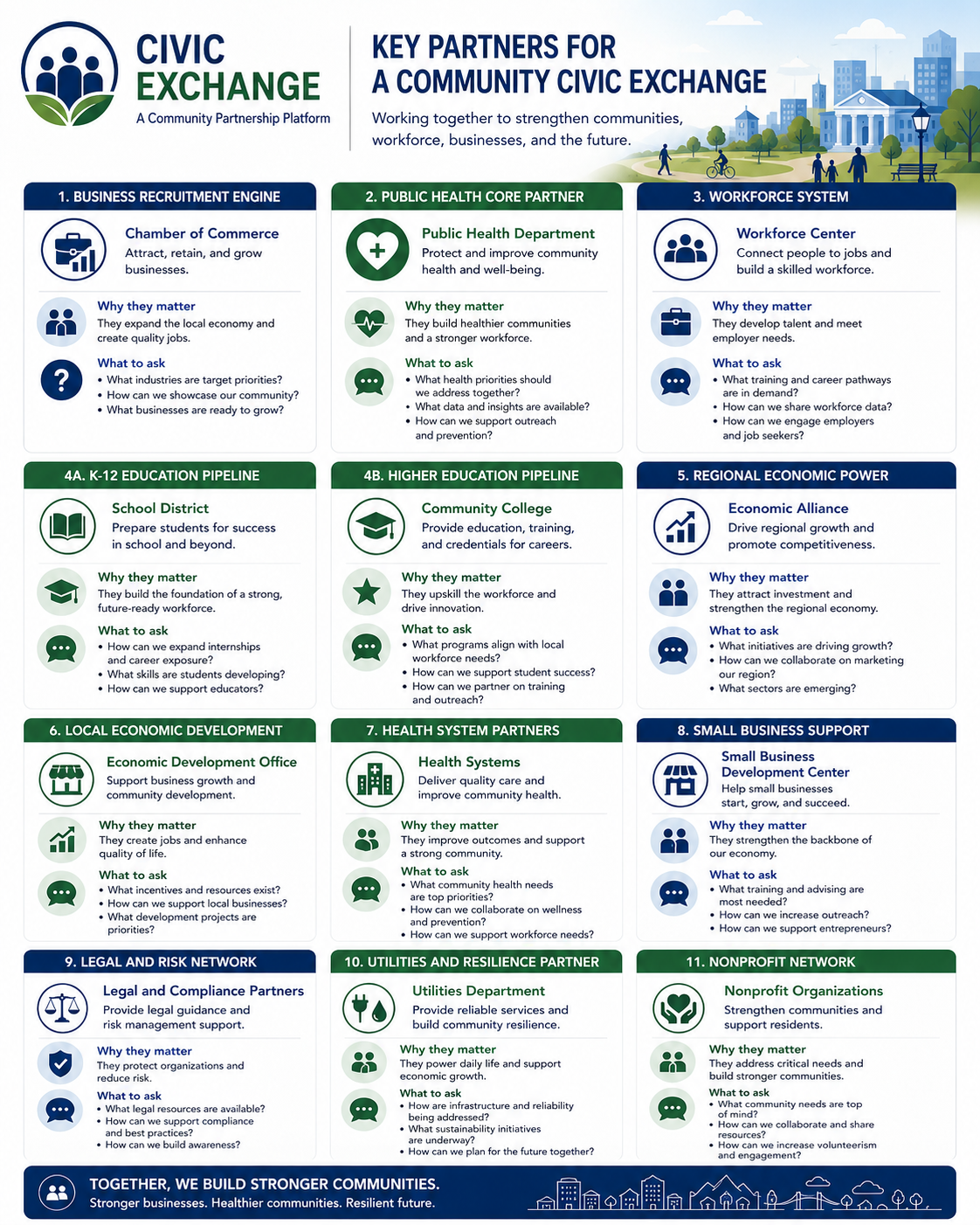
City Civic Exchange: A Partner Model for Any City
City Civic Exchange works because it does not ask one office or one organization to solve everything alone. It recognizes that most cities already have many of the right institutions in place. The opportunity is to connect them through one shared system so businesses know where to enter, partners know where to plug in, and city leaders can see what is happening across the full civic and economic landscape.
The partners in this model represent the operating backbone of the system. Each organization already plays a different role in a city’s economy, workforce, health, education, infrastructure, small business support, legal assistance, or community life. City Civic Exchange would not replace those roles. It would help organize demand, route businesses to the right partners, and make collaboration easier to measure.
Business Recruitment Engine
A city’s tourism, business promotion, chamber, or economic development organization could serve as a powerful business recruitment and visibility partner because these organizations already promote the city’s identity, strengths, industries, events, and competitive advantages.
In a Civic Exchange model, this kind of partner matters because business participation begins with outreach. The city needs trusted messengers who can explain why companies should participate and how this strengthens the city’s brand.
This is different because the Civic Exchange would not only ask businesses to join a civic effort. It would give the city a positive story to tell: this is a place where employers can connect with talent, community partners, sustainability opportunities, public health priorities, and neighborhood impact through one organized system.
For a mayor’s office and economic development leaders, this becomes part of the city’s competitiveness message. For city council members, it helps show local businesses that participation is not abstract. It is tied to practical opportunities, recognition, and stronger neighborhoods.
Public Health Core Partner
A city or county public health department would be a core partner because public health is directly connected to business activity. Employers influence health through jobs, benefits, workplace safety, mental health support, food access, emergency preparedness, and neighborhood investment.
This partner matters because the Civic Exchange could help public health leaders identify businesses interested in wellness, prevention, screenings, mental health, food access, emergency readiness, health education, and community health initiatives.
This is different because it moves public health partnership beyond occasional outreach. It creates a structured way to see which businesses are already supporting health and which businesses are willing to do more. That can support Community Health Assessment work, prevention strategies, grant applications, and community health improvement planning.
Workforce System
A local or regional workforce development board would be essential because workforce development is one of the clearest areas where business participation is needed. Training programs, apprenticeships, career pathways, job placement, youth employment, and employer engagement all depend on strong connections between businesses and workforce partners.
This partner matters because the Civic Exchange could identify businesses that are willing to offer internships, job shadowing, mentoring, apprenticeships, skills training, hiring opportunities, or career exploration programs.
This is different because it captures employer interest before programs have to chase businesses one by one. The workforce system would have a clearer view of which employers are ready to participate and what kind of partnership they can support.
For economic development leaders, this strengthens the city’s talent pipeline. For city council members, it creates a practical way to connect residents to opportunity. For a mayor’s office, it connects workforce strategy to measurable business engagement.
K through 12 Education Pipeline
The local school district would be a critical partner because the Civic Exchange can connect students to employers earlier and more consistently. Many students need exposure to careers, mentors, job readiness experiences, internships, and real examples of what different industries look like.
This partner matters because businesses often want to help students but do not know the right pathway. Schools often need employer partners but may not have a simple citywide structure to identify them.
This is different because it creates a common entry point for school business partnerships. A business could indicate whether it is open to career speakers, job shadowing, mentorship, internships, student tours, project based learning, or sponsorships. That makes school to career pathways more organized and easier to scale.
Higher Education Pipeline
Local colleges, universities, and community colleges matter because they help produce the city’s future workforce, research capacity, innovation ecosystem, and professional talent. They also have deep relationships with students, faculty, employers, hospitals, nonprofits, and neighborhoods.
This partner group matters because the Civic Exchange could connect employers to internships, applied research, workforce aligned credentials, talent pipelines, entrepreneurship support, public health work, sustainability projects, and innovation partnerships.
This is different because higher education would not be isolated from citywide civic and economic priorities. The exchange would help connect colleges and universities to business demand and community need in one structured system.
For economic development leaders, this strengthens the city’s talent and innovation story. For a mayor’s office, it links education, workforce, public health, and economic growth. For city council members, it creates more ways for local students and residents to access opportunity.
Regional Economic Development Partner
A citywide or regional economic development organization would be a natural partner because it already works on business attraction, retention, expansion, investment, and job growth. In this model, it could help align the Civic Exchange with the city’s broader economic development priorities.
This partner matters because businesses increasingly care about talent, quality of life, sustainability, civic reputation, employee engagement, and community impact. A Civic Exchange gives economic development leaders a stronger product to show employers.
This is different because it turns public private collaboration into a business attraction asset. A city could say to prospective employers: when you grow here, we can connect you to workforce pipelines, schools, community partners, sustainability opportunities, health initiatives, and neighborhood impact through one organized system.
Local Business Support Partner
A city business affairs office, small business office, chamber, or local economic development partner matters because local businesses are the foundation of the neighborhood economy. Small businesses, commercial corridors, entrepreneurs, and local employers often need resources, technical assistance, protection, and clearer pathways to city support.
This partner matters because the Civic Exchange could help local businesses find assistance while also helping the city understand what businesses need and where they are willing to contribute.
This is different because it gives neighborhood businesses a role in civic partnership, not just compliance or licensing. A small business could receive support and also participate in youth opportunity, community events, local hiring, health initiatives, or neighborhood improvement.
For city council members, this is especially valuable because it connects directly to district and neighborhood level economic vitality.
Health System Partners
Hospitals, clinics, and health systems matter because they are major employers, anchor institutions, care providers, research centers, and community health partners.
This partner group matters because health systems can contribute to workforce development, community health improvement, prevention, screenings, health education, mental health, food access, neighborhood investment, and data informed planning.
This is different because the Civic Exchange would help align health system community benefit work with citywide and neighborhood priorities. It could also help connect smaller businesses to health resources and wellness partnerships.
For a mayor’s office and public health leaders, this strengthens the bridge between clinical care, public health, employers, and community conditions. For city council members, it helps connect major anchor institutions to local needs.
Small Business Support Network
Small Business Development Centers, entrepreneurship centers, nonprofit business assistance providers, chambers, and technical assistance organizations matter because many businesses need practical support before they can fully participate in larger civic or economic initiatives. Small businesses may need help with business planning, capital access, marketing, operations, training, compliance, or growth strategy.
This partner matters because the Civic Exchange should not only ask businesses to contribute. It should also help businesses become stronger. Stronger businesses are better able to hire, train, volunteer, sponsor, donate, and invest locally.
This is different because it connects business support with public purpose. Small business assistance becomes part of a larger citywide strategy for workforce, neighborhood vitality, resilience, and community impact.
Legal and Risk Network
Legal and risk partners matter because many businesses need prevention support. Legal aid groups, volunteer legal services, law schools, bar associations, fair housing organizations, community legal organizations, insurance professionals, cybersecurity partners, and professional service providers could help businesses understand compliance, contracts, workplace policies, data privacy, cybersecurity, safety, and risk management.
This partner group matters because preventable legal and operational problems can hurt businesses, workers, customers, and neighborhoods. For small businesses especially, one avoidable problem can become a major threat.
This is different because it treats prevention as economic development. The goal is not only to help after a crisis. The goal is to reduce the chance of crisis in the first place.
For city council members, this helps protect neighborhood businesses. For economic development leaders, it improves retention. For a mayor’s office, it supports a more stable and responsible business environment.
Utilities and Resilience Partners
Electric, gas, water, broadband, transportation, and infrastructure partners matter because energy, infrastructure, efficiency, outage readiness, and resilience are central to business stability and community wellbeing.
This partner group matters because businesses may be interested in energy efficiency, rebates, sustainability planning, emergency preparedness, electrification, emissions reduction, water conservation, or resilience upgrades but may not know where to start.
This is different because the Civic Exchange could connect business interest to practical utility programs and city resilience goals. It translates sustainability from a broad aspiration into specific business actions.
For economic development leaders, this supports cost savings and long term competitiveness. For a mayor’s office, it supports climate and resilience priorities. For city council members, it can help connect local businesses and residents to practical resources.
Nonprofit Network
The nonprofit network is the heart of many community solutions. Nonprofits work on food security, housing, homelessness, youth opportunity, arts and culture, neighborhood development, violence prevention, health, education, and many other priorities.
This partner group matters because nonprofits often need volunteers, funding, sponsorships, technical assistance, board members, space, supplies, and business partnerships. Businesses often want to help but do not know which nonprofit is the right fit.
This is different because the Civic Exchange creates a more organized way to match business capacity with nonprofit need. It does not depend only on personal relationships or one time appeals. It creates a repeatable structure for collaboration.
For city council members, this can strengthen local community organizations. For a mayor’s office, it helps align civic capacity with citywide priorities. For economic development leaders, it shows that the business community is connected to the social fabric of the city.
Why This Partner Model Matters
The strongest argument for City Civic Exchange is that a city does not need to invent every solution from scratch. Most cities already have powerful institutions. The missing piece is an organized system that connects them.
This partner model gives each group a clear role. Business recruitment partners help bring employers in. Public health partners connect prevention and wellness. Workforce partners connect talent and jobs. Schools and universities connect students and employers. Economic development partners connect growth and investment. Small business partners strengthen local firms. Legal and risk partners reduce avoidable harm. Utilities and infrastructure partners support resilience. Nonprofits connect business capacity to real community needs.
That is why this model would matter to city leaders. It gives a mayor’s office a citywide coordination tool. It gives city council members a district and neighborhood level partnership tool. It gives economic development leaders a business retention and attraction tool. It gives businesses a simpler way to participate. It gives community partners a better way to find help.
At its best, City Civic Exchange becomes the connective tissue between business, government, education, health, workforce, infrastructure, nonprofits, and neighborhoods. It helps any city move from isolated relationships to coordinated partnership, from scattered activity to shared outcomes, and from good intentions to measurable civic impact.
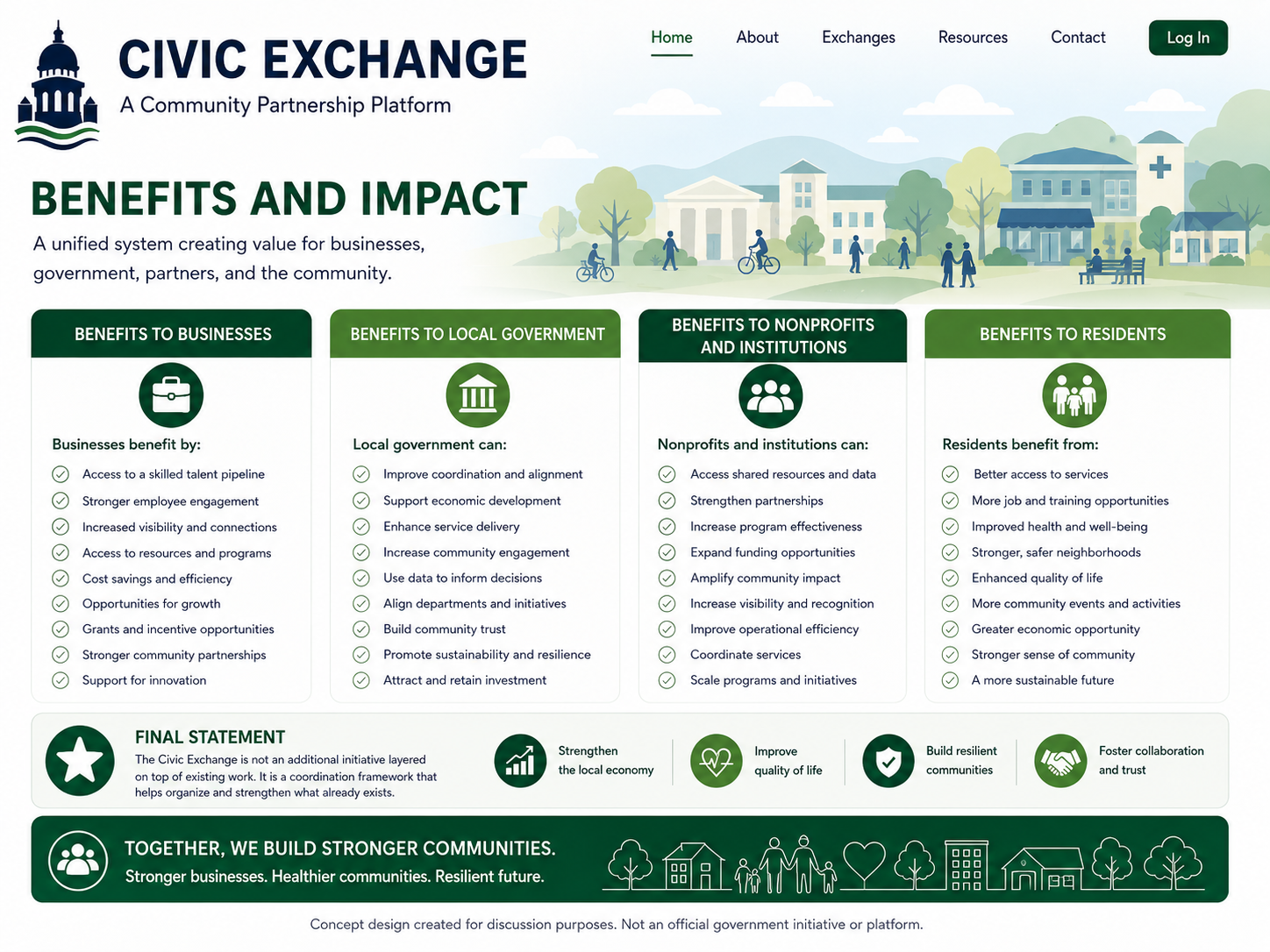
Why City Civic Exchange Creates Value
City Civic Exchange creates value because it is not designed for only one audience. It helps businesses, city government, nonprofits, institutions, residents, and economic development leaders at the same time. That is why the model is powerful. It aligns private sector interest with public priorities in a way that is structured, voluntary, measurable, and useful.
For businesses, the benefit is simplicity and value. Companies want access to talent, stronger employee engagement, better community relationships, lower risk, improved reputation, and clearer connections to resources. But many businesses do not know which city department, school, nonprofit, workforce program, public health partner, or community organization to contact first. City Civic Exchange gives them one place to participate. It helps them connect to workforce pipelines, health initiatives, sustainability opportunities, legal and risk support, grant programs, incentives, volunteer opportunities, and neighborhood partnerships.
This matters because businesses are under pressure to hire, retain workers, manage costs, show community value, and reduce operational risk. The exchange gives them a practical way to do that while also helping the city. It turns civic participation into a business asset, not just a charitable activity.
For the city, the benefit is coordination. Most cities already have major programs, departments, partners, and civic institutions doing important work. The problem is that many efforts are disconnected. City Civic Exchange creates one shared structure for organizing business participation across workforce development, public health, sustainability, civic engagement, economic opportunity, and prevention. That gives city leadership better visibility into what is happening and where more support is needed.
For a mayor’s office, this creates a clearer way to show progress. For city council members, it creates district, ward, and neighborhood level insight. For departments, it reduces duplication and improves alignment. For economic development leaders, it creates a stronger business retention and attraction tool. A company looking at a city could see that the city has an organized way to connect employers with talent, communities, resources, and public priorities.
For nonprofits and institutions, the benefit is access. Many organizations need volunteers, sponsors, funding, technical assistance, board members, event support, employer partners, student opportunities, health partnerships, or community resources. At the same time, many businesses are willing to help but do not know where to plug in. The exchange helps close that gap.
This is different because it does not make nonprofits and institutions chase every business one by one. It creates a more consistent way to identify business interest and match it to community need. Schools can find career partners. Health organizations can find employers interested in wellness and prevention. Workforce groups can find companies willing to offer internships or training. Nonprofits can find volunteers and supporters. Community partners can see more clearly where private sector capacity exists.
For residents, the benefit is better outcomes. When businesses, government, nonprofits, schools, health partners, and workforce organizations are better connected, residents experience the results. That can mean more job and training opportunities, stronger local services, better health and wellbeing, safer and more resilient neighborhoods, more community events, stronger small business corridors, and a better quality of life.
This is the part that matters most politically and practically. Residents do not judge systems by how many meetings happen. They judge them by whether things improve. City Civic Exchange helps turn partnership into visible results. It gives a city a way to show where businesses are helping, which neighborhoods are gaining support, and where more work is still needed.
The larger impact is that a city can move from fragmented goodwill to coordinated civic infrastructure. Instead of separate programs asking businesses different questions in different formats, the city could use one common structure. Instead of partnership claims being based only on anecdotes, leaders could point to aggregate data. Instead of businesses trying to navigate a maze, they could enter through one front door.
That creates a rare opportunity for any city. The exchange could strengthen the local economy, improve quality of life, support public health, build workforce pipelines, reduce legal and operational risk, support sustainability, and position the city as a leader in civic and economic coordination.
The final point is simple: City Civic Exchange is not another initiative layered on top of existing work. It is a restructuring of how partnership work is coordinated. It helps a city use what it already has more effectively. If implemented well, it would give any city a stronger way to build stronger businesses, healthier communities, and a more resilient future.
 Chad Trivette
Leave a comment