
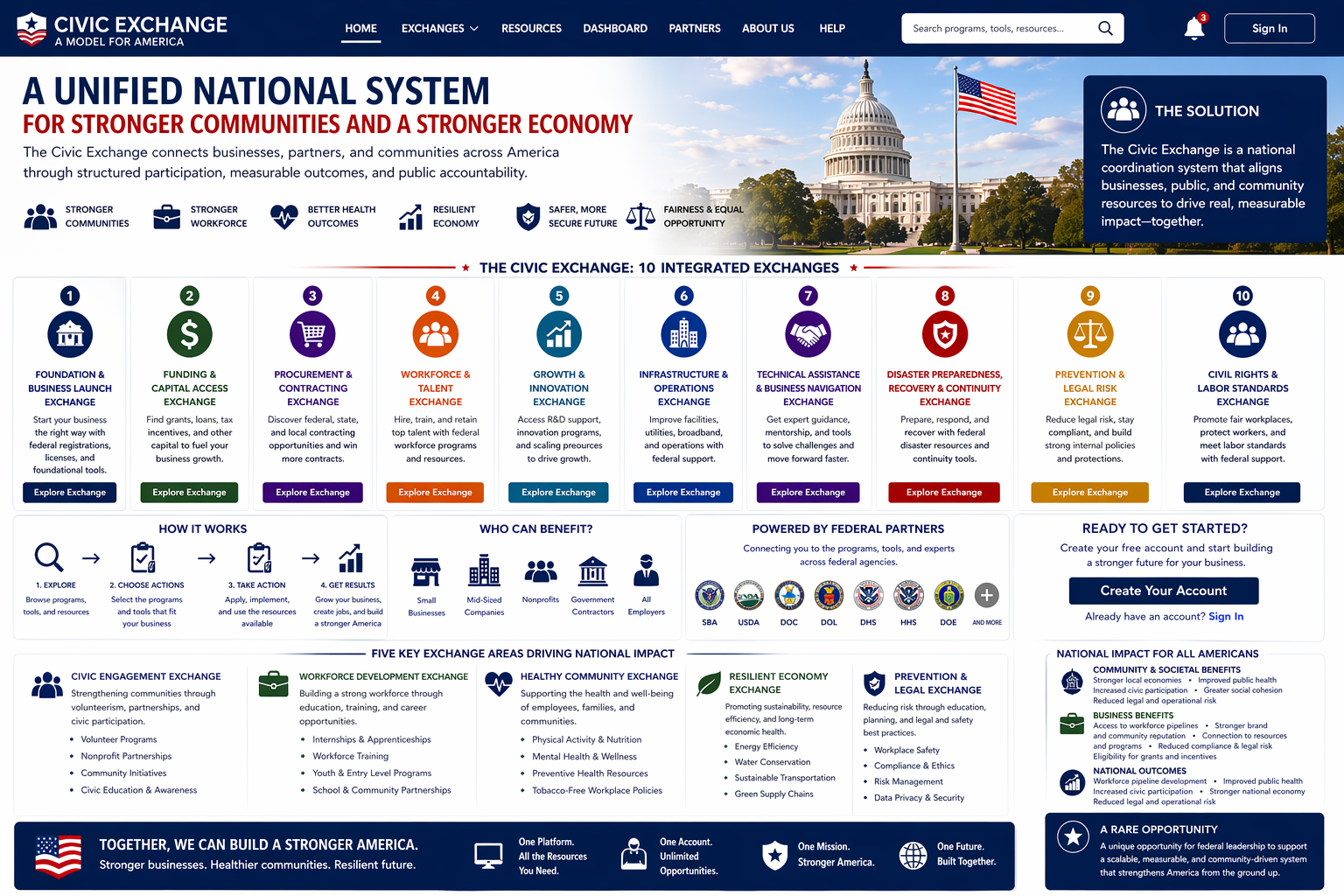
A National Model for Connecting Businesses, Government, and Communities
The Civic Exchange is an idea for a national platform that could make it easier for businesses to connect with government resources, public programs, funding opportunities, workforce support, compliance guidance, and community partnership opportunities in one organized place. The purpose of the idea is simple: many useful public resources already exist, but they are often spread across different agencies, websites, programs, and systems. For many businesses, especially small and mid sized businesses, knowing where to start can be difficult.
This idea would create a single, structured civic access point where businesses could better understand what resources are available, what opportunities they may qualify for, and how they can participate in broader economic and community goals. Instead of asking businesses to search across many disconnected systems, the Civic Exchange would organize those opportunities into clear categories that are easier to understand and act on.
The concept is organized around ten core exchange areas, each representing a major way businesses interact with government and community priorities. These could include business formation, access to capital, procurement and contracting, workforce development, infrastructure, innovation, public health, sustainability, emergency preparedness, and regulatory compliance. Businesses could select what they are already doing, what they need help with, and where they may be willing to contribute in the future.
From a public leadership perspective, the idea could also help government better understand economic and civic activity already happening across the country, states, regions, and local communities. If businesses voluntarily shared information through a structured platform, public leaders could see where engagement is strong, where resources are being used, where gaps exist, and where additional outreach may be needed. Over time, this could create a useful data layer for decision making, grant planning, program alignment, and public reporting.
The Civic Exchange idea is not about creating new mandates or replacing existing programs. It is about organizing what already exists into a more useful, visible, and measurable system. Businesses would participate voluntarily, and government would benefit from a clearer picture of participation, needs, and opportunities.
At its core, this is a practical public service idea. It is a way to make government resources easier to find, make business participation easier to understand, and help public leaders see how existing programs and partnerships are contributing to economic growth and community impact.
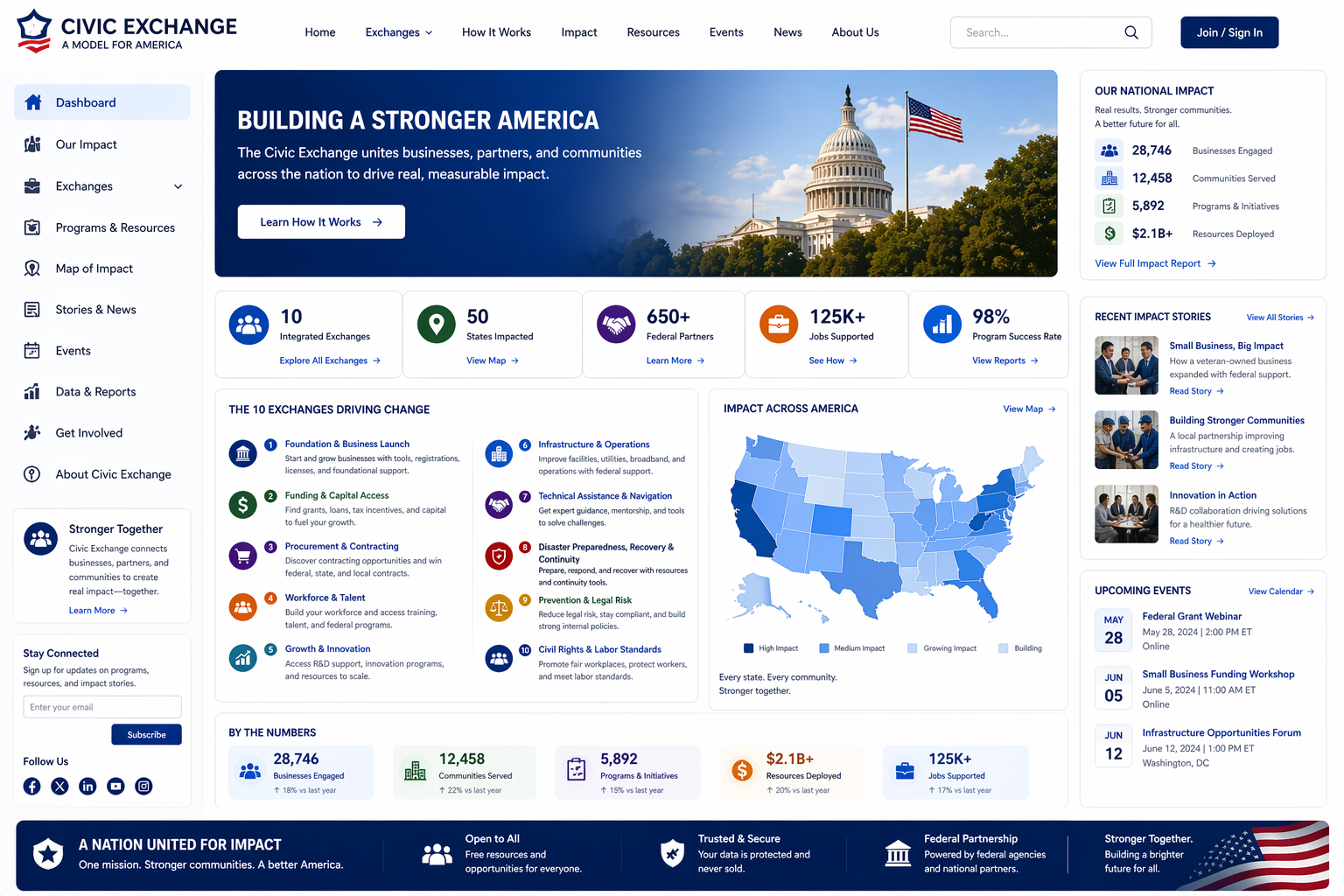
How a Public Dashboard Could Make the Civic Exchange Idea More Useful
A public dashboard could be one of the most important parts of the Civic Exchange idea because it would make progress easier to see, understand, and explain. Instead of relying only on scattered reports, delayed updates, or individual success stories, communities could have a clearer picture of what is happening across key areas such as job creation, workforce development, small business support, health initiatives, sustainability, volunteer service, local investment, and community partnerships. The goal would not be to create a complicated reporting system. The goal would be to make public progress more visible, practical, and understandable.
For residents, this kind of dashboard could help build trust. People often hear about programs, initiatives, investments, and partnerships, but they do not always see how those efforts connect to real outcomes. A dashboard could show where progress is happening, where needs remain, and how businesses, nonprofits, schools, health organizations, and government agencies are contributing. This could help residents better understand how public priorities are being acted on, not just announced.
For businesses, the dashboard could provide both clarity and recognition. It would give organizations a way to see how their work connects to larger economic and community goals. A business that supports internships, employee wellness, local hiring, volunteer service, sustainability, emergency preparedness, or community giving could have its efforts counted as part of a broader civic picture. This could strengthen public trust, improve reputation, support employee recruitment and retention, and help businesses identify new partnership opportunities.
For elected officials and public leaders, the dashboard could become a practical decision making tool. It could help show which programs are reaching businesses, which areas are seeing strong participation, where gaps exist, and where more outreach may be needed. Over time, this could support better planning, stronger grant applications, more targeted resource allocation, and clearer communication with the public. Instead of relying only on fragmented information, leaders could have a more consistent view of what is working and where coordinated action could make a bigger difference.
The larger value of the dashboard is that it could turn the Civic Exchange idea from a simple access point into a measurable public service framework. It would not just help businesses find resources. It could also help communities understand participation, track progress, recognize contributions, and make better decisions. In that sense, the dashboard would help answer a simple but important public question: what are we actually improving together?
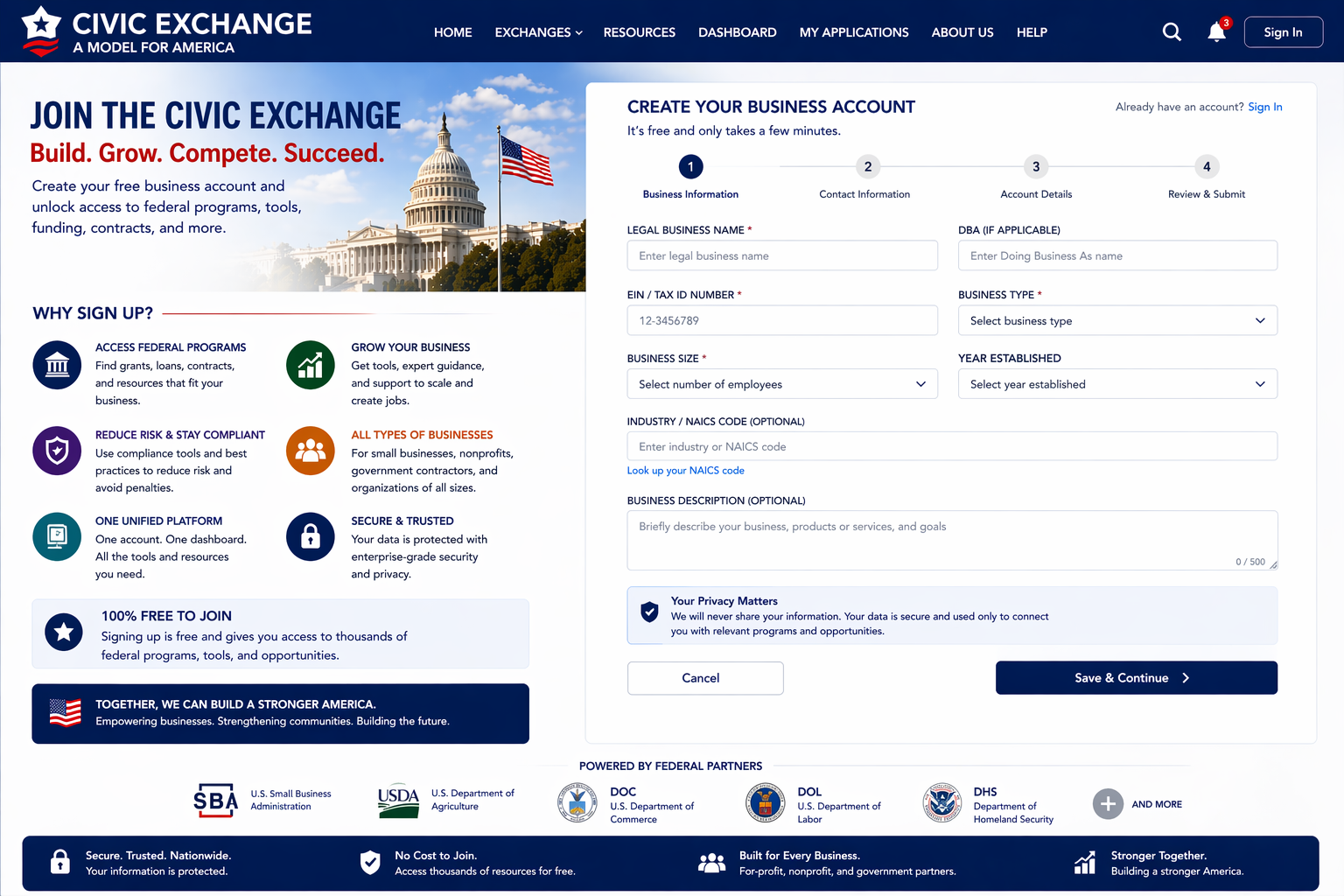
How Businesses Could Participate in the Civic Exchange Idea
This part of the Civic Exchange idea focuses on how businesses could enter the platform, why they might choose to participate, and how their involvement could strengthen the larger model. At its core, the idea is to create a simpler national access point where businesses could connect with public resources, partnership opportunities, and community impact efforts in one organized place. Instead of navigating many disconnected programs, agencies, websites, and initiatives, businesses would have a clearer starting point for finding opportunities that match their needs, goals, and capacity.
The sign up process would be designed to be simple and low burden. A business could provide basic information, select the areas it is interested in, and identify how it may want to participate. This matters because the platform would need to be accessible to businesses of different sizes, industries, and levels of capacity. A small business might be interested in workforce support, access to capital, or technical assistance. A larger employer might be interested in internships, employee volunteerism, sustainability, emergency preparedness, or community partnerships. The goal would be to let each business engage in ways that are realistic and relevant.
The sign up process would also serve a larger purpose. It would not only collect contact information. It could capture what businesses are already doing, what they need help with, and where they may be willing to contribute in the future. That distinction is important because it gives public leaders a better understanding of both current activity and future opportunity. For example, a business may already offer internships, support employee wellness, donate to local organizations, or participate in sustainability efforts. Another business may not be doing those things yet, but may be open to learning more if the right opportunity is presented.
For businesses, the value would come from clarity, connection, and recognition. They could find verified opportunities more easily, connect with government and nonprofit partners, and better understand how their efforts fit into broader economic and community priorities. Participation could also support their own goals, including employee engagement, public reputation, recruitment, retention, community relations, and long term growth. In this way, the Civic Exchange idea would not ask businesses to do something separate from their mission. It would help them connect what they already care about with the needs of the communities they serve.
From a system perspective, business participation is what would make the model useful and measurable. Each business that signs up would add to a broader picture of activity, needs, and potential partnerships. Over time, that information could support public dashboards, better outreach, stronger grant applications, and more targeted decision making. More participation would create better data. Better data would create stronger insights. Stronger insights would help public leaders, businesses, and community partners coordinate more effectively.
In practical terms, the sign up process would be more than an onboarding form. It would be the front door to the Civic Exchange idea. It would help businesses understand where they fit, help government see what is happening, and help communities identify where coordinated action could make the greatest difference.
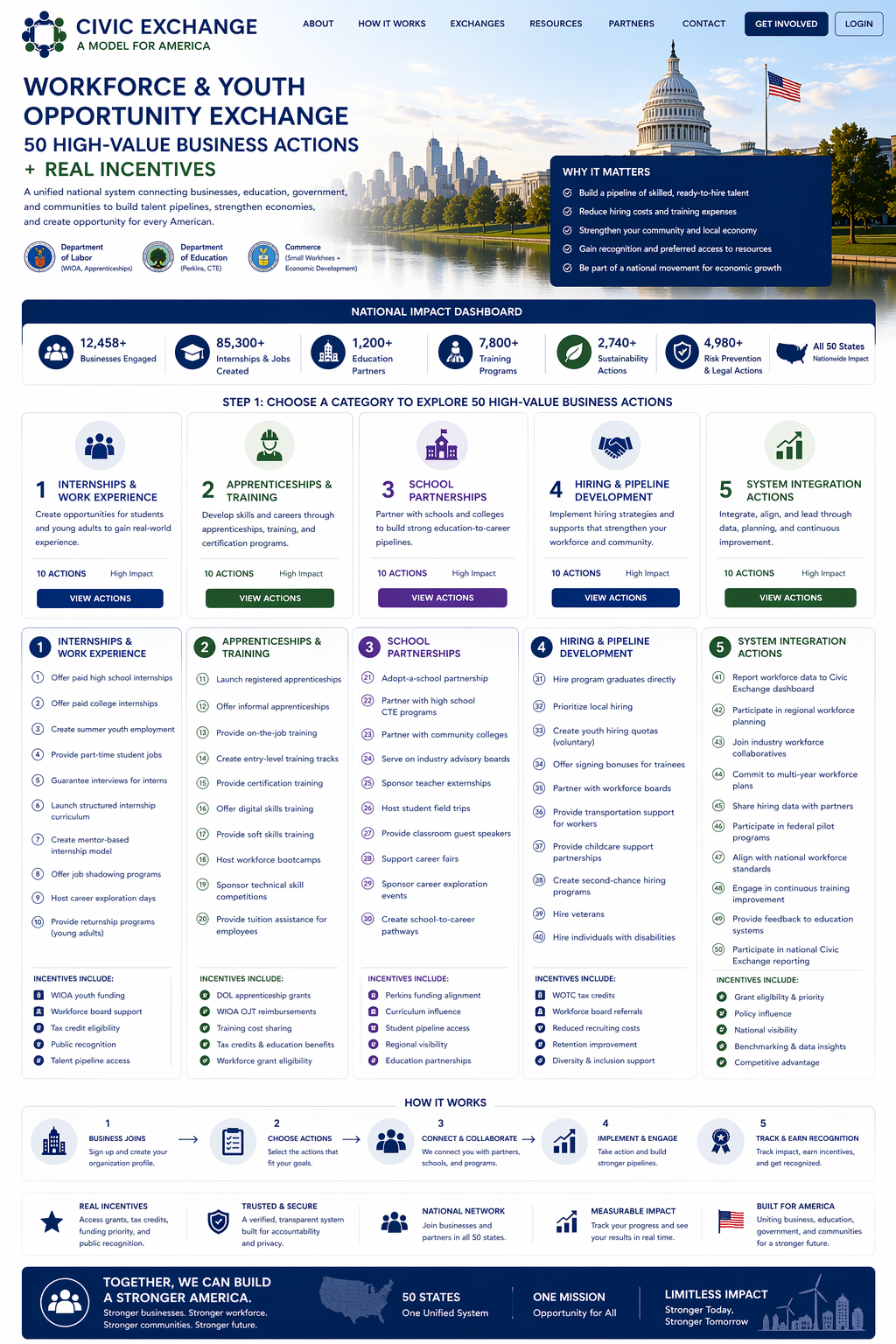
How a Workforce and Youth Opportunity Exchange Could Work
The Workforce and Youth Opportunity Exchange is an idea for making it easier for businesses to connect with existing workforce, education, apprenticeship, and employer support programs in one organized place. The federal government already has many of the pieces needed to support employers, workers, students, and young people. The challenge is that those pieces are often spread across different agencies, websites, eligibility rules, workforce boards, schools, and grant programs. This idea would not replace those programs. It would organize them into a simpler, more business friendly front door.
At the center of the idea would be a one stop platform where a business could create a profile, enter its location, industry, size, hiring needs, and workforce interests, and then receive a customized menu of actions. A small manufacturer might see options related to apprenticeships, community college partnerships, workforce training support, and local workforce board contacts. A healthcare employer might see clinical pathway partnerships, youth career exposure programs, incumbent worker training, and hiring incentives. A construction company might see registered apprenticeship resources, veterans hiring support, and pre apprenticeship partners.
The exchange could be built around existing federal and local workforce systems. The Department of Labor would be a natural foundation because it already supports workforce programs connected to training, employer services, apprenticeships, and work based learning. Apprenticeship.gov and the Registered Apprenticeship system could be integrated so businesses could more easily understand how to launch an apprenticeship, find technical assistance, identify funding options, and connect with the right state or local contacts.
The youth opportunity side of the exchange could help businesses connect with high schools, community colleges, technical education programs, summer employment programs, internships, mentorships, job shadowing, and youth apprenticeship opportunities. Instead of schools and workforce boards having to reach out to employers one by one, the platform could create a more structured marketplace for education to career partnerships. Businesses could select what they are already doing, what they need help with, and where they may be willing to participate in the future.
A major strength of the idea is that it could connect business actions directly to incentives and support. For example, if an employer selected “start an apprenticeship,” the platform could show apprenticeship consultants, funding opportunities, tuition support, state resources, and local workforce partners. If a business selected “hire workers facing barriers,” the platform could connect that action to hiring incentives, workforce partners, veterans programs, disability employment resources, second chance hiring support, or youth employment opportunities.
This idea could also help small businesses participate. Many small employers may want to hire, train, mentor, or partner with schools, but they do not have large human resources departments or government relations staff. A simple exchange could guide them to Small Business Development Centers, SCORE mentors, workforce boards, apprenticeship support, and other local partners that can help them take practical next steps.
From a public leadership perspective, the exchange could create a clearer picture of workforce activity across the country. If businesses voluntarily report participation in areas like internships, apprenticeships, school partnerships, incumbent worker training, hiring incentives, and youth employment, federal, state, and local leaders could better understand where engagement is strong and where gaps remain. This could support better planning, stronger grant applications, more targeted outreach, and more accountable public reporting.
The dashboard connected to the exchange could show practical measures such as the number of businesses participating, internships created, apprenticeships launched, sectors engaged, youth opportunities offered, workers trained, veterans hired, and regions needing additional support. This would help move workforce development from scattered program reporting to a more unified view of what is happening.
The value for businesses would be simplicity. They would not need to know which agency manages which program. They would only need to know what they want to do: hire, train, partner with schools, launch apprenticeships, offer internships, or recruit from new talent pools. The exchange would then help guide them to the right programs, partners, incentives, and next steps.
The value for students and workers would be clearer access to real opportunity. Career pathways should not depend only on whether a school, employer, or workforce board happens to have the right relationship. A better organized exchange could help make work based learning, training, and hiring opportunities more visible, especially for young people, rural communities, low income workers, veterans, people with disabilities, and individuals reentering the workforce.
At its core, the Workforce and Youth Opportunity Exchange is a practical public service idea. It does not require inventing an entirely new workforce system. It is about making the existing system easier to find, easier to use, easier to coordinate, and easier to measure.
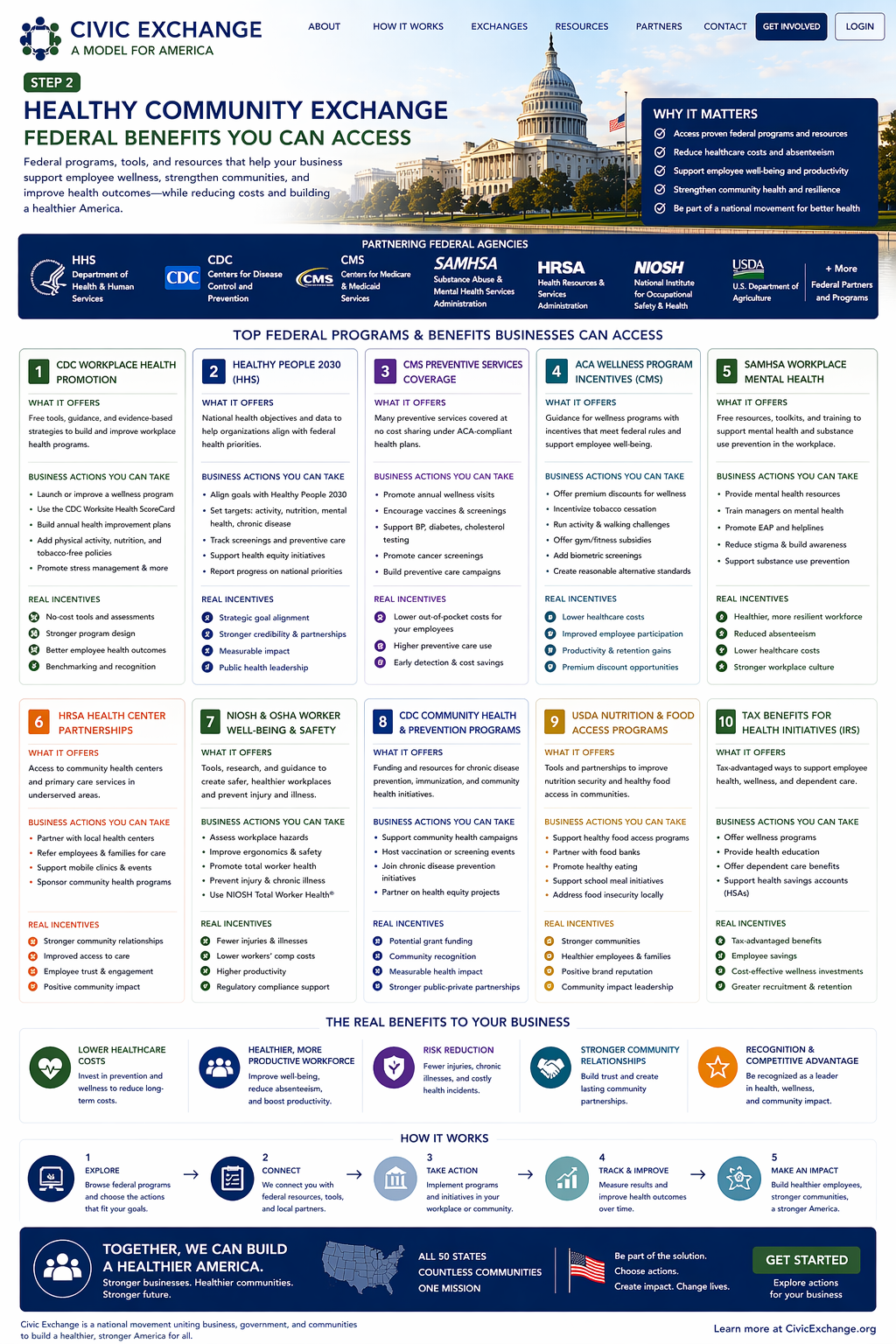
How a Healthy Community Exchange Could Work
The Healthy Community Exchange is an idea for making it easier for businesses to connect with existing health, prevention, nutrition, mental health, environmental health, and community wellbeing programs in one organized place. The federal government already supports many programs that touch community health, but those programs are often spread across different agencies, websites, funding streams, eligibility rules, and local partners. The goal of this idea would not be to create a new health system. It would be to make the existing system easier to find, easier to use, and easier to coordinate.
At its core, the Healthy Community Exchange could serve as a one stop access point for businesses that want to support healthier employees, stronger communities, and better local outcomes. A business could create one profile, enter basic information such as location, industry, size, workforce needs, and community interests, and then receive a customized set of possible actions. These actions could include supporting employee wellness, improving mental health access, promoting healthy food access, partnering with local health departments, supporting maternal and child health efforts, reducing environmental health risks, preparing for public health emergencies, or helping with community outreach.
The exchange could organize these opportunities into clear categories so businesses do not have to guess where to begin. A small employer might see resources related to workplace wellness, mental health support, tobacco prevention, healthy food access, and local health department partnerships. A grocery store might see opportunities related to nutrition access, food donation, emergency preparedness, and community health campaigns. A manufacturer might see actions connected to workplace safety, environmental health, employee health screenings, and resilience planning.
The federal role would be coordination, not control. The platform could bring together existing programs and resources from health, labor, agriculture, environmental, emergency preparedness, and small business systems. It would act as a front door that helps businesses find the right path, while existing agencies and local partners would continue operating their programs. In this way, the exchange would not replace public health departments, nonprofits, hospitals, schools, or federal agencies. It would help connect businesses to them more effectively.
A major strength of the idea is that it could connect business actions directly to available support. If a business selected “support employee mental health,” the platform could show relevant toolkits, local partners, training resources, grant opportunities, or workplace programs. If a business selected “support healthy food access,” it could be connected to food banks, nutrition programs, community organizations, schools, or local health initiatives. If a business selected “improve emergency preparedness,” it could be connected to public health preparedness resources, continuity planning guidance, and local emergency partners.
The exchange could also help public health agencies build stronger relationships with the business community. Many health departments want to engage employers around prevention, wellness, emergency preparedness, chronic disease, food access, mental health, and community needs, but business outreach can be difficult and time consuming. A structured exchange would give businesses a clearer way to indicate what they are already doing, what they need help with, and where they may be open to future partnership.
Standardization would be important. The platform could define common categories for health related business actions so participation can be understood across cities, counties, states, and sectors. For example, actions could be grouped around employee health, mental health, food access, prevention, emergency preparedness, environmental health, maternal and child health, and community partnerships. This would allow public leaders to see patterns without forcing businesses into a complicated reporting system.
The dashboard connected to the exchange could show practical measures such as the number of businesses participating, health initiatives supported, employees reached, community partnerships created, food access efforts supported, preparedness actions completed, and regions where additional outreach may be needed. This kind of data could help inform Community Health Assessments, grant planning, resource coordination, public reporting, and future partnership development.
For businesses, the value would be simplicity and relevance. They would not need to understand every public health program or agency structure. They would only need to identify what they care about: employee wellness, mental health, food access, community service, emergency preparedness, local partnerships, or environmental health. The exchange would then help guide them to the right resources, partners, and next steps.
For residents, the value would be stronger community health connections. When businesses participate in prevention, wellness, food access, mental health, emergency preparedness, and local partnerships, those efforts can support healthier communities. The exchange could help make that work more visible, more coordinated, and more connected to actual community needs.
For government and public health leaders, the value would be better visibility. Instead of relying only on scattered outreach, separate grant reports, or informal relationships, leaders could see where businesses are engaging, where gaps remain, and where partnerships could be strengthened. This could support better planning, stronger funding applications, and more credible reporting on community health progress.
At its core, the Healthy Community Exchange is a practical public service idea. It would not add new mandates or create a new compliance burden. It would organize existing health and community resources into a clearer system, help businesses participate more easily, and give public leaders better information about what is happening across communities. Its purpose would be simple: make it easier for businesses, government, and community partners to work together on health.
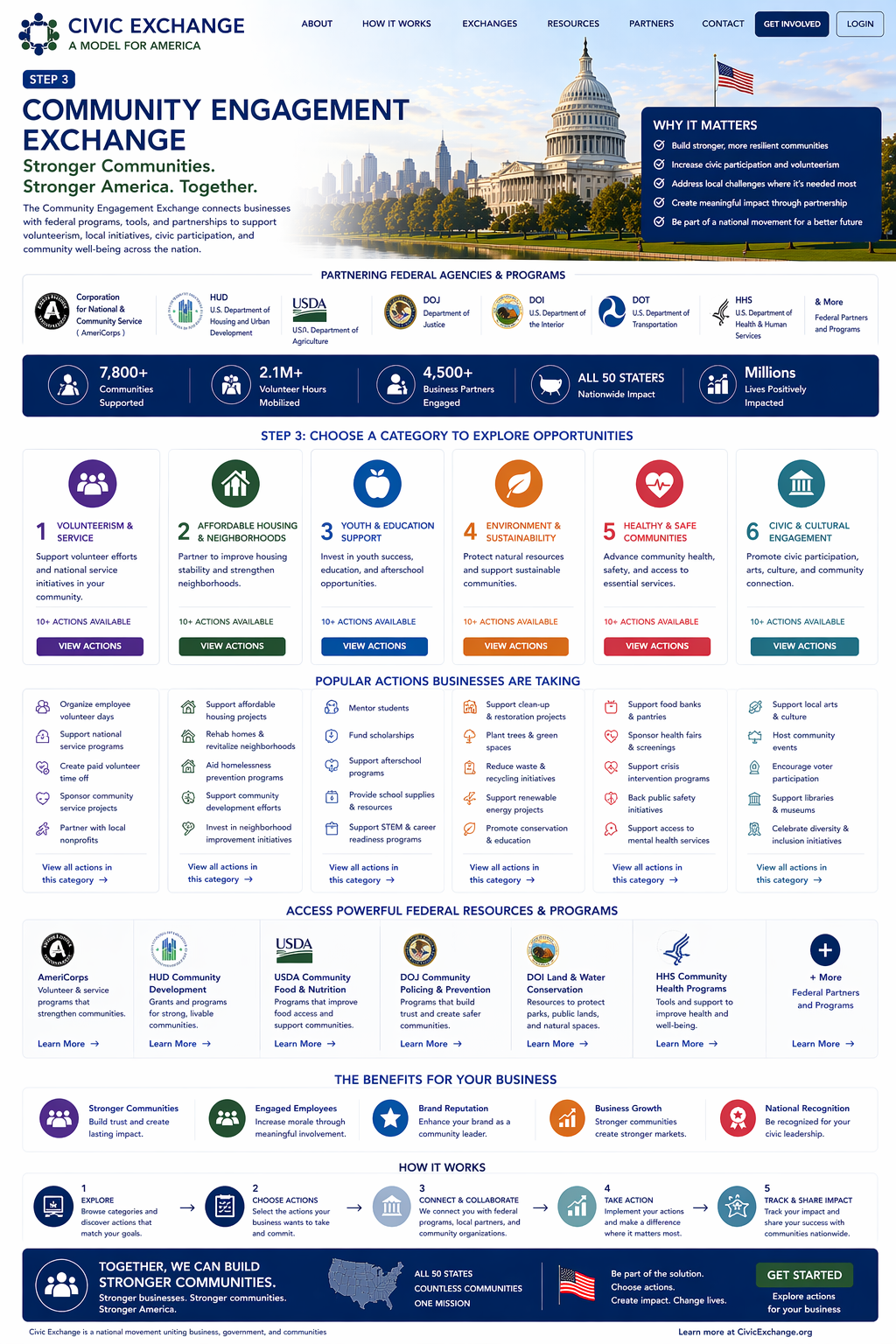
How a Community Engagement Exchange Could Work
The Community Engagement Exchange is an idea for making it easier for businesses to support civic life, volunteer service, housing, youth development, neighborhood improvement, public safety, and community based partnerships in one organized place. Many businesses want to help their communities, but they often do not know where to start, who to contact, or which opportunities are most useful. At the same time, many nonprofits, local governments, schools, and community organizations need stronger connections with the business community. This idea would help bring those pieces together in a more structured and practical way.
The goal would not be to create a new federal program or replace local organizations. The goal would be to create a clearer front door where businesses could find existing opportunities and connect with the right partners. Today, community engagement is often fragmented across nonprofits, local initiatives, volunteer networks, housing programs, youth programs, faith based organizations, schools, and government agencies. A Community Engagement Exchange could organize those opportunities into one easier to use platform.
A business could create a profile, enter its location, industry, size, interests, and capacity, and then receive a customized list of possible community actions. Those actions could include employee volunteerism, mentoring young people, supporting after school programs, partnering with local nonprofits, helping with affordable housing efforts, supporting neighborhood revitalization, contributing to public safety and prevention efforts, participating in food drives, sponsoring civic events, or supporting environmental and cultural projects.
The platform could organize these opportunities into clear categories so businesses do not have to interpret vague requests to “get involved.” For example, the exchange could include sections for volunteer service, youth and education, housing and neighborhood development, healthy and safe communities, civic and cultural engagement, rural community support, environmental projects, and nonprofit partnerships. Each category would include specific actions businesses could take, along with local partners, available resources, and possible next steps.
A major strength of the idea is that it would connect business participation to existing community infrastructure. Businesses would not need to invent new programs from scratch. They could plug into efforts that already exist but may need more volunteers, funding, visibility, technical support, donated services, or employer partnerships. This could make community engagement more efficient because businesses would be guided toward real needs instead of one time or disconnected efforts.
The federal role would be coordination, not control. A national version of this idea could help organize existing civic, service, housing, rural development, health, education, and community programs into a more accessible structure. Federal agencies and national service programs could provide resources and guidance, while local governments, nonprofits, schools, and community organizations would remain the primary partners for implementation. This would keep the model grounded in local needs while still benefiting from national coordination.
For businesses, the value would be simplicity, credibility, and visibility. Instead of trying to figure out which nonprofit to contact or which community issue to support, businesses could identify the areas that match their values and capacity. They could also better understand how their efforts fit into broader community priorities. Participation could support employee engagement, recruitment, retention, public reputation, customer trust, and stronger relationships with local leaders.
For nonprofits and local organizations, the exchange could create a more reliable pipeline of business partners. Many organizations spend significant time trying to find volunteers, sponsors, mentors, donors, board members, event partners, and employer connections. A structured platform could help match those organizations with businesses already interested in helping. This could reduce outreach burden and make partnerships more targeted and useful.
For communities, the benefit would be stronger coordination. Instead of businesses acting separately and organizations competing for attention, the exchange could make community needs and opportunities more visible. It could help show where volunteer support is available, which neighborhoods need more investment, which youth programs need employer partners, which housing efforts need support, and where local organizations could benefit from stronger business involvement.
The dashboard connected to the exchange could track practical measures such as volunteer hours, businesses participating, nonprofit partnerships formed, youth mentoring opportunities created, community projects supported, housing related partnerships, populations reached, and regions where more engagement is needed. This would help public leaders and community partners understand not just who is participating, but where participation is making a difference.
The idea could also help elected officials and public agencies communicate progress more clearly. Instead of relying only on scattered stories or separate program reports, leaders could see a more consistent picture of civic engagement across communities. That could support better planning, stronger grant applications, improved public reporting, and more targeted outreach to businesses and community partners.
At its core, the Community Engagement Exchange is a practical public service idea. It would help businesses find meaningful ways to serve, help nonprofits and local organizations connect with support, and help government better understand where civic engagement is happening. The larger purpose is simple: make it easier for businesses, government, and community partners to work together on the needs that matter most.
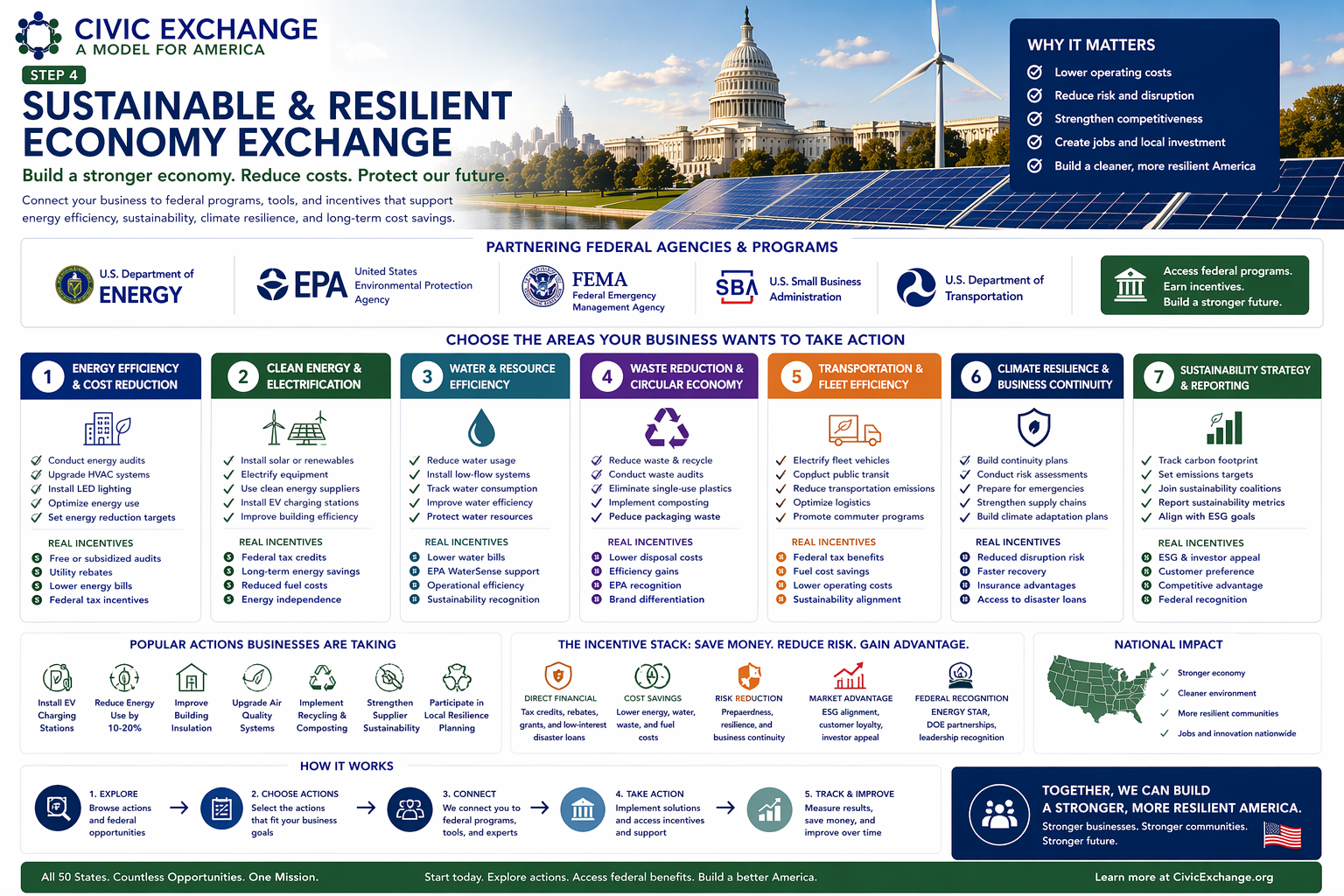
How a Sustainable and Resilient Economy Exchange Could Work
The Sustainable and Resilient Economy Exchange is an idea for making it easier for businesses to connect with existing energy, environmental, infrastructure, cost saving, and resilience resources in one organized place. Many businesses want to reduce costs, improve efficiency, prepare for disruption, and operate more sustainably, but the resources that can help them are often spread across different agencies, websites, tax incentives, grant programs, technical assistance providers, and local partners. This idea would bring those opportunities into a clearer, more business friendly structure.
The goal would not be to create a new federal sustainability program. The goal would be to organize what already exists into a practical one stop access point. Businesses could use the exchange to find resources related to energy efficiency, clean energy, water use, waste reduction, transportation, supply chains, climate resilience, and business continuity. Instead of asking businesses to navigate separate systems on their own, the platform could guide them toward the programs, incentives, and partners that match their needs.
A business could create a profile, enter its location, industry, size, facilities, transportation needs, energy concerns, and resilience priorities, and then receive a customized set of possible actions. A small restaurant might see opportunities related to energy efficient equipment, food waste reduction, water savings, utility rebates, and emergency preparedness. A manufacturer might see options related to energy audits, equipment upgrades, emissions reduction, waste management, supply chain resilience, and continuity planning. A logistics company might see resources related to fleet efficiency, electric vehicles, charging infrastructure, route optimization, and fuel cost reduction.
The exchange could organize sustainability and resilience into clear business actions. Instead of using broad language like “go green,” the platform could present practical steps such as conduct an energy audit, upgrade lighting or HVAC systems, reduce water use, improve recycling, reduce waste, electrify fleet vehicles, install renewable energy, strengthen supply chains, develop a continuity plan, or assess climate related operational risks. Each action could be connected to relevant programs, incentives, technical guidance, and local support.
A major strength of the idea is that it connects sustainability to business value. Many companies may be interested in environmental responsibility, but they are also focused on costs, operations, risk, customers, and long term growth. This exchange could show that sustainability is not only about environmental goals. It can also mean lower utility bills, reduced fuel costs, better risk management, stronger supply chains, fewer disruptions, improved reputation, and better market positioning.
The federal role would be coordination, not control. A national version of this idea could bring together existing resources from energy, environmental, transportation, emergency management, infrastructure, and small business systems. Federal agencies could provide program information, incentives, standards, guidance, and technical assistance pathways, while state agencies, utilities, local governments, chambers, economic development organizations, and community partners could help businesses implement specific actions.
The incentive layer would be especially important. If a business selected “upgrade energy systems,” the platform could show relevant tax credits, rebates, grants, utility programs, financing options, and technical assistance. If a business selected “improve resilience,” it could be connected to continuity planning tools, emergency preparedness resources, insurance related guidance, local emergency managers, and resilience partners. If a business selected “electrify fleet vehicles,” it could see charging infrastructure resources, tax incentives, financing options, and transportation planning support.
For businesses, the value would be simplicity and practicality. They would not need to understand which agency manages which program. They would only need to identify what they want to improve: energy costs, water use, waste, transportation, resilience, supply chains, or long term sustainability. The exchange would then help guide them to the right resources, partners, incentives, and next steps.
For public leaders, the exchange could create a clearer view of sustainability and resilience activity across regions and sectors. If businesses voluntarily report actions such as energy audits completed, equipment upgrades made, renewable energy projects launched, water savings efforts started, waste reduction plans adopted, fleet improvements made, or resilience plans created, leaders could better understand where progress is happening and where gaps remain.
The dashboard connected to the exchange could track practical measures such as businesses participating, energy efficiency projects started, clean energy actions completed, water reduction efforts, waste reduction efforts, fleet upgrades, resilience plans, cost savings estimates, and regions needing additional outreach. This could support better planning, grant applications, infrastructure strategy, economic development, environmental reporting, and public accountability.
For communities, the value would be a stronger and more resilient local economy. Businesses that reduce energy costs, prepare for disruptions, manage resources better, and strengthen operations are more likely to remain stable during economic, environmental, or infrastructure challenges. That matters for jobs, local services, supply chains, and long term community wellbeing.
The exchange could also help sustainability become more accessible to small and mid sized businesses. Larger companies often have staff or consultants who can navigate incentives, reporting, and technical programs. Smaller businesses may not. A structured platform could reduce that gap by making the first steps clearer and connecting businesses to support they may not know exists.
At its core, the Sustainable and Resilient Economy Exchange is a practical public service idea. It would not add new mandates or create a new compliance burden. It would help organize existing sustainability and resilience resources into a clearer system, make participation easier for businesses, and give public leaders better information about what is happening across the economy. The larger purpose is simple: help businesses save money, reduce risk, strengthen operations, and contribute to a more resilient future.
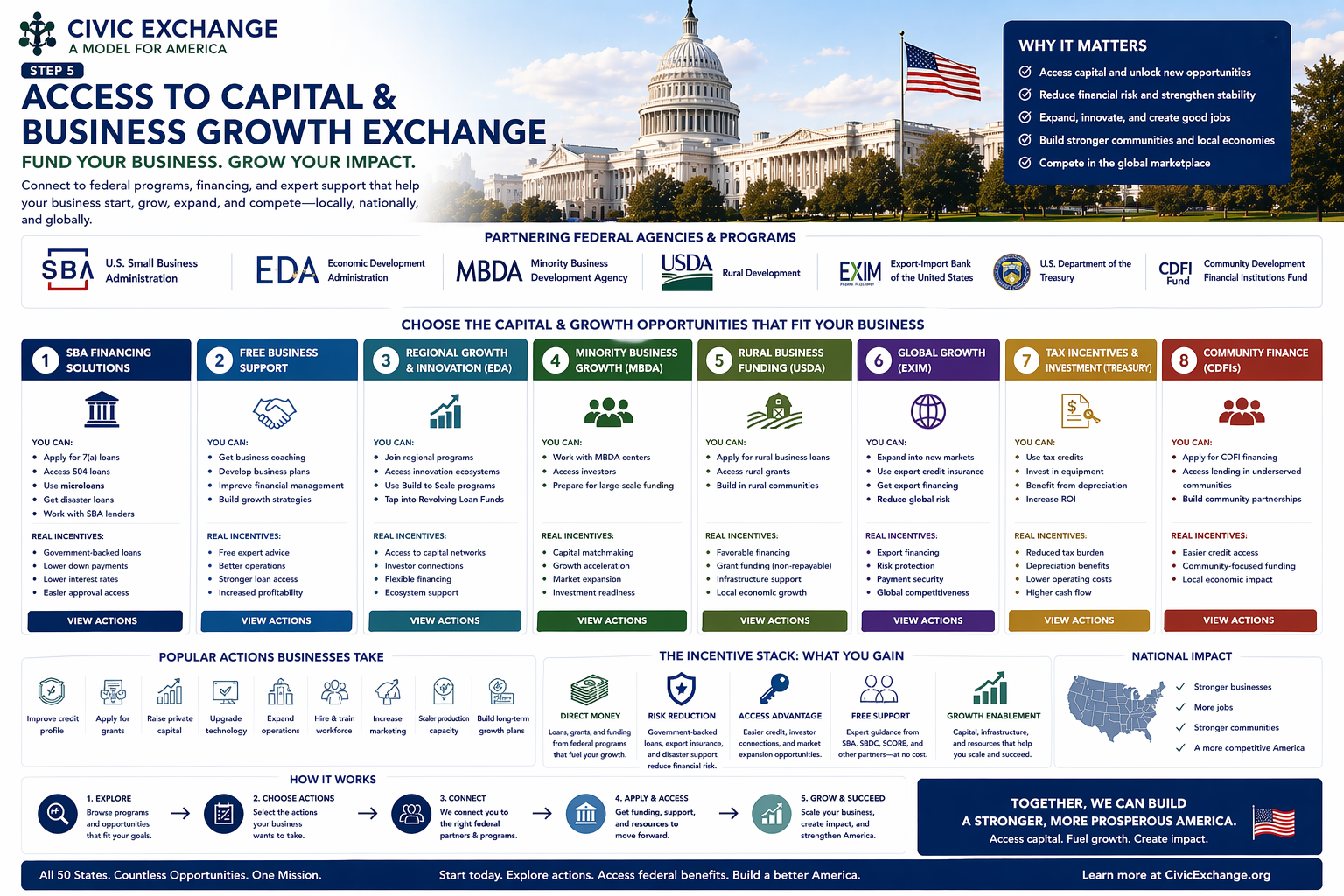
How an Access to Capital and Business Growth Exchange Could Work
The Access to Capital and Business Growth Exchange is an idea for making it easier for businesses to find financing, advisory support, lender connections, investment tools, and growth resources in one organized place. Access to capital is one of the most important parts of business growth, but it is also one of the most confusing. Many businesses have to navigate different agencies, loan programs, grant opportunities, lenders, tax incentives, technical assistance providers, and eligibility rules without a clear starting point. This idea would bring those pathways into a simpler, more business friendly structure.
The goal would not be to create a new financing agency or replace existing programs. The goal would be to organize what already exists into a clearer front door for businesses. A business owner could use the exchange to better understand which financing options may fit their needs, which support partners can help them prepare, and which growth opportunities may be available based on their size, location, industry, and stage of development.
A business could create a profile, enter basic information about its location, industry, number of employees, revenue stage, growth goals, financing needs, and challenges, and then receive a customized menu of possible next steps. A startup might see resources related to business planning, microloans, mentorship, and local startup support. A growing manufacturer might see options related to equipment financing, workforce expansion, export assistance, tax incentives, and regional economic development programs. A rural business might see USDA related resources, local lenders, technical assistance, and community based financing partners.
The exchange could organize capital access into clear business actions. Instead of asking business owners to search through disconnected programs, the platform could present practical steps such as prepare for a loan, connect with a lender, apply for a microloan, explore SBA financing, improve financial readiness, seek technical assistance, pursue export support, identify grant opportunities, or connect with community development lenders. Each action could be connected to relevant programs, partners, eligibility information, and next steps.
A major strength of the idea is that it would connect financing with guidance. Many businesses do not just need money. They need help understanding what type of capital is appropriate, how to prepare financial documents, how to improve credit readiness, how to build a business plan, how to manage growth, and how to reduce risk. The exchange could connect businesses to partners such as Small Business Development Centers, SCORE mentors, community lenders, economic development organizations, and other advisory networks.
The federal role would be coordination, not control. A national version of this idea could help organize existing resources from small business, economic development, rural development, export, tax, community finance, and minority business development systems. Existing agencies and partners would continue managing their own programs. The exchange would simply make those programs easier to find, compare, and use.
The platform could also make access more inclusive. Many small businesses, rural businesses, minority owned businesses, women owned businesses, veteran owned businesses, and businesses in underserved communities face additional barriers to capital. The exchange could help route businesses toward programs and lenders designed to support their needs, including community development financial institutions, rural development tools, technical assistance providers, and targeted business support programs.
For businesses, the value would be clarity, access, and confidence. They would not need to know which agency manages which program or which lender is the best starting point. They would only need to identify what they are trying to do: start, stabilize, expand, purchase equipment, hire workers, enter new markets, recover from disruption, or improve financial readiness. The exchange would then help guide them to the right resources, partners, financing options, and next steps.
For public leaders, the exchange could create a clearer picture of where business growth is happening and where gaps remain. If businesses voluntarily report interest in financing, technical assistance, export growth, hiring, equipment investment, or expansion, leaders could better understand which regions and sectors need support. This could help improve outreach, economic development planning, grant applications, and program alignment.
The dashboard connected to the exchange could track practical measures such as businesses seeking capital, financing pathways used, technical assistance connections made, loans or grants accessed, jobs created, businesses expanded, rural businesses supported, underserved businesses reached, and sectors showing growth potential. This would help move capital access from scattered program reporting to a more unified view of economic development activity.
For lenders and support organizations, the exchange could also create a better pipeline of prepared businesses. Instead of businesses reaching out without knowing what they need, the platform could help them understand basic readiness steps before connecting them to lenders, advisors, or agencies. That could improve the quality of referrals and make the system more efficient for everyone involved.
For the broader economy, the value would be stronger business formation, expansion, job creation, innovation, and competitiveness. When businesses can access the right financing and guidance at the right time, they are better positioned to grow, hire, invest in technology, enter new markets, and remain resilient during economic disruption.
At its core, the Access to Capital and Business Growth Exchange is a practical economic development idea. It would not add new mandates or create a new layer of bureaucracy. It would organize existing financing and growth resources into a clearer system, help businesses find the support they need, and give public leaders better information about where economic opportunity is growing. The larger purpose is simple: make it easier for businesses to access capital, use it wisely, and grow in ways that strengthen communities.
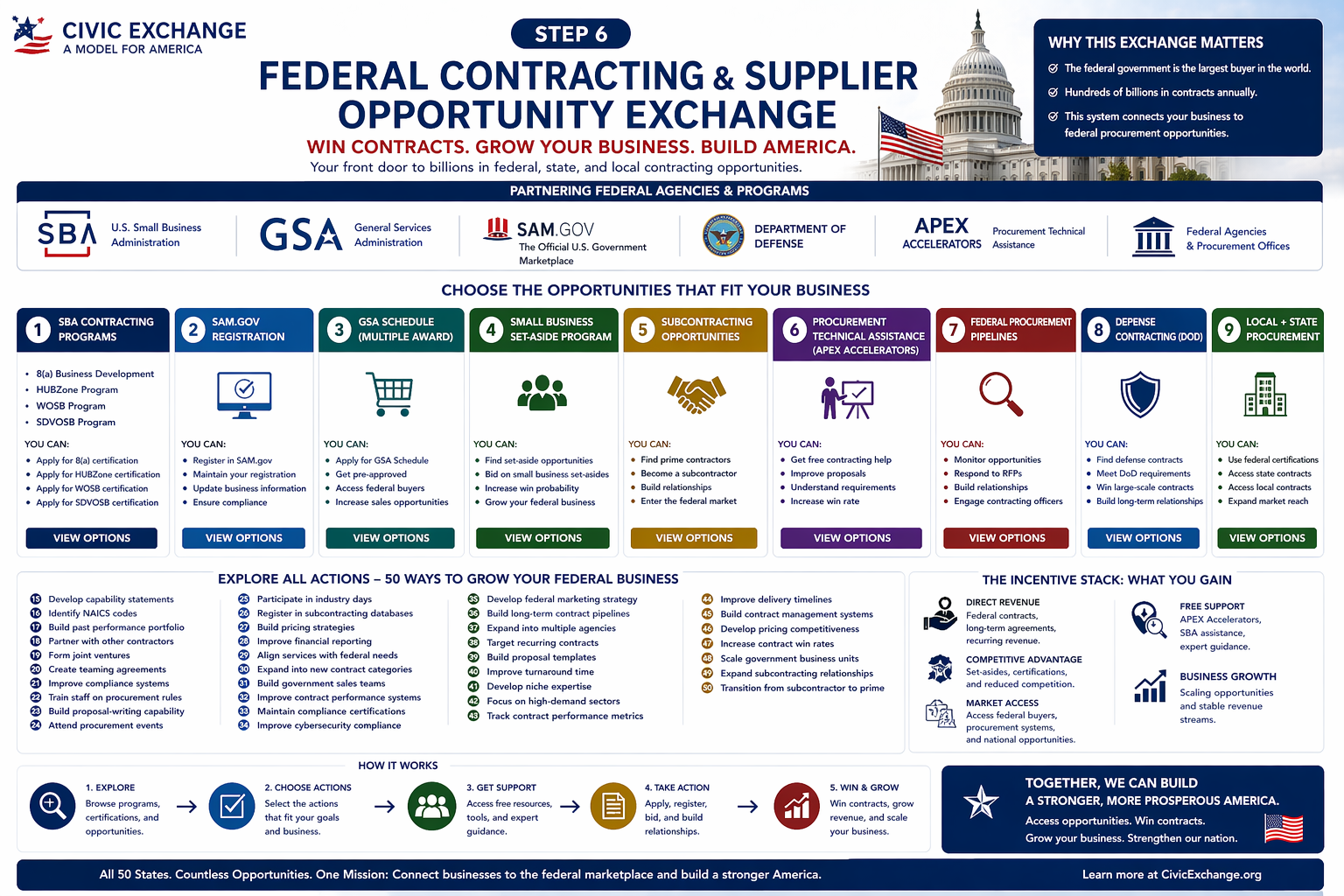
How a Federal Contracting and Supplier Opportunity Exchange Could Work
The Federal Contracting and Supplier Opportunity Exchange is an idea for making it easier for businesses to understand, enter, and grow within the government contracting system. Federal contracting can be one of the largest economic opportunities available to businesses, but it is also complex, technical, and difficult to navigate, especially for small and mid sized companies. Many businesses do not know where to start, how to register, which certifications matter, how to find opportunities, or how to compete effectively. This idea would organize those steps into a clearer, more business friendly pathway.
The goal would not be to replace existing procurement systems or create a new contracting agency. The goal would be to make the existing system easier to access and understand. A business could use the exchange as a one stop guide for registration, certifications, contracting opportunities, subcontracting, technical assistance, proposal support, and supplier development.
A business could create a profile, enter its industry, location, size, ownership status, services, products, past experience, and growth goals, and then receive a customized contracting pathway. A small construction company might see steps related to registration, local subcontracting opportunities, bonding support, and certification options. A technology company might see federal buyer categories, cybersecurity requirements, proposal support, and agency opportunities. A veteran owned business might see certification pathways, set aside opportunities, APEX Accelerator support, and prime contractor connections.
The exchange could organize federal contracting into clear business actions. Instead of asking businesses to figure out the entire procurement system on their own, the platform could present practical steps such as register for federal contracting, explore small business certifications, identify contracting opportunities, connect with procurement advisors, find subcontracting partners, prepare a capability statement, learn proposal basics, understand compliance requirements, and build relationships with agency buyers.
A major strength of the idea is that it could make contracting less intimidating. Many businesses are capable of providing goods or services to government, but the process can feel closed off or confusing. The exchange could help translate technical procurement language into a more understandable sequence of actions. It could show what comes first, what documents are needed, who can help, and which opportunities may be realistic based on the business’s readiness level.
The federal role would be coordination, not control. A national version of this idea could help organize existing resources from small business programs, procurement systems, technical assistance providers, agency contracting offices, supplier development programs, and prime contractor networks. Existing systems would still do their jobs. The exchange would simply help businesses find the right door and understand the right sequence.
Certification pathways could be built into the platform in a clear and practical way. Businesses could learn about small business, disadvantaged business, women owned, veteran owned, service disabled veteran owned, HUBZone, and other relevant certification pathways. The exchange could help businesses understand which certifications may apply, what benefits they may provide, and what steps are needed to pursue them.
Subcontracting could also be presented as an important entry point. Many businesses may not be ready to compete as prime contractors at first. The exchange could help them connect with larger prime contractors, supplier diversity programs, mentor protege opportunities, and subcontracting pipelines. This would allow businesses to build experience, develop past performance, and grow into larger opportunities over time.
Technical assistance would be central to the idea. Businesses often need help with registrations, capability statements, market research, pricing, proposal writing, compliance, and contract management. The exchange could connect them to APEX Accelerators, SBA resources, local procurement assistance, chambers, economic development organizations, and other trusted support partners.
For businesses, the value would be clarity, access, and growth. They would not need to understand every procurement office, contracting vehicle, or federal acronym before taking the first step. They would only need to identify what they want to do: register, get certified, find opportunities, become a subcontractor, sell to an agency, or improve their ability to compete. The exchange would then guide them toward the right resources, partners, and next steps.
For public leaders and agencies, the exchange could help strengthen the supplier base. By lowering barriers to entry, the federal government could reach more small businesses, regional firms, rural businesses, minority owned businesses, women owned businesses, veteran owned businesses, and innovative companies. That could increase competition, improve supplier diversity, strengthen supply chains, and help agencies access a broader range of capable vendors.
The dashboard connected to the exchange could track practical measures such as businesses registered, certifications pursued, contracting support connections made, subcontracting partnerships formed, proposals submitted, contracts awarded, small businesses engaged, regions reached, and sectors represented. This would help leaders better understand where supplier participation is growing and where additional outreach or technical assistance may be needed.
For the broader economy, the value would be stronger business growth and more inclusive access to public purchasing. Government contracts can provide stable revenue, credibility, long term growth opportunities, and job creation. When more businesses can understand and compete for those opportunities, the benefits can reach more communities and more sectors.
At its core, the Federal Contracting and Supplier Opportunity Exchange is a practical economic opportunity idea. It would not create new mandates or replace the procurement system. It would organize existing contracting resources into a clearer pathway, help businesses move from confusion to action, and give public leaders better visibility into supplier participation. The larger purpose is simple: make it easier for capable businesses to find, compete for, and grow through government contracting opportunities.
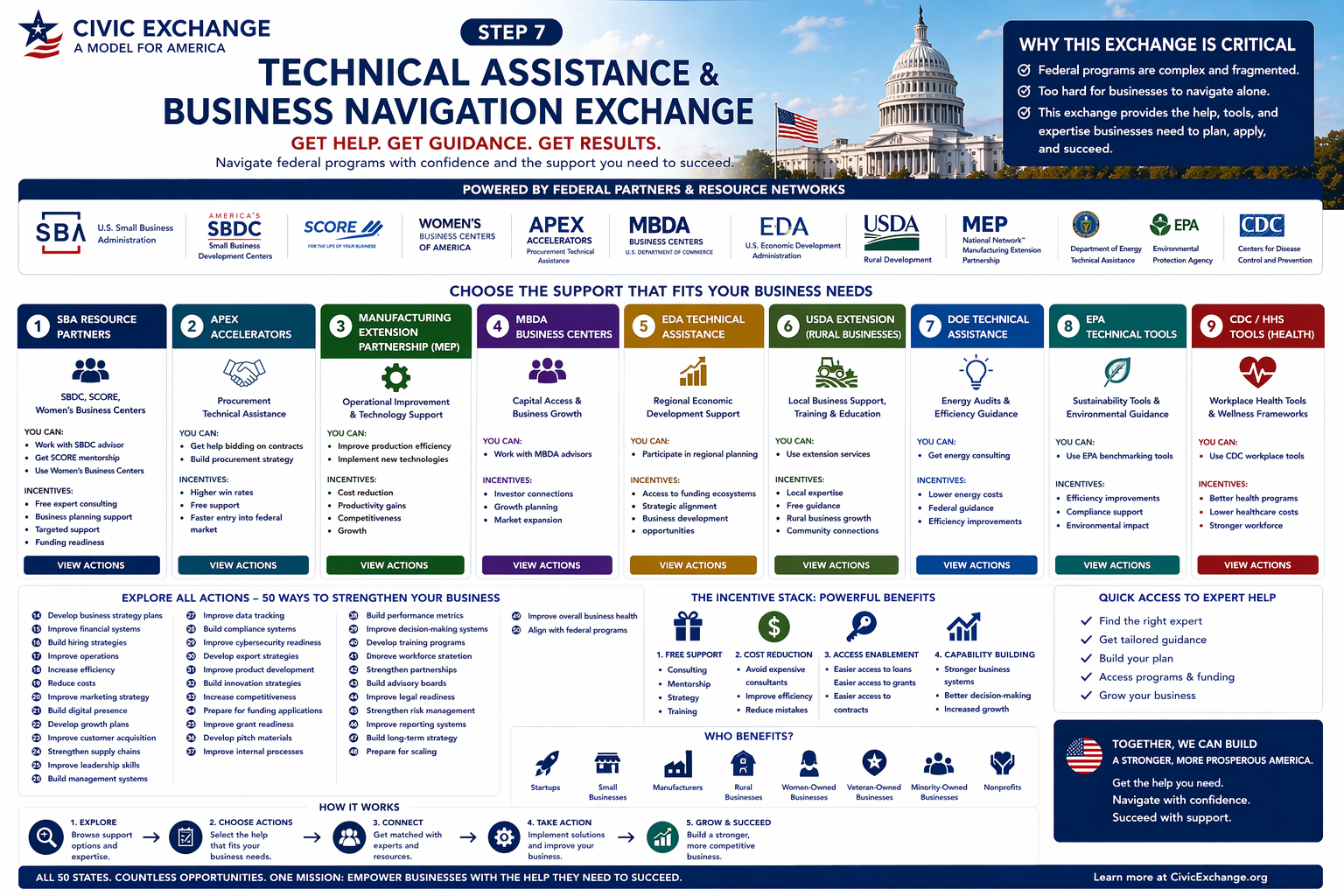
How a Technical Assistance and Business Navigation Exchange Could Work
The Technical Assistance and Business Navigation Exchange is an idea for making the entire Civic Exchange model easier for businesses to use. Many public programs already exist, but businesses often struggle to understand which ones apply to them, where to begin, who to contact, or what steps are required. This exchange would act as the guidance layer of the larger system, helping businesses move from confusion to action.
The goal would not be to create a new consulting agency or replace existing support organizations. The goal would be to organize the technical assistance, mentoring, advisory, and business navigation resources that already exist into one clearer access point. Businesses could use the exchange to find help with planning, financing, contracting, workforce development, compliance, operations, sustainability, innovation, and growth.
A business could create a profile, enter its location, industry, size, stage of growth, challenges, and goals, and then receive a customized set of support options. A startup might be connected to business planning help, mentoring, market research, and financial readiness support. A small manufacturer might be connected to process improvement, technology adoption, workforce training, and supply chain assistance. A business interested in government contracting might be connected to procurement advisors, certification help, proposal guidance, and capability statement support.
The exchange could organize technical assistance into clear business needs. Instead of asking business owners to search across many different organizations, the platform could present practical options such as get help writing a business plan, prepare for a loan, improve financial management, connect with a mentor, understand compliance requirements, explore contracting opportunities, improve operations, adopt new technology, strengthen workforce planning, or prepare for growth.
A major strength of the idea is that it would help businesses access the right support at the right time. Many businesses do not fail because resources do not exist. They struggle because the system is difficult to navigate. A business owner may not know whether to contact a Small Business Development Center, SCORE mentor, Women’s Business Center, APEX Accelerator, Manufacturing Extension Partnership, minority business support center, local chamber, economic development office, or another organization. The exchange could help route them to the most relevant support based on what they are trying to accomplish.
The federal role would be coordination, not control. A national version of this idea could help organize existing business support networks into a more understandable structure. Federal agencies and national partners could provide program information, tools, technical guidance, and referral pathways, while local and regional organizations would continue delivering direct support. This would keep the model practical and close to the businesses it is meant to serve.
For businesses, the value would be clarity, confidence, and reduced burden. They would not have to navigate complex public systems alone. They could describe their goal, such as starting a business, growing revenue, hiring workers, applying for capital, improving operations, entering new markets, or preparing for government contracts, and the exchange would help guide them toward the right advisors, programs, tools, and next steps.
This exchange could also reduce costs for small and mid sized businesses. Many companies cannot afford expensive consultants, attorneys, grant writers, compliance specialists, or strategy advisors. By connecting them to free or low cost public and nonprofit support, the exchange could help businesses avoid costly mistakes, improve readiness, and make better decisions with limited resources.
The exchange would also strengthen the other parts of the Civic Exchange model. Access to capital becomes more useful when businesses receive help preparing loan documents and financial plans. Federal contracting becomes more realistic when businesses get proposal support and certification guidance. Workforce programs become easier to use when employers receive help understanding training options. Sustainability and resilience efforts become more achievable when businesses are connected to technical experts and implementation tools.
For public leaders, the exchange could create a clearer picture of what kinds of support businesses need most. If businesses voluntarily identify needs related to financing, workforce, contracting, compliance, technology, operations, or growth, leaders could better understand where technical assistance is in demand and where gaps exist. This could support better program alignment, stronger grant applications, improved outreach, and more effective use of existing resources.
The dashboard connected to the exchange could track practical measures such as businesses seeking assistance, referrals made, advisory sessions completed, loan readiness support provided, contracting assistance delivered, workforce planning help requested, technology adoption support, compliance guidance, and business growth outcomes. This would help show not just which programs exist, but whether businesses are actually being connected to useful help.
For support organizations, the exchange could create a stronger referral system. Instead of businesses contacting the wrong office or giving up because the process is confusing, the platform could route them to the right partner more quickly. This would make the entire business support ecosystem more efficient and easier to understand.
For the broader economy, the value would be a stronger and more capable business base. Businesses that receive timely guidance are more likely to grow, hire, innovate, compete, win contracts, access capital, and remain resilient during challenges. Better navigation can turn existing public resources into real economic outcomes.
At its core, the Technical Assistance and Business Navigation Exchange is a practical economic development idea. It would not add new mandates or create a new bureaucracy. It would organize existing business support resources into a clearer system, help businesses find the guidance they need, and make the larger Civic Exchange model more usable. The larger purpose is simple: make it easier for businesses to understand what help exists, connect with the right experts, and take the next step with confidence.
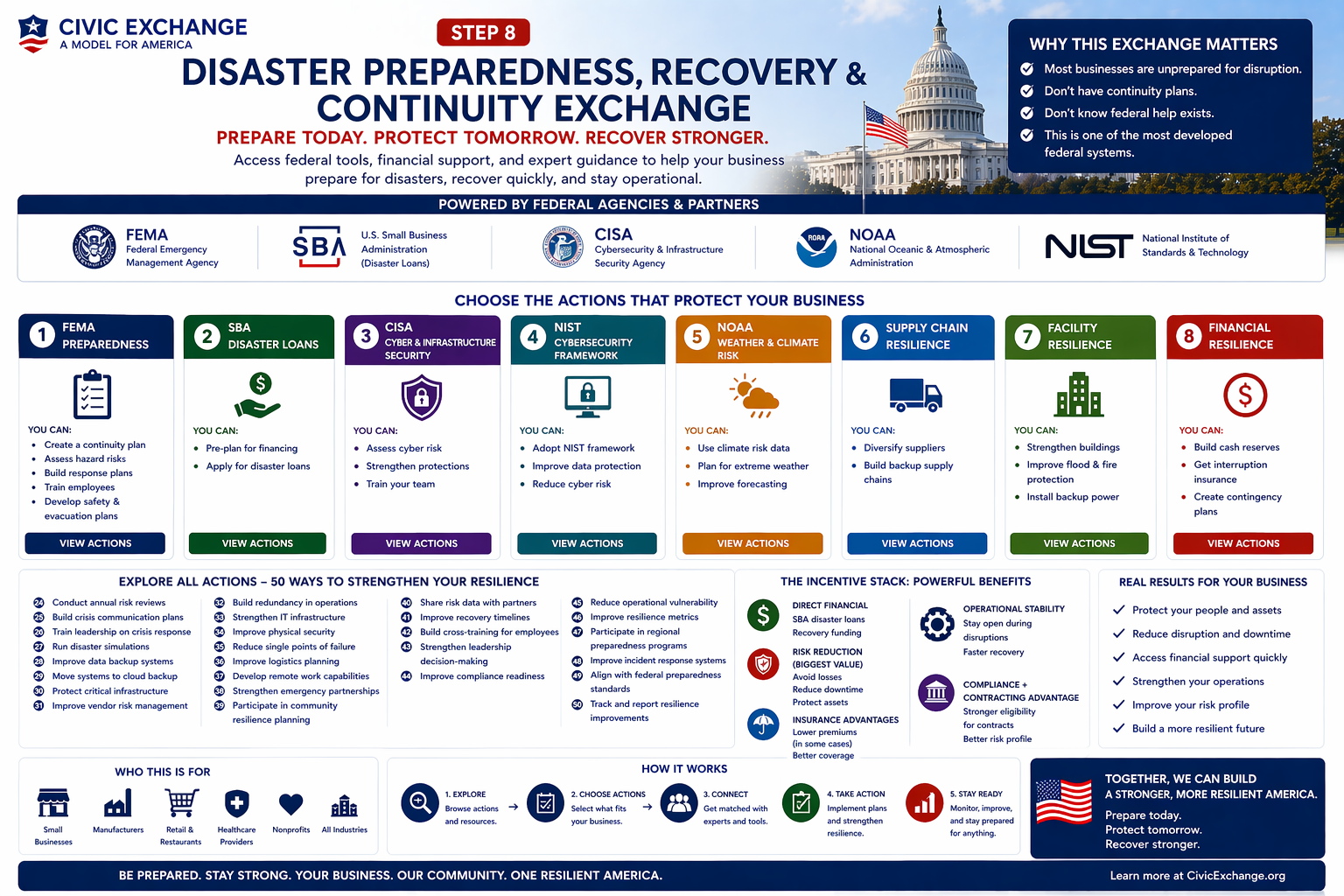
How a Disaster Preparedness, Recovery, and Continuity Exchange Could Work
The Disaster Preparedness, Recovery, and Continuity Exchange is an idea for making it easier for businesses to prepare for emergencies, stay open during disruptions, and recover faster after disasters. Many businesses only interact with disaster systems after something bad happens, when they are already trying to apply for aid, repair damage, reopen, or protect employees. This idea would shift that approach by making preparedness and continuity part of normal business planning before a crisis occurs.
The goal would not be to create a new disaster agency or replace existing emergency management systems. The goal would be to organize the disaster related resources that already exist into one clearer, more business friendly access point. Businesses could use the exchange to find guidance on emergency planning, continuity planning, risk assessment, insurance readiness, supply chain resilience, cybersecurity, weather and climate risks, recovery financing, and local emergency partnerships.
A business could create a profile, enter its location, industry, size, facilities, workforce, supply chain needs, and major risks, and then receive a customized preparedness and recovery pathway. A small retailer might see actions related to emergency communication, flood risk, insurance review, backup power, and recovery loan information. A manufacturer might see resources related to supply chain continuity, facility hardening, workforce safety, cybersecurity, and backup operations. A healthcare provider might see actions related to continuity of service, emergency staffing, patient communication, and coordination with local emergency partners.
The exchange could organize disaster preparedness into clear business actions. Instead of asking businesses to interpret complex emergency management language, the platform could present practical steps such as create a continuity plan, identify location based risks, prepare an emergency communication plan, back up critical records, review insurance coverage, strengthen cybersecurity, diversify suppliers, prepare for power outages, understand disaster loan options, and connect with local emergency management partners.
A major strength of the idea is that it would make resilience practical before a disaster happens. Many businesses know they should prepare, but they may not know what that actually means. The exchange could break preparedness into manageable steps, helping businesses understand what to do first, which risks matter most, what resources are available, and which partners can help them take action.
The federal role would be coordination, not control. A national version of this idea could help organize existing resources from emergency management, small business recovery, cybersecurity, infrastructure resilience, weather forecasting, climate data, and risk management systems. Federal agencies could provide guidance, tools, data, financing pathways, and planning resources, while state agencies, local governments, emergency managers, chambers, utilities, insurers, and community organizations could help businesses apply those resources locally.
Recovery support would be an important part of the exchange. Businesses often struggle after a disaster because they do not know which financial resources are available, what documents they need, or how to begin the recovery process. The exchange could help businesses understand recovery financing, disaster loans, eligibility requirements, documentation steps, and local recovery partners before an event occurs. That could reduce confusion and speed up recovery when time matters most.
Continuity planning would also be central. Businesses could be guided through steps to keep operations going during disruptions, including backup systems, remote work plans, employee communication, vendor alternatives, emergency staffing, data protection, and customer notification. This would help businesses think beyond immediate response and focus on how they continue serving customers, protecting workers, and preserving revenue during a crisis.
The exchange could also support supply chain resilience. Many businesses are vulnerable not only to disasters that hit their own location, but also to disruptions affecting suppliers, transportation, utilities, or customers. The platform could help businesses identify supply chain risks, find backup suppliers, plan alternative delivery routes, and prepare for delays or shortages.
For businesses, the value would be survival, stability, and confidence. Disasters, cyberattacks, extreme weather, infrastructure failures, and supply chain disruptions can be especially damaging for small and mid sized businesses. A clear exchange could help them reduce risk, protect employees, limit losses, recover faster, and avoid being caught unprepared.
For communities, the value would be stronger local resilience. Businesses are part of the basic structure of community life. They provide jobs, goods, services, supplies, tax base, and stability. When businesses are better prepared, communities are better able to withstand disruptions and recover after emergencies.
For public leaders, the exchange could create a clearer picture of business resilience across regions and sectors. If businesses voluntarily report preparedness actions, continuity plans, recovery needs, cybersecurity readiness, supply chain risks, or facility vulnerabilities, leaders could better understand where additional outreach, training, investment, or emergency planning support may be needed.
The dashboard connected to the exchange could track practical measures such as businesses participating, continuity plans completed, emergency communication plans created, disaster recovery resources accessed, cybersecurity readiness actions, supply chain resilience steps, insurance readiness reviews, facility resilience improvements, and regions with higher preparedness gaps. This could support emergency planning, economic recovery strategy, grant applications, infrastructure planning, and public accountability.
The exchange could also help businesses prepare for changing risk patterns. Extreme weather, flooding, heat, wildfires, cyber disruptions, and infrastructure failures can affect businesses in different ways depending on location and industry. A structured platform could help businesses use risk data and planning tools to make smarter long term decisions.
At its core, the Disaster Preparedness, Recovery, and Continuity Exchange is a practical public service and economic resilience idea. It would not add new mandates or create a new compliance burden. It would organize existing disaster preparedness and recovery resources into a clearer system, help businesses prepare before a crisis, and give public leaders better information about resilience gaps. The larger purpose is simple: help businesses stay open, recover faster, protect workers, and strengthen community resilience before the next disruption happens.
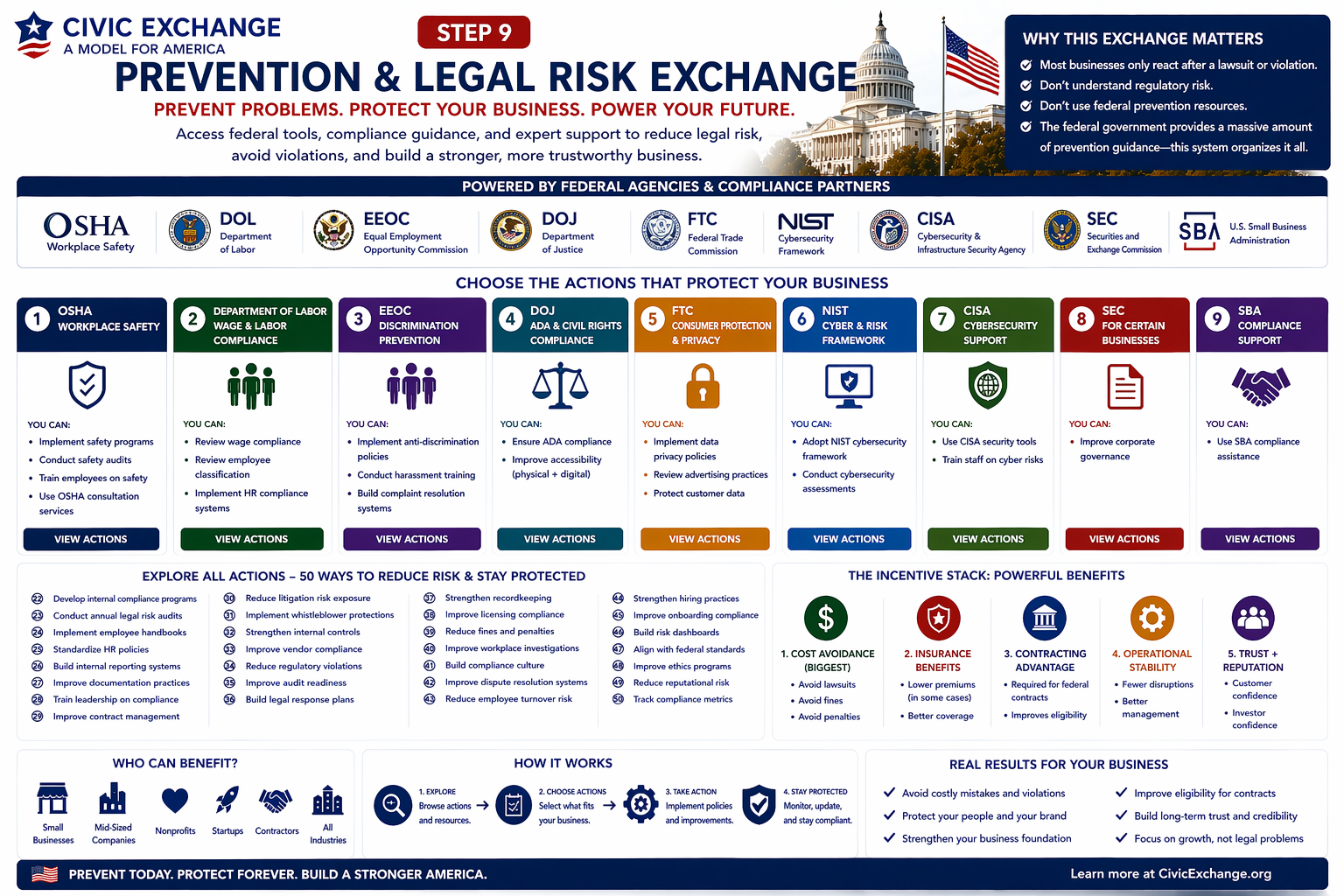
How a Prevention and Legal Risk Exchange Could Work
The Prevention and Legal Risk Exchange is an idea for making it easier for businesses to prevent legal, regulatory, workplace, cybersecurity, and operational risks before they become serious problems. Many businesses only interact with compliance systems after something goes wrong, such as a complaint, audit, violation, lawsuit, cyber incident, workplace injury, or enforcement action. This idea would shift the focus from reaction to prevention by giving businesses a clearer way to find guidance, tools, and support before problems occur.
The goal would not be to create a new enforcement agency or add another layer of regulation. The goal would be to organize existing prevention and compliance resources into one practical, business friendly access point. Businesses could use the exchange to better understand workplace safety, wage and labor standards, civil rights requirements, accessibility, cybersecurity, data protection, consumer protection, governance, insurance readiness, and general risk management.
A business could create a profile, enter its location, industry, size, workforce structure, customer base, digital systems, and risk concerns, and then receive a customized risk prevention pathway. A restaurant might see actions related to workplace safety, wage compliance, food related employment practices, employee training, insurance review, and emergency procedures. A technology company might see resources related to cybersecurity, data privacy, customer protection, employment practices, and internal reporting systems. A construction company might see actions related to OSHA safety, subcontractor risk, worker classification, training, documentation, and injury prevention.
The exchange could organize prevention into clear business actions. Instead of asking business owners to interpret complicated legal or regulatory language on their own, the platform could present practical steps such as conduct a workplace safety review, create an employee handbook, review wage and hour practices, strengthen anti discrimination policies, improve accessibility, adopt cybersecurity safeguards, protect customer data, review insurance coverage, create internal reporting procedures, and prepare basic compliance documentation.
A major strength of the idea is that it would make compliance feel less intimidating and more useful. Many businesses want to do the right thing, but they may not know which rules apply, where to find reliable guidance, or how to build internal systems that reduce risk. The exchange could help translate complex requirements into plain language actions, trusted resources, and realistic next steps.
The federal role would be coordination, not control. A national version of this idea could help organize existing guidance and tools from workplace safety, labor, civil rights, consumer protection, cybersecurity, emergency preparedness, small business support, and risk management systems. Agencies would still keep their existing authority. The exchange would simply make their prevention resources easier for businesses to find and use.
The prevention focus is important because legal risk is rarely isolated. A business may face overlapping risks related to employee safety, payroll practices, discrimination prevention, cybersecurity, customer data, accessibility, contracts, insurance, and internal management. A structured exchange could help businesses look at those risks together instead of treating each one as a separate problem.
For businesses, the value would be clarity, protection, and cost avoidance. Avoiding lawsuits, fines, penalties, cyber incidents, workplace injuries, insurance claims, and operational disruptions can protect revenue and stability. The exchange would help businesses understand that prevention is not just a legal obligation. It can also be a smart business strategy.
The exchange could also support stronger workplaces. Clear policies, safer working conditions, fair employment practices, internal reporting systems, and better training can improve employee trust, reduce turnover, and prevent conflicts from becoming larger problems. That makes risk prevention connected not only to compliance, but also to workforce stability and organizational culture.
Cybersecurity and data protection would be especially important parts of the exchange. Many small and mid sized businesses are vulnerable to cyber threats but may not know where to begin. The platform could guide them toward basic actions such as using stronger authentication, backing up data, training employees, protecting customer information, preparing an incident response plan, and using trusted cybersecurity frameworks.
The exchange could also help businesses become more competitive. Many government contracts, corporate supplier programs, insurance policies, and partnership opportunities require businesses to show that they have basic compliance, safety, cybersecurity, and risk management practices in place. By helping businesses prepare before they apply, the exchange could turn prevention into a pathway for growth.
For public leaders and agencies, the value would be better voluntary compliance. When businesses have clearer guidance and easier access to prevention tools, they may be more likely to address problems before enforcement is needed. This could reduce avoidable violations, improve workplace and consumer protections, and allow agencies to focus more attention on serious or repeated bad actors.
The dashboard connected to the exchange could track practical measures such as businesses participating, safety reviews completed, compliance guidance accessed, cybersecurity actions taken, employee training completed, internal policies created, insurance readiness steps, accessibility improvements, and sectors or regions where more outreach may be needed. This would help leaders understand where prevention efforts are happening and where gaps remain.
For the broader economy, the value would be a more stable and resilient business environment. Businesses that prevent risk are more likely to stay open, hire, grow, win contracts, protect workers, serve customers well, and avoid costly disruptions. Stronger prevention systems can support both business success and public trust.
At its core, the Prevention and Legal Risk Exchange is a practical business support idea. It would not add new mandates or create a new compliance burden. It would organize existing guidance into a clearer system, help businesses reduce risk before problems happen, and give public leaders better information about where prevention support is needed. The larger purpose is simple: help businesses protect themselves, their workers, their customers, and their communities before avoidable problems become costly crises.
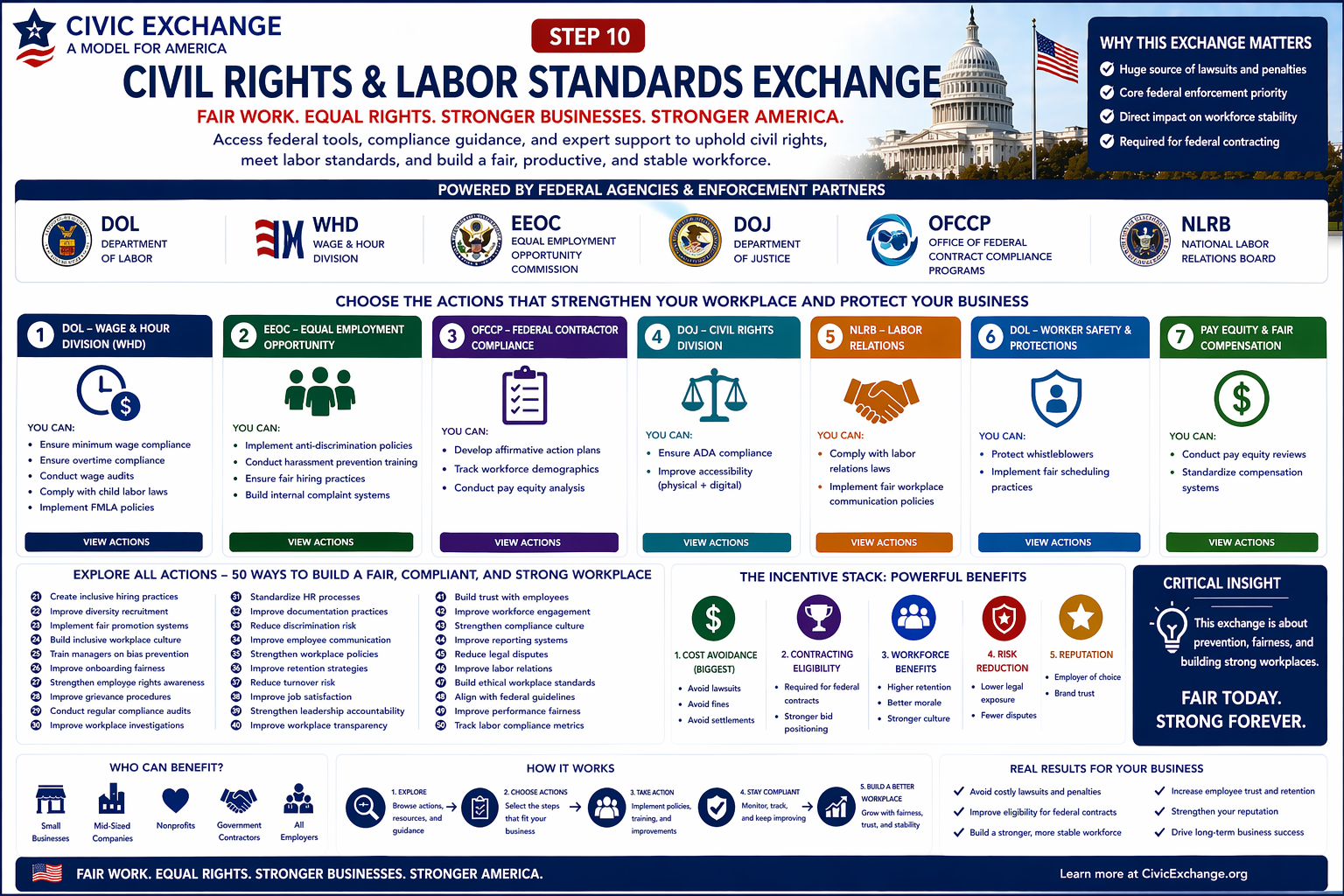
How a Prevention and Legal Risk Exchange Could Work
The Prevention and Legal Risk Exchange is an idea for making it easier for businesses to prevent legal, regulatory, workplace, cybersecurity, and operational risks before they become serious problems. Many businesses only interact with compliance systems after something goes wrong, such as a complaint, audit, violation, lawsuit, cyber incident, workplace injury, or enforcement action. This idea would shift the focus from reaction to prevention by giving businesses a clearer way to find guidance, tools, and support before problems occur.
The goal would not be to create a new enforcement agency or add another layer of regulation. The goal would be to organize existing prevention and compliance resources into one practical, business friendly access point. Businesses could use the exchange to better understand workplace safety, wage and labor standards, civil rights requirements, accessibility, cybersecurity, data protection, consumer protection, governance, insurance readiness, and general risk management.
A business could create a profile, enter its location, industry, size, workforce structure, customer base, digital systems, and risk concerns, and then receive a customized risk prevention pathway. A restaurant might see actions related to workplace safety, wage compliance, food related employment practices, employee training, insurance review, and emergency procedures. A technology company might see resources related to cybersecurity, data privacy, customer protection, employment practices, and internal reporting systems. A construction company might see actions related to OSHA safety, subcontractor risk, worker classification, training, documentation, and injury prevention.
The exchange could organize prevention into clear business actions. Instead of asking business owners to interpret complicated legal or regulatory language on their own, the platform could present practical steps such as conduct a workplace safety review, create an employee handbook, review wage and hour practices, strengthen anti discrimination policies, improve accessibility, adopt cybersecurity safeguards, protect customer data, review insurance coverage, create internal reporting procedures, and prepare basic compliance documentation.
A major strength of the idea is that it would make compliance feel less intimidating and more useful. Many businesses want to do the right thing, but they may not know which rules apply, where to find reliable guidance, or how to build internal systems that reduce risk. The exchange could help translate complex requirements into plain language actions, trusted resources, and realistic next steps.
The federal role would be coordination, not control. A national version of this idea could help organize existing guidance and tools from workplace safety, labor, civil rights, consumer protection, cybersecurity, emergency preparedness, small business support, and risk management systems. Agencies would still keep their existing authority. The exchange would simply make their prevention resources easier for businesses to find and use.
The prevention focus is important because legal risk is rarely isolated. A business may face overlapping risks related to employee safety, payroll practices, discrimination prevention, cybersecurity, customer data, accessibility, contracts, insurance, and internal management. A structured exchange could help businesses look at those risks together instead of treating each one as a separate problem.
For businesses, the value would be clarity, protection, and cost avoidance. Avoiding lawsuits, fines, penalties, cyber incidents, workplace injuries, insurance claims, and operational disruptions can protect revenue and stability. The exchange would help businesses understand that prevention is not just a legal obligation. It can also be a smart business strategy.
The exchange could also support stronger workplaces. Clear policies, safer working conditions, fair employment practices, internal reporting systems, and better training can improve employee trust, reduce turnover, and prevent conflicts from becoming larger problems. That makes risk prevention connected not only to compliance, but also to workforce stability and organizational culture.
Cybersecurity and data protection would be especially important parts of the exchange. Many small and mid sized businesses are vulnerable to cyber threats but may not know where to begin. The platform could guide them toward basic actions such as using stronger authentication, backing up data, training employees, protecting customer information, preparing an incident response plan, and using trusted cybersecurity frameworks.
The exchange could also help businesses become more competitive. Many government contracts, corporate supplier programs, insurance policies, and partnership opportunities require businesses to show that they have basic compliance, safety, cybersecurity, and risk management practices in place. By helping businesses prepare before they apply, the exchange could turn prevention into a pathway for growth.
For public leaders and agencies, the value would be better voluntary compliance. When businesses have clearer guidance and easier access to prevention tools, they may be more likely to address problems before enforcement is needed. This could reduce avoidable violations, improve workplace and consumer protections, and allow agencies to focus more attention on serious or repeated bad actors.
The dashboard connected to the exchange could track practical measures such as businesses participating, safety reviews completed, compliance guidance accessed, cybersecurity actions taken, employee training completed, internal policies created, insurance readiness steps, accessibility improvements, and sectors or regions where more outreach may be needed. This would help leaders understand where prevention efforts are happening and where gaps remain.
For the broader economy, the value would be a more stable and resilient business environment. Businesses that prevent risk are more likely to stay open, hire, grow, win contracts, protect workers, serve customers well, and avoid costly disruptions. Stronger prevention systems can support both business success and public trust.
At its core, the Prevention and Legal Risk Exchange is a practical business support idea. It would not add new mandates or create a new compliance burden. It would organize existing guidance into a clearer system, help businesses reduce risk before problems happen, and give public leaders better information about where prevention support is needed. The larger purpose is simple: help businesses protect themselves, their workers, their customers, and their communities before avoidable problems become costly crises.
How the Final Review and Submission Step Could Work
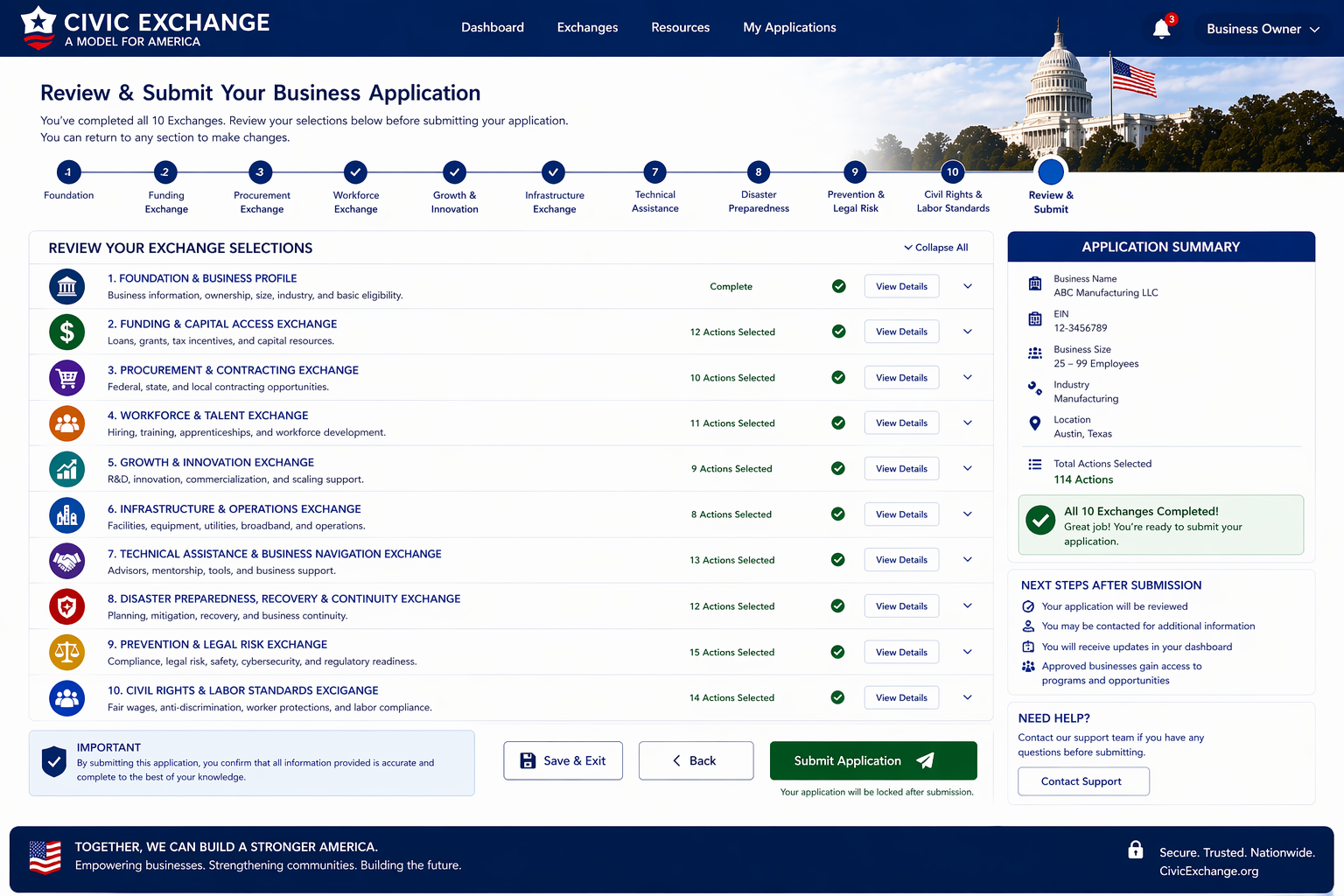
The final review and submission step is where a business would bring its profile, selected exchange areas, and intended actions together into one organized submission. In the Civic Exchange idea, this step would serve as the point where a business moves from exploring options to formally indicating how it wants to participate. Instead of leaving selections scattered across different sections, the platform would collect everything into one clear summary that the business can review, edit, and confirm.
The purpose of this step would be simplicity and accuracy. A business could see the information it entered, the exchange areas it selected, and the specific actions it may want to take. For example, it could review whether it selected workforce partnerships, access to capital, federal contracting, community engagement, sustainability, disaster preparedness, health initiatives, or risk prevention. This would give the business a chance to make sure the submission reflects its real interests, needs, and capacity.
This step would also help keep the model voluntary and realistic. Businesses would not be automatically enrolled in every program or expected to participate in every area. They would choose what fits. A small business might select only two or three actions, while a larger employer might select several across different exchanges. The review page would help prevent confusion by showing exactly what the business is choosing before anything is submitted.
From a system perspective, this step would be important because it would create a consistent intake process. Different businesses may have very different goals, but the platform could organize their selections into a common format. That would make it easier for public agencies, local partners, workforce boards, economic development organizations, health departments, nonprofit partners, and technical assistance providers to understand what each business needs or wants to do.
The application summary could also reduce duplication. Instead of asking a business to repeatedly enter the same basic information across multiple programs, the Civic Exchange idea would allow core information such as business name, location, industry, size, contact information, and areas of interest to be captured once. That information could then help route the business toward the most relevant resources, partners, and next steps.
The selected actions total would also matter. If a business chooses five actions across three exchange areas, the platform could show that clearly. Over time, when many businesses participate, this kind of structured information could help create a broader picture of business engagement. Public leaders could better understand which exchange areas are attracting interest, where businesses need support, and which regions or sectors may require more outreach.
The final submission could also trigger a coordinated follow up process. After a business confirms its selections, the platform could provide a clear next steps page. This might include suggested contacts, relevant programs, local partners, funding opportunities, technical assistance providers, or timeline expectations. This would help businesses avoid the common problem of submitting information and then not knowing what happens next.
For businesses, the value of this step would be reduced burden. Instead of completing separate forms for many different systems, they would complete one structured review and submission process that reflects their full range of interests. That could make participation feel more manageable, especially for small and mid sized businesses that do not have large administrative teams.
For government and public partners, the value would be better coordination. A unified submission would give agencies and partners a clearer view of the business’s needs, goals, and intended actions. This could reduce duplicate outreach, improve referrals, and help connect businesses to the right support faster.
The final review step could also strengthen accountability. Because businesses would review and confirm their selections, the platform would have a clearer record of what the business intended to do or explore. That could help track follow up, participation, completed actions, and outcomes over time. It would make the Civic Exchange idea more measurable without turning it into a heavy compliance system.
From a broader perspective, this is the step where individual business participation becomes useful systemwide information. Each submission could add to a growing dataset showing how businesses are engaging across workforce, capital, contracting, health, community, sustainability, resilience, and prevention priorities. That information could support dashboards, public reporting, grant planning, resource allocation, and future program design.
At its core, the final review and submission step is the practical bridge between business interest and coordinated action. It would take many possible programs, partners, and priorities and organize them into one clear submission. The larger purpose is simple: make it easier for businesses to participate, easier for government to respond, and easier for communities to understand how business engagement is contributing to public impact.
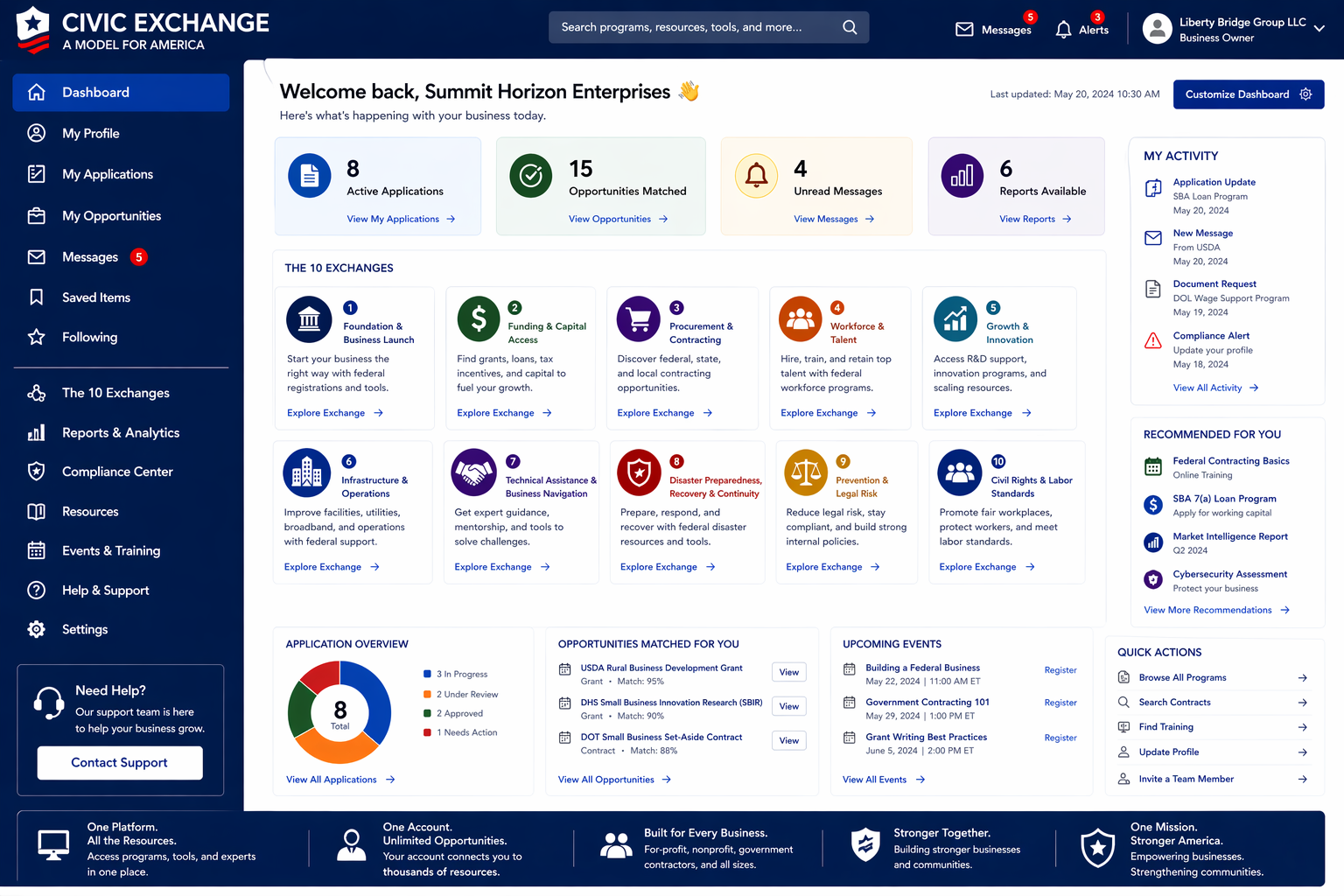
How a Personalized Business Profile Could Work
After a business completes the onboarding process, the Civic Exchange idea could create a personalized business profile that becomes the center of its experience. This profile would take the information the business provided during sign up and turn it into a practical, usable dashboard. Instead of giving every business the same generic list of programs, the platform could show opportunities, resources, messages, and next steps based on that business’s location, industry, size, goals, and selected areas of interest.
The purpose of the profile would be to make the Civic Exchange more useful and less overwhelming. A business would not have to search through every possible program or opportunity. The system could use the business’s information to highlight what is most relevant. A company focused on hiring might see workforce training programs, apprenticeship resources, local workforce partners, and hiring incentives. A business interested in community impact might see volunteer opportunities, health partnerships, nonprofit connections, and local engagement options. A business focused on growth might see capital access resources, technical assistance, contracting support, or export opportunities.
The profile would also serve as the business’s central record of engagement. Everything the business selects, submits, explores, applies for, or completes could be organized in one place. This could include active applications, matched opportunities, saved programs, messages from partners, selected exchange areas, completed actions, and reported outcomes. Instead of managing many different accounts, contacts, and systems, the business could have one clear view of its relationship with the broader Civic Exchange model.
A major strength of this idea is personalization. The profile would allow the platform to move beyond being a directory of links. It could become a guided system that helps each business understand what it can do next. The more accurate the profile is, the more useful the recommendations become. This could make participation easier for small and mid sized businesses that may not have the time or staff to navigate complicated public systems.
The profile could also help connect activity across different exchange areas. For example, a business that selects workforce development might also be matched with funding opportunities, technical assistance, youth apprenticeship partners, and community college programs. A business interested in sustainability might also be shown energy incentives, resilience planning tools, infrastructure support, and cost saving resources. This cross exchange coordination is what could make the model more powerful than separate program websites.
For businesses, the value would be clarity and efficiency. They could log in and quickly see what they are working on, what opportunities match their goals, what actions need attention, and what support is available. Messages and alerts could be tied to their actual profile rather than broad, generic outreach. That would make the information more relevant and easier to act on.
For government and public partners, the profile could create a more consistent way to understand business participation. Instead of each agency or partner working from separate records, the Civic Exchange idea could provide a clearer shared view of what a business needs, what it has selected, and where follow up may be useful. This could reduce duplicate outreach, improve referrals, and help programs serve businesses more effectively.
The profile could also support better measurement. As businesses take actions, join programs, form partnerships, or report outcomes, that activity could update the broader dashboard. Over time, this would help show how businesses are engaging across workforce, capital access, contracting, health, community engagement, sustainability, disaster preparedness, and risk prevention. Public leaders could then see patterns across regions, industries, and exchange areas.
Importantly, the profile would not need to be complicated. The best version would be simple, clear, and action oriented. It would show who the business is, what it cares about, what it has selected, what opportunities are available, and what steps come next. The goal would be to reduce confusion, not add another administrative burden.
Over time, the business profile could become more useful as the business grows or changes priorities. A company that begins by looking for workforce support might later explore capital access, contracting, sustainability, or community partnerships. The profile could evolve with the business, helping it stay connected to relevant opportunities at each stage.
At its core, the personalized business profile is the operating center of the Civic Exchange idea. It would turn a one time sign up form into an ongoing relationship. The larger purpose is simple: give each business one organized place to manage opportunities, receive relevant guidance, track participation, and connect with the programs and partners that can help it grow and contribute to the community.
Conceptual Prototype Disclaimer
This material is a conceptual prototype developed to illustrate how a unified national Civic Exchange system could potentially function. It is not an official government program, platform, initiative, or public service. There is currently no active government operated website or platform under the name Civic Exchange or civicexchange.org.
All designs, dashboards, workflows, exchange categories, user pathways, and examples shown are illustrative only. They are intended to demonstrate a possible structure, user experience, and coordination model. They do not represent a finalized system, approved policy framework, implemented technology platform, or official government solution.
References to federal agencies, public programs, funding streams, and existing resources are based on publicly available information and are included only to show how current systems could potentially be organized, aligned, and made easier to access. No formal partnership, endorsement, sponsorship, approval, or affiliation with any federal, state, or local government agency is implied.
This concept has been developed independently and remains in an exploratory stage. Any real world version of this model would require significant additional review, stakeholder input, legal analysis, technical development, policy alignment, data governance, privacy protections, accessibility review, and collaboration with appropriate public, nonprofit, and private sector partners.
Participation in any system described in this prototype would not guarantee access to funding, contracts, grants, tax incentives, technical assistance, government programs, or partnership opportunities. Actual eligibility, approval, funding, and outcomes would depend on the rules, requirements, and decision making processes of the relevant programs and agencies.
This material is provided for informational, educational, and discussion purposes only. It should not be interpreted as legal, financial, regulatory, procurement, compliance, or policy advice. Businesses, organizations, and public entities should consult the appropriate agencies, professionals, or official program guidance before making decisions based on any concept described here.
All visuals, dashboards, forms, profiles, workflows, and platform examples are mockups created to simulate what a future system could look like. They may not reflect the full technical, legal, operational, cybersecurity, privacy, funding, procurement, or administrative requirements that would apply to a real platform.
The purpose of this overview is to spark conversation about how government, businesses, nonprofits, and communities could work together in a more coordinated, transparent, and measurable way. Feedback, ideas, critique, and potential collaboration would be important to further developing, testing, and refining what this model could become.
 Chad Trivette
Leave a comment