
This concept is not presented as a finished plan or as a criticism of existing state agencies, local governments, schools, chambers, nonprofits, workforce boards, health partners, or economic development organizations. Many of these partners are already doing important work with limited staff, funding, time, and technology capacity. The purpose of this idea is to explore whether existing work could be easier to find, easier to coordinate, and easier to measure through a shared voluntary framework.
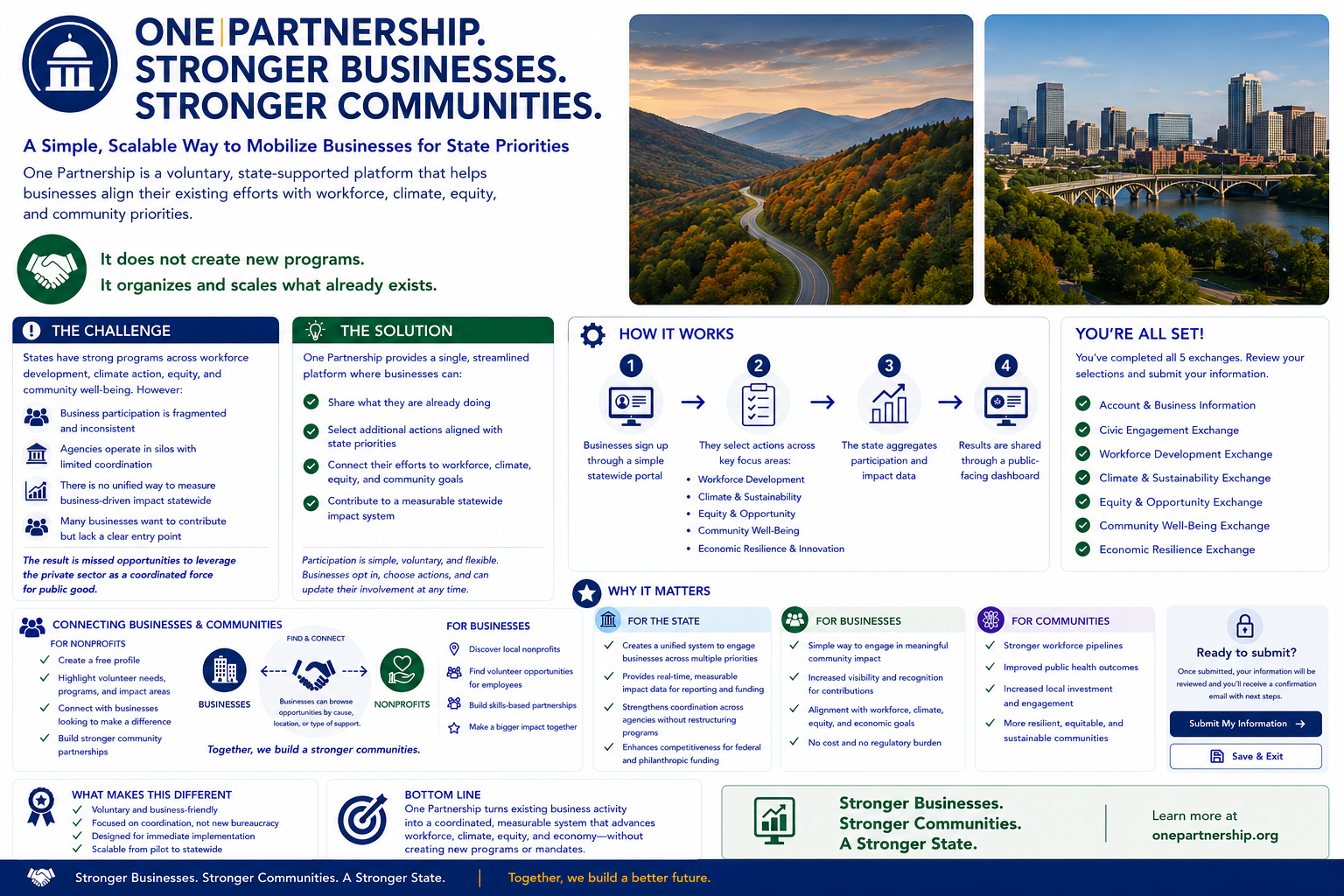
Every state is already home to employers, universities, health systems, small businesses, manufacturers, farms, nonprofits, chambers of commerce, workforce leaders, local governments, and community organizations working every day to strengthen their communities. The challenge is not that states lack effort. The challenge is that much of this work is spread across separate systems, making it harder for businesses to know where to engage and harder for public and community leaders to see, measure, and coordinate what is already happening.
A One Partnership model would create one shared connection point between business activity and statewide priorities. A business could go to one place, share what it is already doing, identify where it may be willing to contribute next, and connect with the right workforce, education, public health, sustainability, nonprofit, rural, emergency preparedness, or economic development partner. Instead of asking businesses to navigate multiple disconnected systems, this concept would make participation simpler, clearer, and more organized.
This idea would not replace existing agencies, programs, schools, nonprofits, chambers, workforce boards, health partners, or economic development organizations. It would help bring them together through a common structure. The value is coordination. A One Partnership model would act as a front door, helping businesses find the right partners faster while helping public leaders better understand where participation, needs, and opportunities already exist.
The value is practical. A small business could identify interest in mentoring students or supporting local nonprofits. A tourism business could connect with workforce, hospitality training, and community engagement opportunities. An energy company could support workforce pathways, safety training, sustainability, and resilience. A farm, ranch, or food business could help with healthy food access, conservation, water stewardship, or rural economic development. A health system or clinic could support community health goals. A company connected to science, research, technology, or manufacturing could help build education and career pathways for the next generation.
For a Governor’s Office and state leaders, this kind of model could provide better visibility across major priorities, including workforce readiness, economic competitiveness, public health, education, sustainability, emergency preparedness, rural opportunity, and community wellbeing. Instead of relying only on individual examples of business engagement, the state could begin to see aggregate patterns: where employers are already active, where future interest exists, which regions need more outreach, and which priorities are gaining momentum.
For state legislators, this could become a practical tool for district level impact. Legislators could better understand which businesses in their regions are supporting internships, apprenticeships, employee wellness, volunteerism, community health, sustainability, emergency preparedness, nonprofit partnerships, rural development, or youth opportunity. That information could help connect local employers with existing state and community resources without creating new mandates or unnecessary reporting burdens.
For economic development leaders, this could strengthen business attraction and retention. Companies increasingly want to locate in places where talent pipelines are strong, communities are healthy, infrastructure is resilient, and public partners are organized. A One Partnership model would help show that a state has a structured way to connect businesses with workforce development, schools, colleges, community partners, sustainability resources, health initiatives, rural priorities, and local needs.
For businesses, the benefit is simplicity. Employers would not have to guess which agency, nonprofit, school, workforce board, chamber, local government, or community organization to contact first. They could use one shared connection point to say what they are already doing, where they may be willing to help, and what kind of partner they need. Participation would be voluntary, flexible, and based on what each business can realistically do.
For existing partners, this would increase visibility rather than create competition. Workforce programs could find more employers. Schools and colleges could identify businesses willing to offer internships, apprenticeships, mentorships, career speakers, or job shadowing. Health departments and hospitals could connect with employers interested in wellness, prevention, mental health, food access, or community health. Nonprofits could find businesses willing to volunteer, donate, sponsor projects, or provide technical expertise. Sustainability and resilience partners could identify companies interested in energy efficiency, conservation, water stewardship, waste reduction, climate resilience, or emergency preparedness.
This model could also strengthen grant applications and funding strategies. Many federal, philanthropic, and regional funding opportunities reward evidence of employer engagement, cross sector collaboration, community need, rural participation, and measurable outcomes. A One Partnership model could help document business participation in one organized structure, making it easier to show where collaboration is happening, where needs remain, and how public and private partners are working together.
The larger opportunity is to turn scattered goodwill into measurable public value. A state does not need every business to do the same thing. It needs a system that helps each business do something useful, realistic, and aligned with community need. Some businesses may support students. Some may strengthen employee wellness. Some may invest in sustainability. Some may help local nonprofits. Some may provide volunteers. Some may support emergency preparedness. Some may help workers gain new skills. Some may support rural partnerships. A One Partnership model would organize those actions into a broader statewide impact strategy.
At its best, this idea becomes one shared connection point for business, government, nonprofits, schools, health partners, workforce leaders, economic development organizations, rural communities, and local leaders to align around practical action. Businesses get a clearer way to participate. Existing programs get more visibility. Communities get better access to partners. Economic development leaders get a stronger attraction and retention tool. Legislators get a practical way to support district level impact. State leaders get better visibility into statewide progress.
The purpose is simple: help a state answer a question every leader should be able to answer with confidence: what are we improving together, and how do we know?
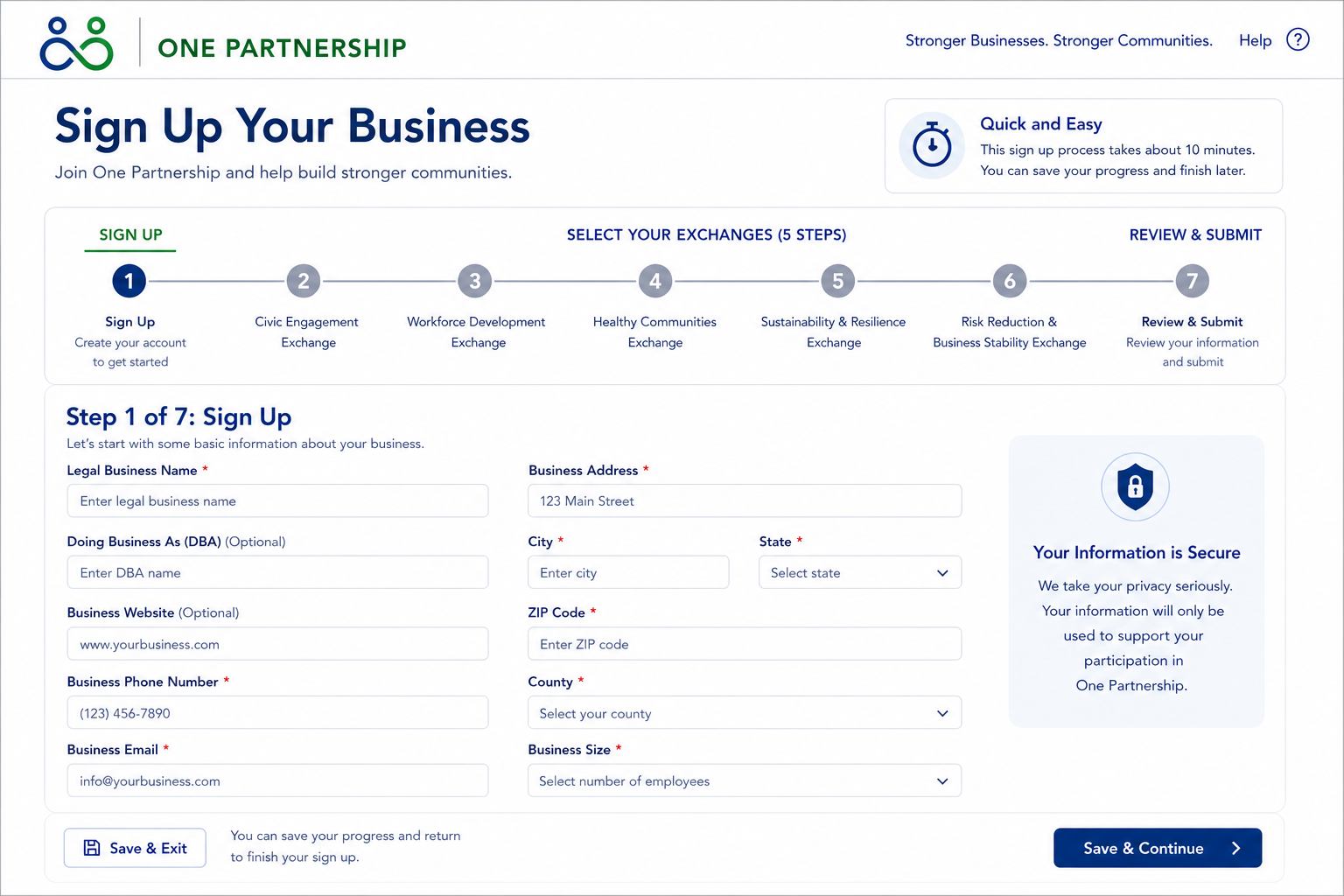
Business Sign Up
A One Partnership model would begin with a simple, business friendly sign up process designed to make participation easy, organized, and useful from the start.
The purpose of this first step is to create one shared connection point for businesses across a state. Instead of asking employers to navigate separate agencies, workforce programs, school partnerships, health initiatives, nonprofit requests, sustainability efforts, rural partnerships, emergency preparedness resources, and economic development contacts on their own, this process gives them one clear place to begin.
A business would start by entering basic information such as its legal business name, location, county, contact information, website, and business size. That information may seem simple, but it matters. It allows state and local leaders to understand which businesses are participating, where they are located, what regions are represented, what types of employers are engaged, and where additional outreach may be needed.
This would be different from a normal contact form because it would be connected to a larger statewide partnership structure. After signing up, businesses could move through voluntary exchange areas such as civic engagement, workforce development, healthy communities, sustainability and resilience, and risk reduction and business stability. In each area, businesses could identify what they are already doing and where they may be willing to contribute next.
For businesses, this makes participation easier. A small business, tourism company, farm, ranch, health clinic, energy company, manufacturer, technology firm, nonprofit partner, or local employer could all use the same process while choosing actions that fit their own capacity and community role. The model would not ask every business to do the same thing. It would give each business a practical way to participate based on what it can realistically offer.
For state leaders, economic development directors, local governments, workforce boards, chambers, schools, health partners, rural development organizations, and nonprofits, this creates more consistent information. A state could better understand business engagement by region, county, industry, business size, and priority area. That makes it easier to identify gaps, connect businesses with the right partners, support grant applications, and measure statewide progress.
The sign up process would also reinforce trust. Businesses would know that their information is being used to support participation, partnerships, and program opportunities. The goal would not be to create another administrative burden. The goal would be to make it easier for businesses to be seen, connected, and included in work that strengthens communities.
At its best, this first step turns business interest into an organized statewide asset. It gives a state a practical way to begin connecting employers with the people, programs, and communities that need them most.
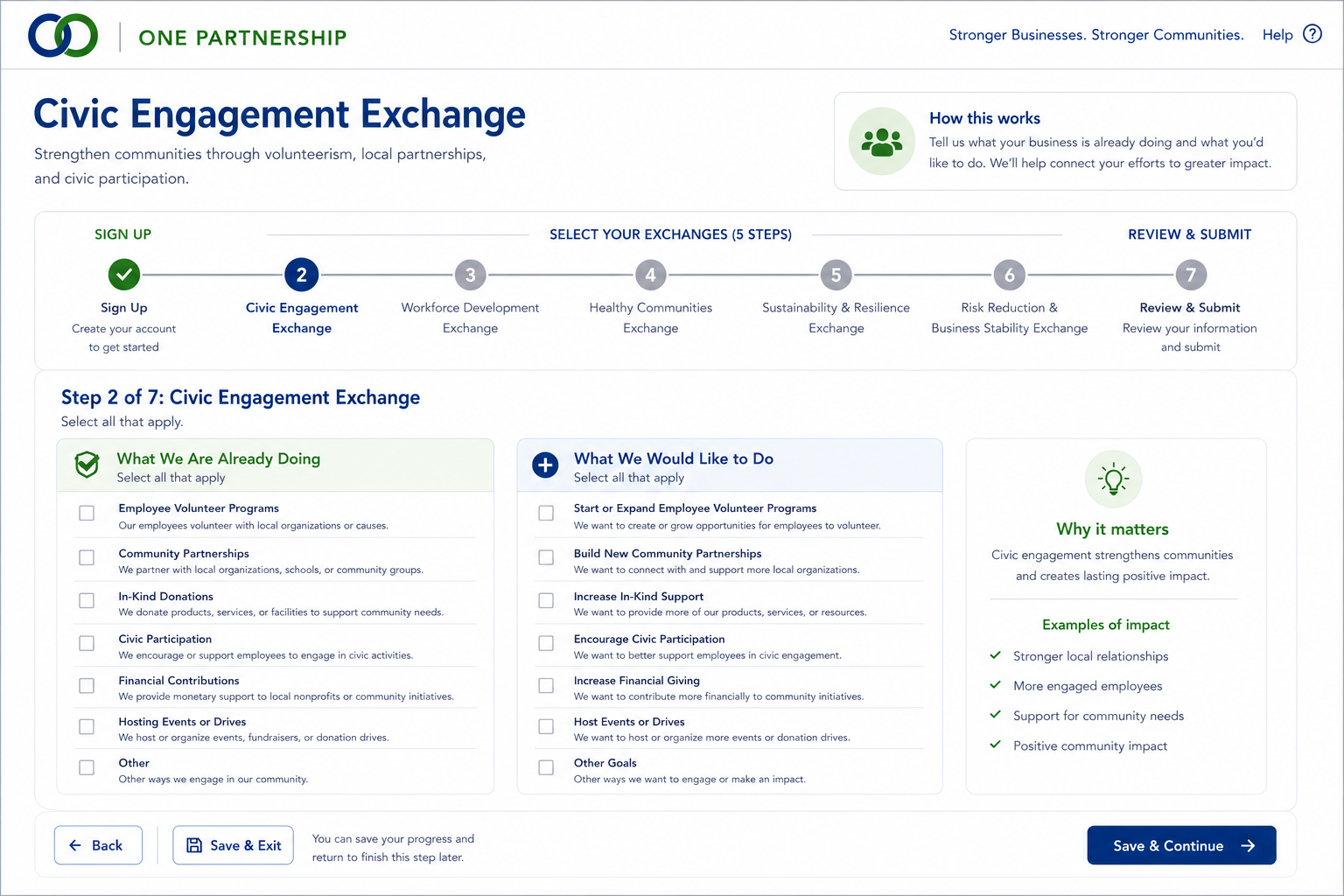
Civic Engagement Exchange
The Civic Engagement Exchange would give a state one shared connection point to understand how businesses are already strengthening communities and where they may be willing to do more.
Across any state, businesses already contribute to civic life in many ways. They support local nonprofits, sponsor community events, organize employee volunteer programs, donate products or services, host food drives and fundraising efforts, encourage civic participation, and build relationships with schools, neighborhood groups, service organizations, local governments, and chambers of commerce. These efforts are valuable, but they are often spread across individual relationships and not always visible as part of a larger statewide picture.
A One Partnership model would help organize that activity. Through this exchange, a business could identify what it is already doing, such as employee volunteer programs, community partnerships, in kind donations, civic participation, financial contributions, or hosting events and drives. It could also select what it would like to do next, such as expanding volunteer opportunities, building new community partnerships, increasing charitable support, hosting more events, or encouraging greater civic participation among employees.
This matters because civic engagement is one of the foundations of strong communities. When businesses are connected to local needs, they help build trust, strengthen relationships, support nonprofits, improve quality of life, and create a stronger sense of shared responsibility. A small business may support a local school fundraiser. A tourism business may help promote community events. A farm or food business may donate food or supplies. A hospital or clinic may partner with local organizations. An energy company, manufacturer, bank, or technology firm may sponsor youth programs, workforce events, or service projects. Each action may look different, but together they represent real public value.
For businesses, this exchange would make civic participation easier and more practical. Employers would not have to guess which nonprofit, school, local government, chamber, or community organization to contact first. They could use one shared connection point to say what they are already doing and where they may be willing to help next. Participation would be voluntary, flexible, and based on each business’s capacity, workforce, location, and community relationships.
For state leaders and local governments, this would create better visibility into civic activity across the state. Leaders could better understand which regions have strong business participation, which communities may need more support, and which types of civic engagement are growing. That information could help improve public reporting, strengthen community partnerships, support grant applications, and identify opportunities for more targeted outreach.
For nonprofits and community organizations, this exchange could make it easier to find business partners. Instead of relying only on personal networks or repeated cold outreach, organizations could identify businesses that have already expressed interest in volunteering, donations, sponsorships, events, or partnerships. That makes collaboration more efficient and helps community groups spend more time serving people and less time searching for support.
For economic development leaders, civic engagement is also part of competitiveness. Strong communities help attract workers, retain families, support small businesses, strengthen local pride, and improve quality of life. Companies increasingly want to operate in places where there is trust, partnership, and a sense of shared purpose. A One Partnership model would help show that a state has an organized way to connect business growth with community strength.
This is what makes the Civic Engagement Exchange different. It is not a new nonprofit program. It does not replace chambers, local governments, schools, service organizations, or community based organizations. It helps bring them together by creating a common structure for business participation, current activity, and future interest.
At its best, the Civic Engagement Exchange helps a state answer a simple but important question: which businesses are ready to help strengthen their communities, and how can that interest be connected to the people and places that need it most?
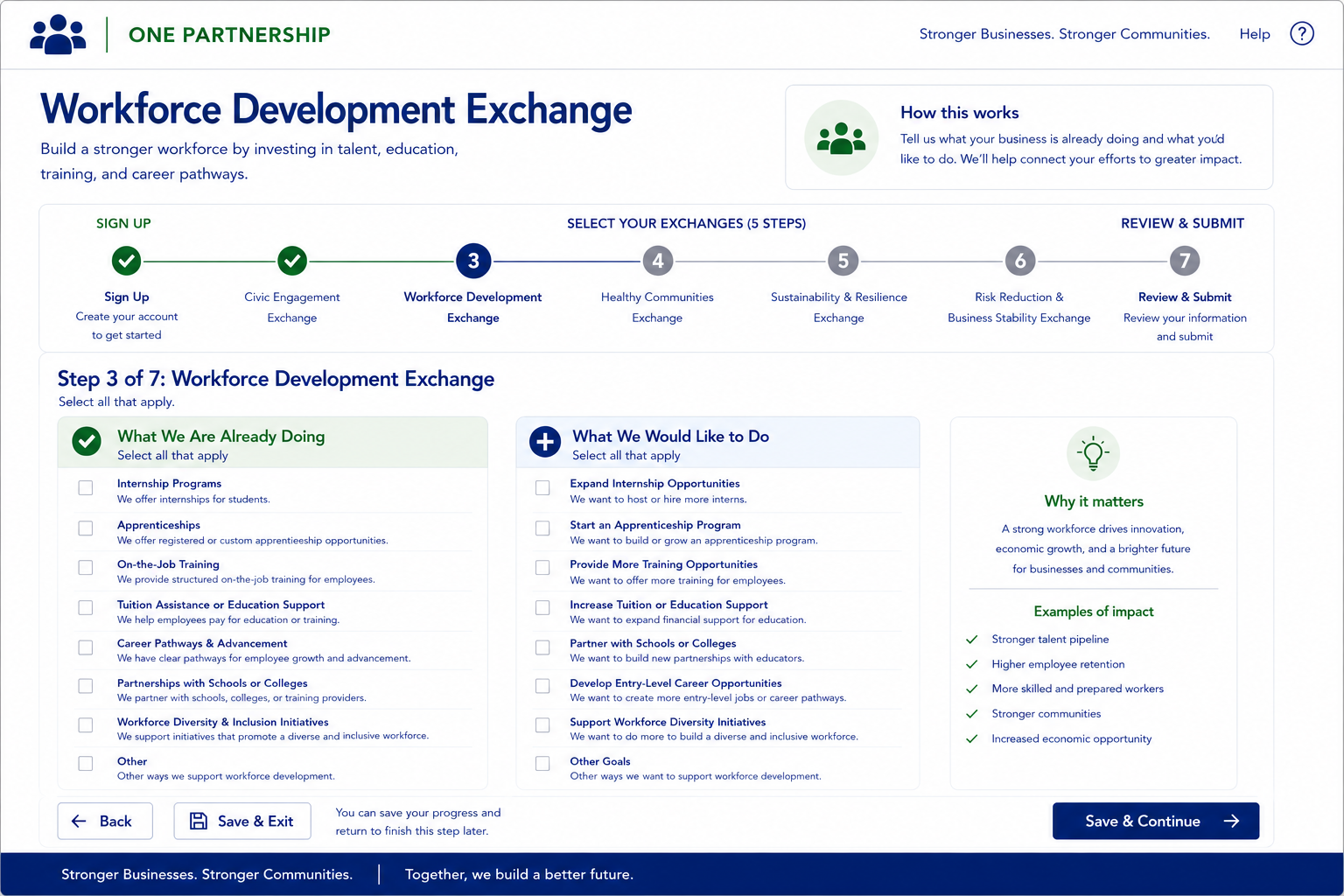
Workforce Development Exchange
The Workforce Development Exchange would give a state one shared connection point to understand how businesses are already investing in talent, education, training, and career pathways, and where they may be willing to do more.
Workforce development is one of the most important issues facing any state. Employers need skilled workers. Students need clearer career pathways. Workers need opportunities to grow. Rural communities need stronger local economies. States already have workforce programs, community colleges, universities, apprenticeship efforts, career and technical education programs, chambers of commerce, economic development organizations, and employer relationships. The challenge is not that states lack workforce activity. The challenge is that these efforts are often spread across different systems, making it harder for businesses to know where to engage and harder for leaders to see where employer participation is strongest.
A One Partnership model would help bring that work together. Through this exchange, businesses could identify what they are already doing, such as offering internships, apprenticeships, on the job training, tuition assistance, career advancement pathways, partnerships with schools or colleges, or workforce diversity and inclusion initiatives. They could also identify what they would like to do next, such as expanding internship opportunities, starting or growing apprenticeship programs, providing more training, partnering with schools or colleges, developing entry level career opportunities, or supporting a more diverse workforce.
This structure matters because it turns employer interest into usable workforce information. Instead of relying only on individual conversations, separate program lists, or disconnected employer outreach, a state could begin to see which businesses are already participating in workforce development, which industries are ready to expand, which regions have strong employer engagement, and where more support may be needed.
For businesses, the benefit is practical. An employer may want to hire interns but not know which school, college, or workforce partner to contact. A small business may be willing to host a career speaker, mentorship opportunity, or job shadowing experience but may not have a clear pathway to connect with students. A farm, ranch, energy company, tourism business, health clinic, manufacturer, technology firm, or local employer may want to build a stronger talent pipeline but need a simpler way to find the right partner. A One Partnership model would give each business one organized place to signal interest and connect with the right workforce, education, or economic development resource.
For a Governor’s Office and state leaders, this exchange could support stronger alignment between workforce policy and employer demand. A state could use aggregate information to better understand where training partnerships are happening, where talent pipelines are growing, where business participation is limited, and where future employer interest exists. That can help inform funding decisions, regional planning, grant applications, and statewide workforce strategy.
For state legislators, this could become a practical district level tool. Legislators could better understand which employers in their regions are supporting internships, apprenticeships, job training, tuition assistance, school partnerships, and career pathways. It could also help identify where local schools, colleges, workforce boards, rural communities, and businesses need stronger connections. That creates a way to support job growth and opportunity without creating new mandates or unnecessary burdens on employers.
For economic development leaders, this is a business attraction and retention asset. Companies want to locate and expand in places where talent systems are organized, responsive, and connected to employer needs. A One Partnership model could help show that a state has a serious, practical way to connect employers with internships, apprenticeships, training programs, school partnerships, career pathways, and regional workforce resources.
For schools, colleges, workforce partners, and training providers, this exchange could make employer engagement more targeted. Instead of repeatedly searching for businesses willing to participate, education and workforce partners could identify employers that have already expressed interest. That makes it easier to build internships, apprenticeships, mentorships, career speakers, job shadowing, work based learning, skills training, and industry aligned pathways.
The Workforce Development Exchange also supports opportunity. A stronger workforce system is not only about filling jobs. It is about helping students, workers, career changers, rural residents, and families see real pathways into stable careers. When businesses participate in training, mentorship, internships, apprenticeships, and advancement opportunities, they help create a more connected and upwardly mobile economy.
This is what makes the exchange different from a traditional workforce program. It does not replace workforce agencies, community colleges, schools, apprenticeship programs, economic development organizations, or training providers. It helps connect them with businesses that are already active or willing to become active. It creates a shared structure for capturing current activity and future interest, then turning that information into stronger partnerships.
At its best, the Workforce Development Exchange helps a state answer a critical question: which employers are ready to help build the state’s talent pipeline, and how can they be connected to the right partners faster?
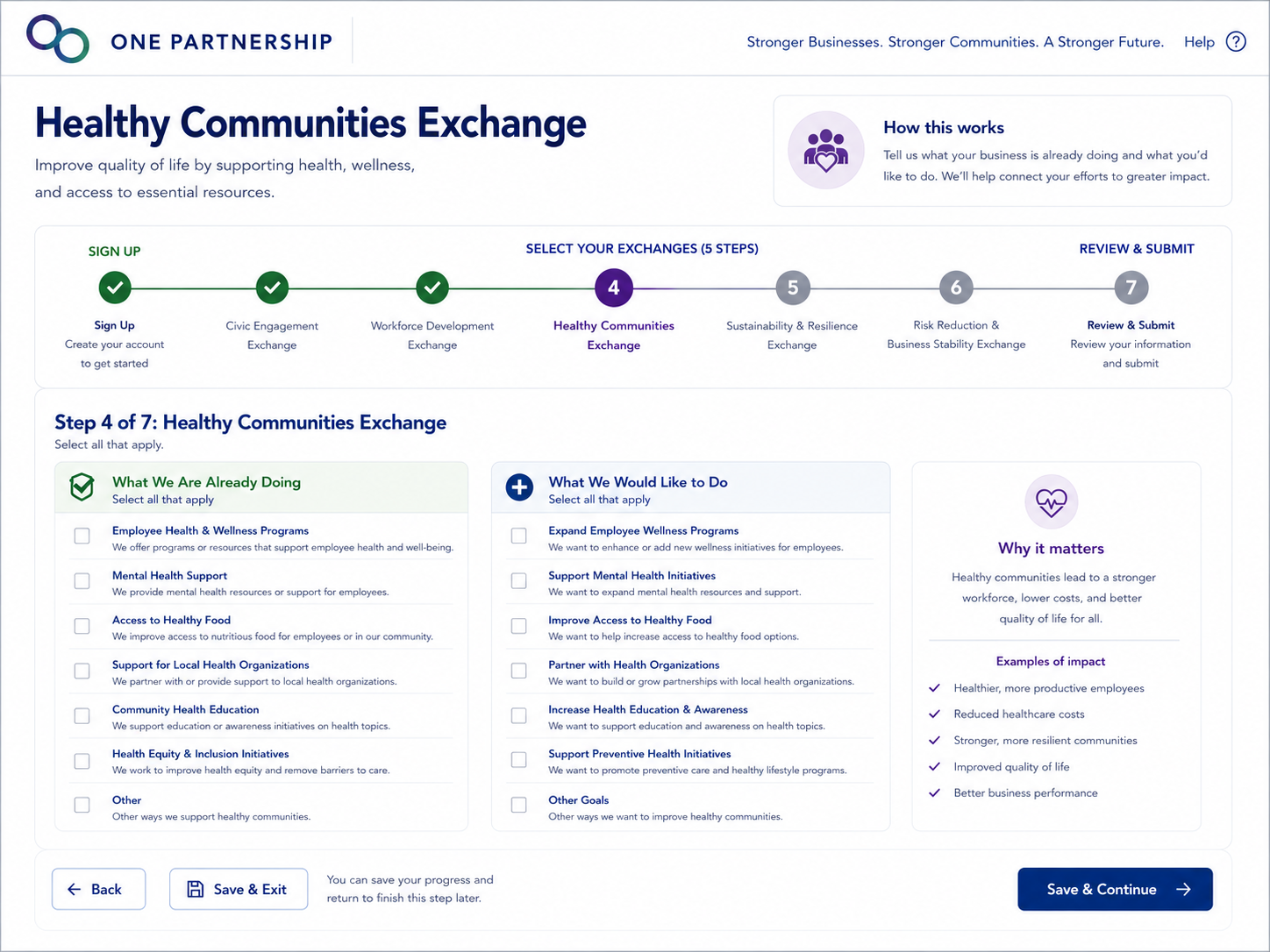
Healthy Communities Exchange
The Healthy Communities Exchange would give a state one shared connection point to understand how businesses are already supporting health, wellness, prevention, and quality of life, and where they may be willing to do more.
Healthy communities are not built by health systems or government alone. They are shaped by jobs, workplace conditions, mental health support, food access, transportation, education, housing stability, safety, and the strength of local relationships. Businesses influence many of those conditions every day. When employers invest in employee wellness, mental health, healthy food access, preventive health, local health partnerships, and inclusive community support, they help strengthen both the workforce and the state.
Most states already have hospitals, clinics, health departments, universities, nonprofits, rural health providers, community health coalitions, food access initiatives, behavioral health organizations, and local prevention efforts. The challenge is that business participation in these efforts is often spread across separate relationships. One employer may have a wellness program. Another may support mental health resources. A farm, grocery store, restaurant, or food company may help expand access to healthy food. A hospital or clinic may partner with community organizations. A local business may sponsor a health fair or support a nonprofit. These actions matter, but they are not always visible as part of a larger statewide strategy.
A One Partnership model would help bring that activity together. Through this exchange, businesses could identify what they are already doing, such as employee health and wellness programs, mental health support, access to healthy food, partnerships with local health organizations, community health education, or health equity and inclusion initiatives. They could also identify what they would like to do next, such as expanding employee wellness programs, supporting mental health initiatives, improving access to healthy food, partnering with health organizations, increasing health education and awareness, or supporting preventive health initiatives.
This structure matters because it turns business support for health into usable information. Public health departments, hospitals, local governments, schools, nonprofits, chambers, rural development organizations, economic development organizations, and state agencies could better understand which businesses are already engaged, which employers want to become more involved, and where community health needs could be matched with private sector support.
For businesses, the benefit is clarity. A company may want to support employee wellness but not know which resources or partners to use. An employer may want to improve mental health support but not know where to begin. A food related business may want to support healthy food access but not know where the need is greatest. A large employer may want to align its community investment or volunteer strategy with measurable health priorities. A One Partnership model would give businesses one organized place to signal interest and connect with the right partners.
For a Governor’s Office and state leaders, this exchange could support a broader quality of life and prevention strategy. Health is connected to workforce productivity, school readiness, economic stability, public safety, health care costs, rural opportunity, and long term competitiveness. When businesses support wellness, mental health, prevention, food access, and community based health partnerships, they help reduce pressure on public systems while strengthening workers, families, and communities.
For state legislators, this could become a practical district level tool. Legislators could better understand which employers in their regions are supporting wellness, mental health, food access, prevention, community health education, or local health partnerships. That information could help connect businesses with local health departments, hospitals, schools, nonprofits, and community based organizations already working on those needs.
For public health departments and health systems, this exchange could be especially useful. Community Health Assessments and Community Health Improvement Plans often identify needs related to mental health, chronic disease prevention, nutrition, access to care, transportation, emergency preparedness, health equity, rural health access, and social connection. Businesses can play a meaningful role in many of those areas, but health leaders may not have a simple way to identify interested employers. This exchange would create a more organized method for finding partners, documenting participation, and showing cross sector collaboration.
For economic development leaders, healthy communities are a competitive advantage. Companies want to locate and grow in places where workers can live well, access care, raise families, and participate in strong communities. A state that connects business growth with health, prevention, and quality of life has a stronger story to tell. A One Partnership model could help show that the state is focused not only on attracting jobs, but also on building the conditions that help people and businesses thrive.
This exchange could also strengthen grant applications and funding strategies. Many federal, philanthropic, and health related funding opportunities value evidence of cross sector collaboration, employer engagement, prevention, community need, rural participation, and measurable impact. By capturing business participation and future interest in one common structure, a state could better show how the private sector is aligned with local and statewide health priorities.
This is what makes the Healthy Communities Exchange different. It is not a new health program. It does not replace health departments, hospitals, clinics, nonprofits, schools, rural health providers, or community coalitions. It helps connect them with businesses that are already active or willing to become active. It creates a practical pathway for employers to support health in ways that fit their capacity, workforce, and community role.
At its best, the Healthy Communities Exchange helps a state answer an important question: which businesses are ready to help build healthier communities, and how can that interest be connected to the people and places that need it most?
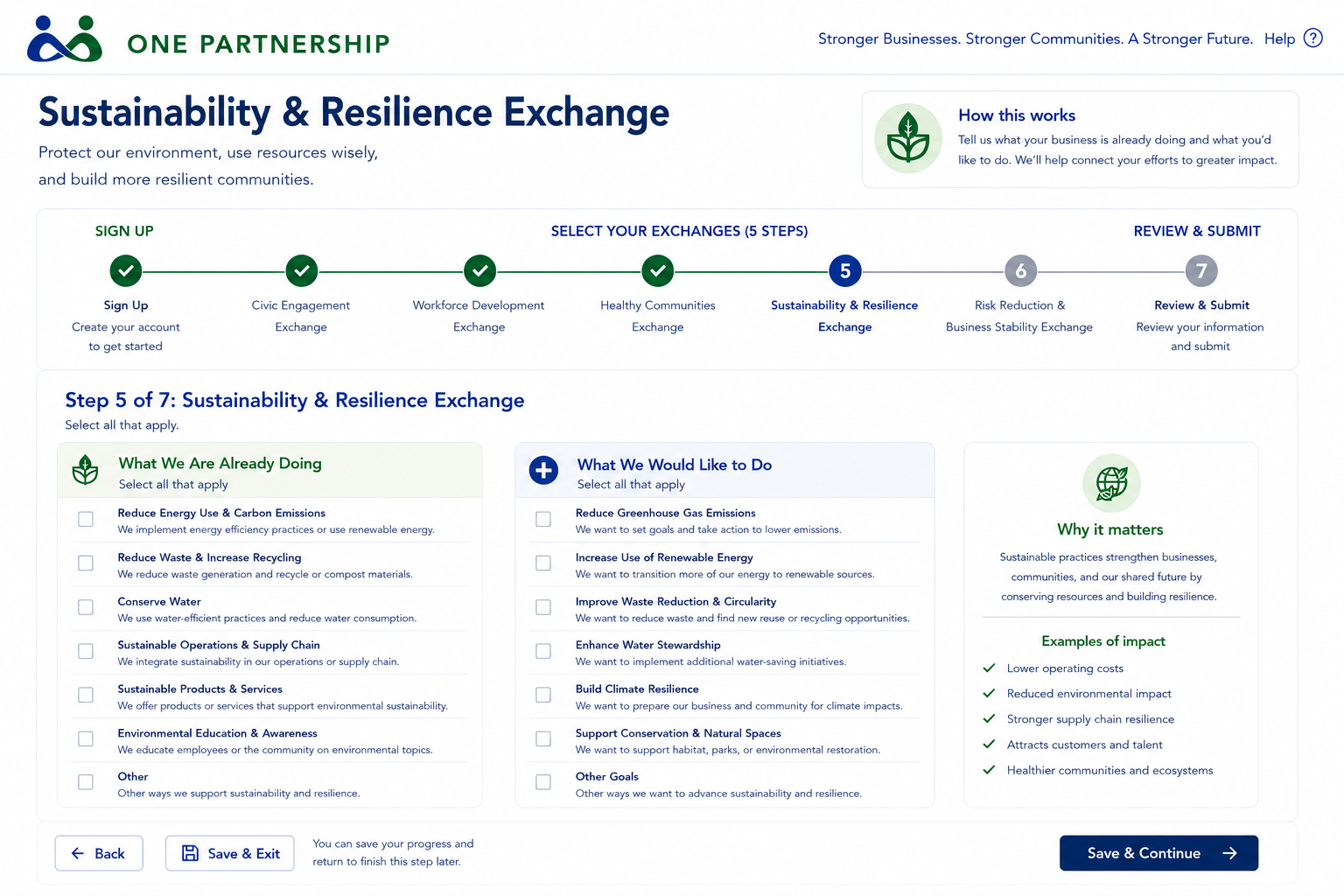
Sustainability and Resilience Exchange
The Sustainability and Resilience Exchange would give a state one shared connection point to understand how businesses are already reducing costs, protecting natural resources, strengthening operations, and preparing for future risks.
Sustainability matters in every state because it connects directly to the economy, environment, water future, rural communities, energy systems, agriculture, tourism, public health, and long term resilience. Businesses are already taking practical steps to reduce energy use, recycle more, conserve water, improve operations, strengthen supply chains, support conservation, and prepare for disruptions. The challenge is that much of this work is difficult to see in one organized statewide picture.
Most states already have environmental programs, energy resources, utility partners, conservation organizations, water planning efforts, agricultural stewardship work, universities, resilience planning, emergency preparedness systems, and business led innovation. A One Partnership model would not replace those efforts. It would help connect them with businesses that are already acting or willing to act.
Through this exchange, businesses could identify what they are already doing, such as reducing energy use and carbon emissions, increasing recycling, conserving water, improving sustainable operations and supply chains, offering sustainable products or services, or educating employees and customers about environmental practices. They could also identify what they would like to do next, such as reducing greenhouse gas emissions, increasing renewable energy use, improving waste reduction and circularity, enhancing water stewardship, building climate resilience, or supporting conservation and natural spaces.
That structure matters because it turns scattered sustainability activity into usable information. State leaders, legislators, economic development directors, local governments, utilities, universities, environmental partners, rural development organizations, emergency management officials, and community organizations could better understand which businesses are already engaged, which sectors are ready to do more, and where technical assistance, incentives, or partnerships may be most useful.
For businesses, the benefit is practical. Many sustainability actions reduce operating costs, improve efficiency, strengthen supply chains, attract customers, and help recruit workers who care about purpose and long term responsibility. A farm or ranch may want to improve water stewardship or conservation practices. An energy company may want to support responsible operations, workforce training, or emissions reduction. A tourism business may want to protect the natural and cultural assets that attract visitors. A manufacturer may want to reduce energy costs or improve waste reduction. A food business may want to reduce waste or support local food systems. This exchange would give each business a simple way to identify what fits its operations and connect with relevant support.
For a Governor’s Office and state leaders, this exchange could support a stronger statewide resilience strategy. Every state faces long term challenges connected to extreme weather, water stress, wildfire, flooding, heat, energy transition, rural infrastructure, agricultural resilience, infrastructure reliability, and emergency preparedness. A platform that captures business activity and future interest could help the state understand where private sector action is already happening and where more coordination is needed.
For state legislators, the exchange could provide practical district level insight. Legislators could better understand which businesses in their communities are investing in energy efficiency, recycling, water conservation, sustainable operations, conservation, and resilience. That information could help connect businesses with available programs, local partners, universities, utilities, and technical assistance.
For economic development leaders, sustainability and resilience are increasingly part of business attraction and retention. Companies want locations that can support efficient operations, reliable infrastructure, resilient supply chains, skilled workers, responsible growth, and long term resource stability. A One Partnership model could help show that a state has an organized way to connect businesses with sustainability resources, resilience planning, cost saving opportunities, water stewardship, conservation, and community priorities.
This exchange could also strengthen grant and funding strategies. Many federal, philanthropic, and regional funding opportunities value evidence of public private collaboration, sustainability planning, resilience, environmental stewardship, rural participation, water conservation, and measurable impact. A One Partnership model could help document employer participation and future interest in a consistent way. That could make a state more competitive when pursuing funding for energy efficiency, resilience, workforce training, environmental restoration, water stewardship, conservation, disaster preparedness, and community infrastructure.
The exchange also helps connect sustainability to health and quality of life. Cleaner air, safer water, reduced waste, lower energy burden, stronger local food systems, conservation of natural spaces, and more resilient infrastructure all affect community wellbeing. Businesses can play a meaningful role in those areas, but public and community partners need a clearer way to identify who is already participating and who may be willing to do more.
This is what makes the Sustainability and Resilience Exchange different. It is not a new environmental program. It does not compete with existing agencies, utilities, local governments, universities, nonprofits, conservation groups, rural organizations, or emergency management partners. It helps bring them together around business interest and practical action. It creates a common structure for capturing current activity, future goals, and partnership opportunities.
At its best, the Sustainability and Resilience Exchange helps a state answer a critical question: which businesses are ready to help build a cleaner, more efficient, more resilient future, and how can that interest be connected to the right programs and partners faster?
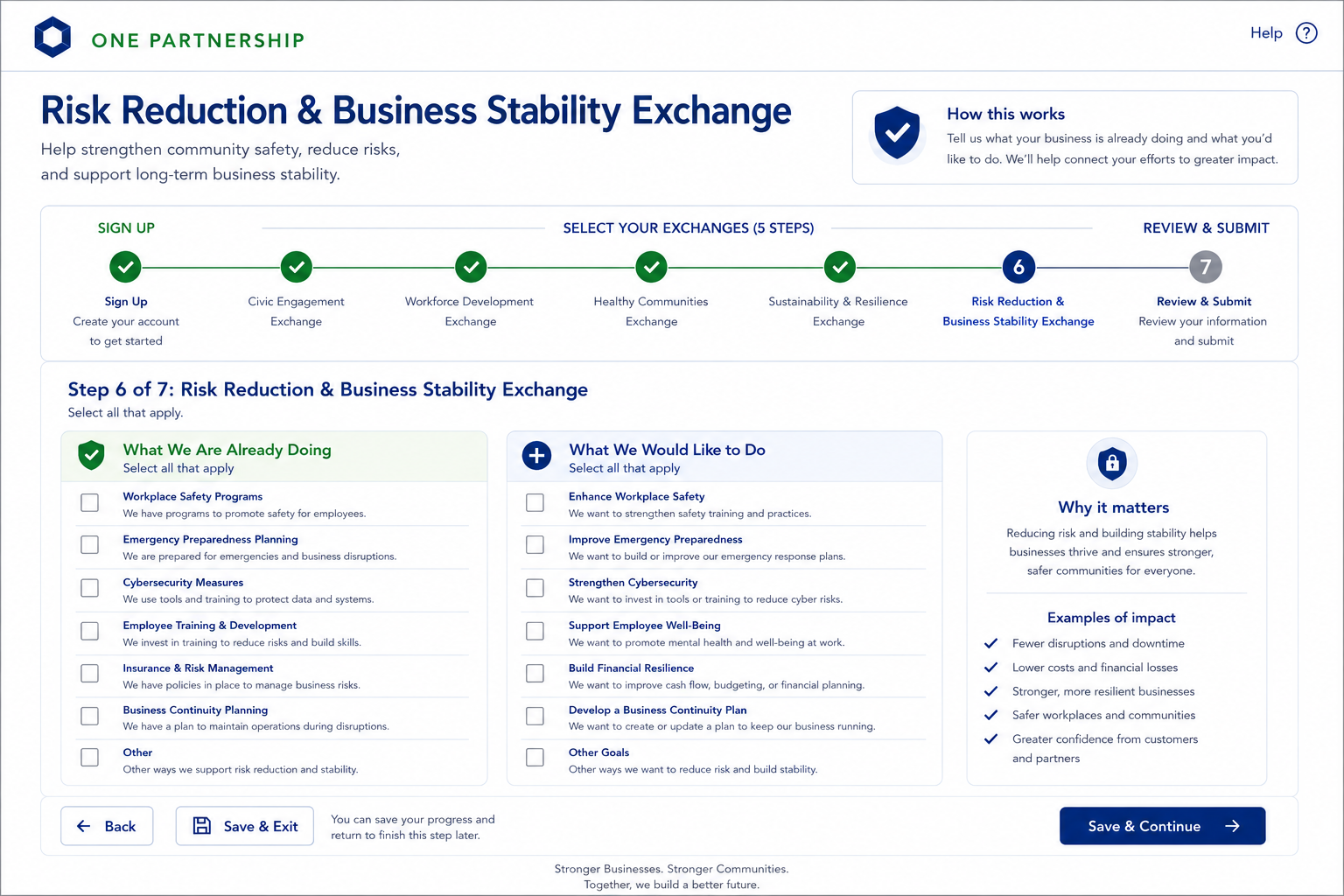
Risk Reduction and Business Stability Exchange
The Risk Reduction and Business Stability Exchange would give a state one shared connection point to understand how businesses are already protecting workers, reducing disruptions, preparing for emergencies, and strengthening long term stability.
Business stability is not only a private sector issue. When businesses are safer, stronger, and better prepared, communities are stronger too. Fewer workplace injuries, stronger emergency planning, better cybersecurity, improved employee training, financial resilience, and continuity planning all help protect jobs, reduce losses, support families, and keep local economies moving during times of stress.
Most states already have emergency management systems, workplace safety resources, cybersecurity guidance, insurance networks, chambers of commerce, small business support organizations, workforce partners, rural development organizations, and economic development leaders working in these areas. The challenge is that many businesses do not always know where to begin, and public leaders do not always have one organized way to see where businesses are prepared and where gaps remain.
A One Partnership model would help bring that work together. Through this exchange, businesses could identify what they are already doing, such as workplace safety programs, emergency preparedness planning, cybersecurity measures, employee training and development, insurance and risk management, or business continuity planning. They could also identify what they would like to do next, such as enhancing workplace safety, improving emergency preparedness, strengthening cybersecurity, supporting employee wellbeing, building financial resilience, or developing a business continuity plan.
That matters because risk reduction is often invisible until something goes wrong. A business that prepares before a disruption can recover faster, keep employees working, continue serving customers, and reduce strain on public systems. A business with a safety plan, cyber protections, emergency procedures, trained employees, and a continuity plan is not only protecting itself. It is helping protect the community around it.
For businesses, the benefit is practical and immediate. A small business may need help developing an emergency plan. A farm, ranch, or rural employer may need support preparing for wildfire, drought, severe weather, flooding, or supply chain disruptions. A health clinic, nonprofit, or professional services firm may need stronger cybersecurity practices. An energy company or manufacturer may want to improve workplace safety training. A local employer may want to strengthen cash flow planning or update its continuity plan. A One Partnership model would give businesses a simple way to identify those needs and connect with appropriate resources.
For a Governor’s Office and state leaders, this exchange could support a stronger statewide resilience strategy. Every state faces risks from extreme weather, cyber threats, supply chain disruptions, workforce shortages, public health emergencies, infrastructure stress, rising operating costs, and economic shocks. By organizing business readiness information in one common structure, state leaders could better understand where employers are prepared, where vulnerabilities exist, and where outreach or technical assistance could have the greatest impact.
For state legislators, this could provide useful district level insight. Legislators could better understand where local businesses may need help with safety, emergency planning, cybersecurity, business continuity, employee wellbeing, or financial resilience. That creates a practical way to support small businesses, rural employers, workers, and local economies without creating new mandates.
For economic development directors, business stability is a core competitiveness issue. Companies want to operate in places where risks are understood, infrastructure is reliable, workers are protected, and disruptions can be managed. A One Partnership model could help show that a state is serious about not only attracting businesses, but helping them stay strong, prepared, and resilient over time.
For emergency management and public safety partners, this exchange could improve coordination before a crisis. Instead of only reacting after a disruption, public agencies and community partners could identify businesses that are already preparing, businesses that need guidance, and sectors or regions that may require additional support. This could strengthen preparedness planning, continuity coordination, and recovery efforts across communities.
For workforce and public health partners, risk reduction also connects directly to employee wellbeing. Safe workplaces, mental health support, training, financial stability, and preparedness all affect whether workers can stay healthy, productive, and secure. This exchange would give a state a way to connect business stability with broader goals around workforce retention, community health, and economic security.
This exchange could also strengthen grant and funding strategies. Many funding opportunities value evidence of preparedness, resilience, public private collaboration, cybersecurity awareness, workplace safety, rural readiness, and continuity planning. A One Partnership model could help document business participation and future interest in a consistent way, making it easier to show need, coordination, and measurable progress.
This is what makes the Risk Reduction and Business Stability Exchange different. It is not a new regulatory program. It is not a compliance checklist. It does not replace emergency management agencies, workplace safety resources, cybersecurity programs, chambers, insurers, workforce partners, rural organizations, or small business support groups. It helps connect businesses with the resources and partners that already exist.
At its best, the Risk Reduction and Business Stability Exchange helps a state answer an important question: which businesses are prepared, which businesses need support, and how can the state help reduce risk before disruptions become community wide problems?
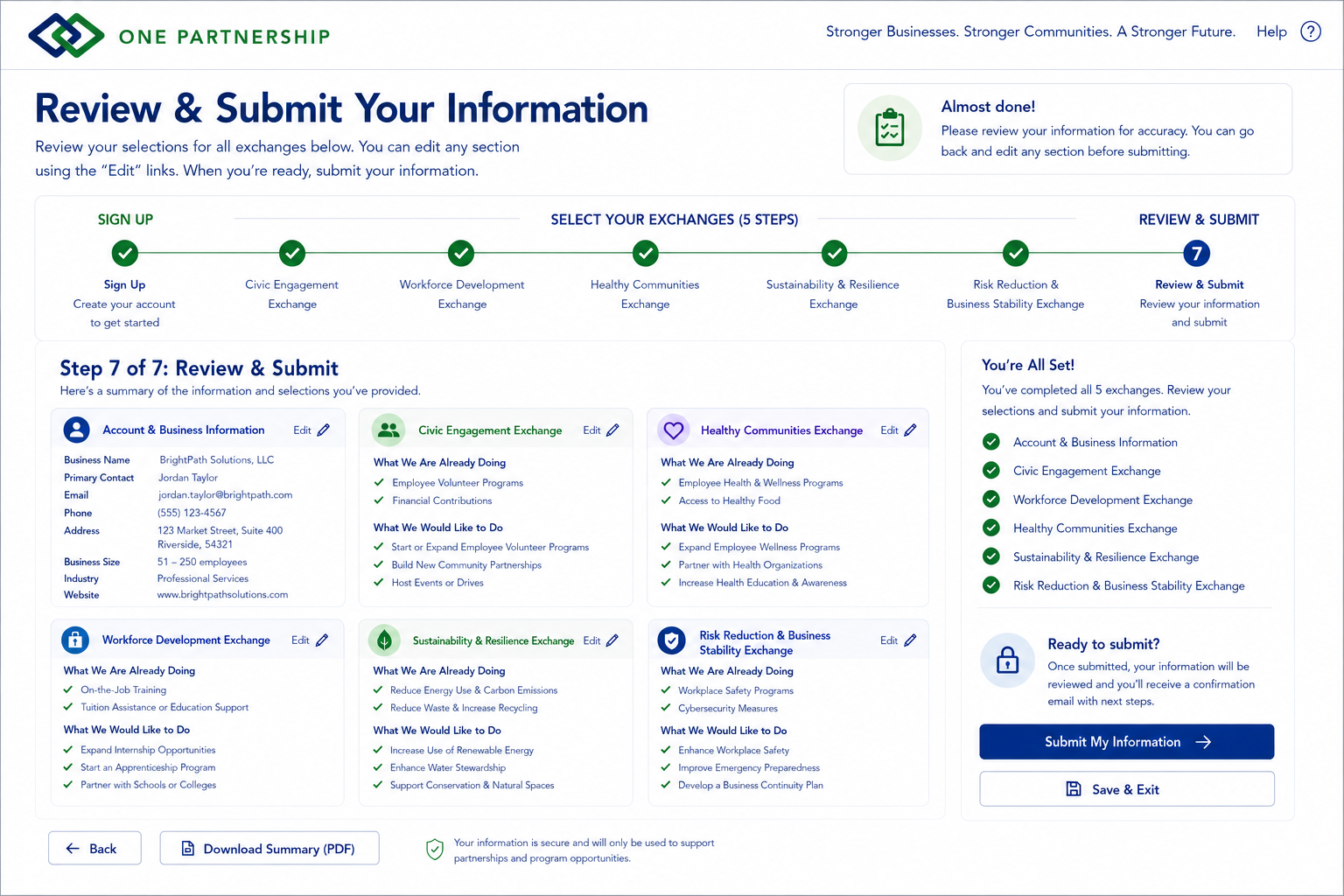
Review and Submit
The Review and Submit page is where a One Partnership model would turn business participation into organized, useful information for a state.
After completing the sign up process and the exchange sections, each business would have the opportunity to review its information before submitting. This step gives employers confidence that their selections are accurate, voluntary, and aligned with what they are actually doing or may be willing to do. Businesses could review their account information, current activities, future interests, and selected partnership areas before final submission.
This page also shows why a One Partnership model would be different from a basic survey or one time contact form. It would not simply collect names and email addresses. It would organize business activity across several major priorities in one common structure, including civic engagement, workforce development, healthy communities, sustainability and resilience, and risk reduction and business stability. That would give a state a clearer way to understand not only which businesses are interested, but how they may be able to contribute.
For businesses, the benefit is clarity and control. They could see everything they selected, edit any section, download a summary, save their progress, and submit only when ready. That would make the process more transparent, professional, and business friendly. It would also reinforce that participation is voluntary and based on each employer’s capacity, interests, and existing community role.
For a Governor’s Office and state leaders, this would create more consistent statewide information. Every participating business would provide information in the same basic format. That means a state could better understand participation by region, county, industry, business size, and priority area. Instead of relying only on scattered examples or disconnected spreadsheets, the state could begin building a clearer picture of business engagement across communities.
For state legislators, this information could support practical district level insight. Legislators could better understand which businesses in their communities are supporting workforce development, civic engagement, employee wellness, sustainability, emergency preparedness, nonprofit partnerships, rural development, and other public priorities. That could help connect local employers with existing resources and community partners without creating new mandates.
For economic development directors, this would create a stronger tool for business attraction, retention, and regional strategy. A state could show current and prospective employers that it has an organized way to connect businesses with workforce pipelines, education partners, community organizations, health initiatives, sustainability resources, resilience planning, rural priorities, and local needs. It would help demonstrate that the state is not only pro business, but organized around helping businesses and communities succeed together.
For existing partners, this step would help turn business interest into action. Workforce partners, schools, colleges, health departments, hospitals, nonprofits, chambers, rural development organizations, sustainability offices, emergency management partners, and local governments could use submitted information to identify businesses that are ready for the right kind of outreach. Instead of starting from zero, partners would know which businesses have already expressed interest and in what areas.
This final step would also create value for grants, public reporting, and accountability. Once information is submitted, a state could generate aggregate summaries showing where participation is strong, where gaps remain, and where additional partnership development is needed. Those summaries could support grant applications, regional planning, economic development strategy, community health improvement work, resilience planning, rural development, and communication with the public.
The Review and Submit page would also reinforce trust. Businesses would know their information is being used to support partnerships and program opportunities, not to create a regulatory burden. The purpose would not be to monitor businesses. The purpose would be to make it easier for them to participate, easier for partners to coordinate, and easier for the state to see where public and private efforts are already aligned.
At its best, this final step turns scattered business goodwill into a structured statewide asset. A business can say what it is doing, where it wants to help, and what kind of connection it may need. A state can then use that information to bring existing programs, agencies, nonprofits, schools, workforce partners, health partners, rural partners, emergency management partners, and community organizations into better alignment.
The result is one shared connection point that helps businesses participate, helps partners coordinate, and helps a state measure progress with greater confidence.
 Chad Trivette
Leave a comment